Saturday, July 4, 2026
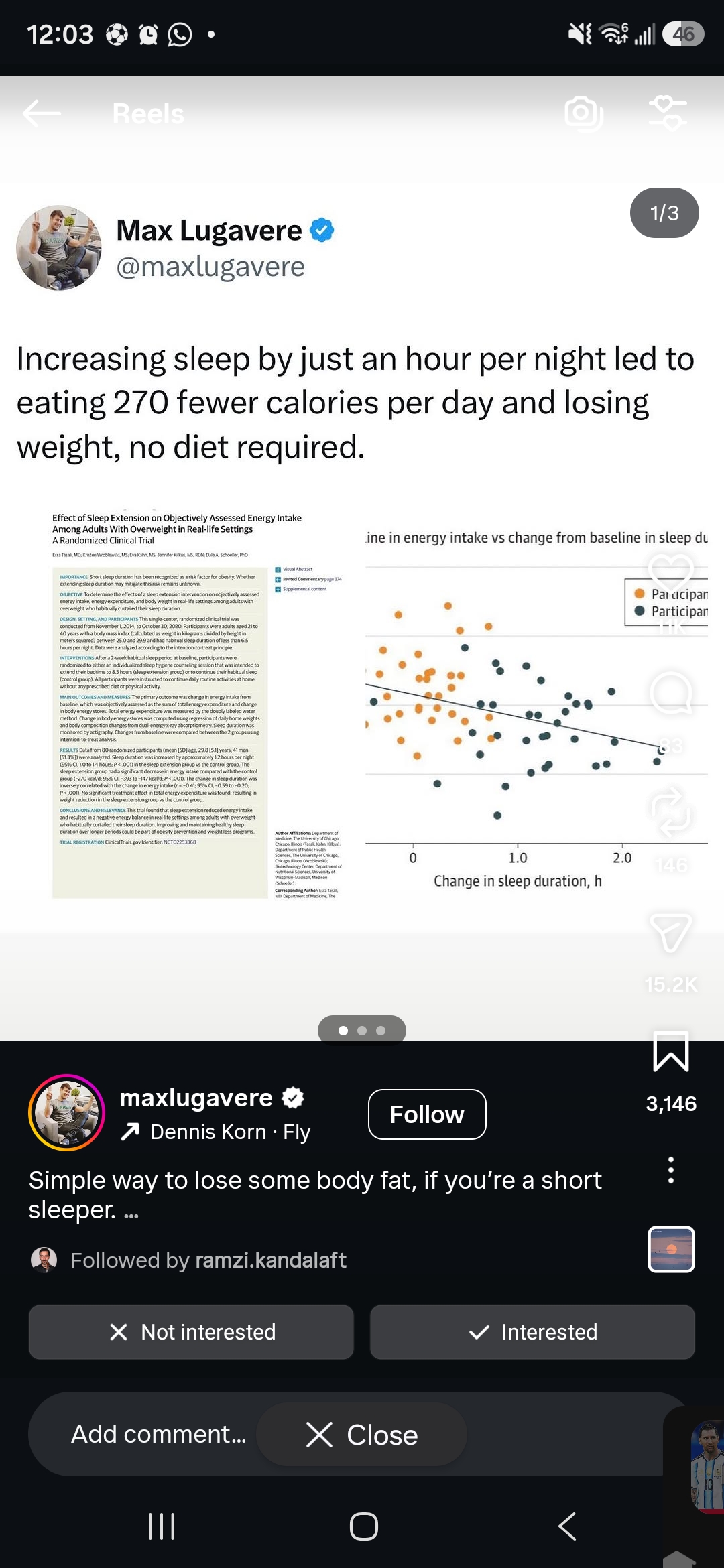
Increasing sleep by one hour per night led to eating 270 fewer calories per day and losing weight without a diet.
“Increasing sleep by just one hour per night led to eating 270 fewer calories per day and losing weight without a diet is supported by a randomized clinical trial published in *JAMA Internal Medicine*, though the study participants actually increased their sleep by an average of 1.2 hours (about 1 hour and 12 minutes)”
Submitted Image
Well-supported — high-quality sources agree
10 sources · 7 support, 3 neutral
What we can confirm
A randomized clinical trial published in JAMA Internal Medicine did find that extending sleep in overweight short sleepers by about 1.2 hours per night led to eating roughly 270 fewer calories per day and producing a negative energy balance without prescribing a diet, and the paper explicitly reports the 1.2‑hour average increase; however, the specific phrasing "increasing sleep by just one hour" slightly oversimplifies what was tested, since the intervention produced about 1.2 hours of additional sleep on average and the per‑hour effect was estimated at about 162 kcal/day fewer, not 270.
Sources
Checked July 4, 2026
Text detected in image
12:03 ← Reels 46 1/3 Max Lugavere @maxlugavere Increasing sleep by just an hour per night led to eating 270 fewer calories per day and losing weight, no diet required. Effect of Sleep Extension on Objectively Assessed Energy Intake Among Adults With Overweight in Real-life Settings A Randomized Clinical Trial ine in energy intake vs change from baseline in sleep du Esra Tasal, MD; Kristen Wroblewski, MS; Eva Kahn, MS; Jennifer Kikus, MS, RDN Dale A. Schoeller, PhD Visual Abstract IMPORTANCE Short sleep duration has been recognized as a risk factor for obesity. Whether extending sleep duration may mitigate this risk remains unknown. OBJECTIVE To determine the effects of a sleep extension intervention on objectively assessed energy intake, energy expenditure, and body weight in real-life settings among adults with overweight who habitually curtailed their sleep duration. DESIGN, SETTING, AND PARTICIPANTS This single-center, randomized clinical trial was conducted from November 1, 2014, to October 30, 2020. Participants were adults aged 21 to 40 years with a body mass index (calculated as weight in kilograms divided by height in meters squared) between 25.0 and 29.9 and had habitual sleep duration of less than 6.5 hours per night. Data were analyzed according to the intention-to-treat principle. INTERVENTIONS After a 2-week habitual sleep period at baseline, participants were randomized to either an individualized sleep hygiene counseling session that was intended to extend their bedtime to 8.5 hours (sleep extension group) or to continue their habitual sleep (control group). All participants were instructed to continue daily routine activities at home without any prescribed diet or physical activity. MAIN OUTCOMES AND MEASURES The primary outcome was change in energy intake from baseline, which was objectively assessed as the sum of total energy expenditure and change in body energy stores. Total energy expenditure was measured by the doubly labeled water method. Change in body energy stores was computed using regression of daily home weights and body composition changes from dual-energy x-ray absorptiometry. Sleep duration was monitored by actigraphy. Changes from baseline were compared between the 2 groups using intention-to-treat analysis RESULTS Data from 80 randomized participants (med by approximately 12 hours per night nts (mean [SD] age, 29.8 [5.1] years: 41 men [51.3%) were an e analyzed. Sleep duration was increased (95% CI, 1.0 to 14 hours; P<.001) in the sleep extension group vs the control group. The sleep extension had a significant decrease in energy intake compared with the control group (-270 kcal/d: 9 -147 kcald: P d: P001). The change in sleep duration was inversely correlated with the change in energy intake (r=-0.41; 95 % CI, -0.59 to -0.20; P<.001). No significant treatment effect in total energy expenditure was found, resulting in weight reduction in the sleep extension group vs the control group. CONCLUSIONS AND RELEVANCE This trial found that sleep extension reduced energy intake and resulted in a negative energy balance in real-life settings among adults with overweight who habitually curtailed their sleep duration. Improving and maintaining healthy sleep. duration over longer periods could be part of obesity prevention and weight loss programs. TRIAL REGISTRATION ClinicalTrials.gov Identifier: NCT02253368 Invited Commentary page 3741 Supplemental content Author Affiliations: Department of Medicine, The University of Chicago, Chicago, Illinois (Tasalah) Department of Public Health Sciences. The University of Chicago Chicago, inois (Wroblewsk Biotechnology Center. Department of Nutritional Sciences, University of Wisconsin-Madison, Madison (Schoeller) gAuthon Eva Tasal MD. Deoartment of Medicine. The 1.0 Change in sleep duration, h Participar Participar 2.0 146 maxlugavere Dennis Korn · Fly Follow Simple way to lose some body fat, if you're a short sleeper. ... Followed by ramzi.kandalaft × Not interested Add comment... × Close ||| Interested く 15.2K 3,146 ...
🔍 Image origin
This image appears on 11 other pages online. Review the sources below to check whether the image is being used in its original context or recycled from an unrelated event.
This image appears on these pages — check whether it's used in its original context:
- 1.Max - I am heartbroken. I love you mom. So much. More than ...
- 2.Max - Need potassium? - Facebook
- 3.Max Lugavere added a new photo. - Facebook
- 4.What's a Screenshot, and How Do I Take One? - YouTube
- 5.What's a Screenshot, and How Do I Take One? - YouTube
- 6.Easy Device Screenshot Tutorial_ Capture Any Screen Fast!
- 7.A 'screenshot' is just a still image of your screen
- 8.What's a Screenshot, and How Do I Take One? - Vimeo
- 9.Simple way to lose some body fat, if you're a short sleeper. In this ...
- 10.Taking over LA!! Watch the film and join the movement at ... - Instagram
- 11.Watch out Hailey Bieber, there's a new smoothie in town ... - Instagram
Community verdict
Log in to react to the verdict.
Not enough reactions yet to summarize community view.
💬Discussion