Can a 20-Minute Workout or 90-Minute Nap Help Your Brain After a Sleepless Night?
Can a 20-minute workout or 90-minute nap help after sleep deprivation? Here’s what a 2026 study found about exercise, naps and memory.
athen
Soval Editorial
Well-supported — high-quality sources agree
5 sources · 4 support · 1 neutral
See all evidence →Can a 20-Minute Workout or 90-Minute Nap Help Your Brain After a Sleepless Night?
If you’ve ever dragged yourself through a day after barely sleeping, you know the feeling. Your coffee tastes like a lifeline, your attention span has the structural integrity of wet cardboard, and remembering why you walked into a room suddenly feels like an advanced cognitive exercise.
So a claim circulating online sounds particularly appealing: if you’ve had a terrible night of sleep, perhaps a quick workout or a long nap can help get your brain back on track.
Surprisingly, there is some good science behind that idea. A 2026 study published in Proceedings of the National Academy of Sciences found that 20 minutes of aerobic exercise or a 90-minute nap helped preserve memory after participants had gone 30 hours without sleep. But, as is often the case with viral science claims, the details matter.
Soval’s assessment: Doctor explains cognitive benefits of nap or quick workout →
Can a 20-minute workout or 90-minute nap really help after sleep deprivation?
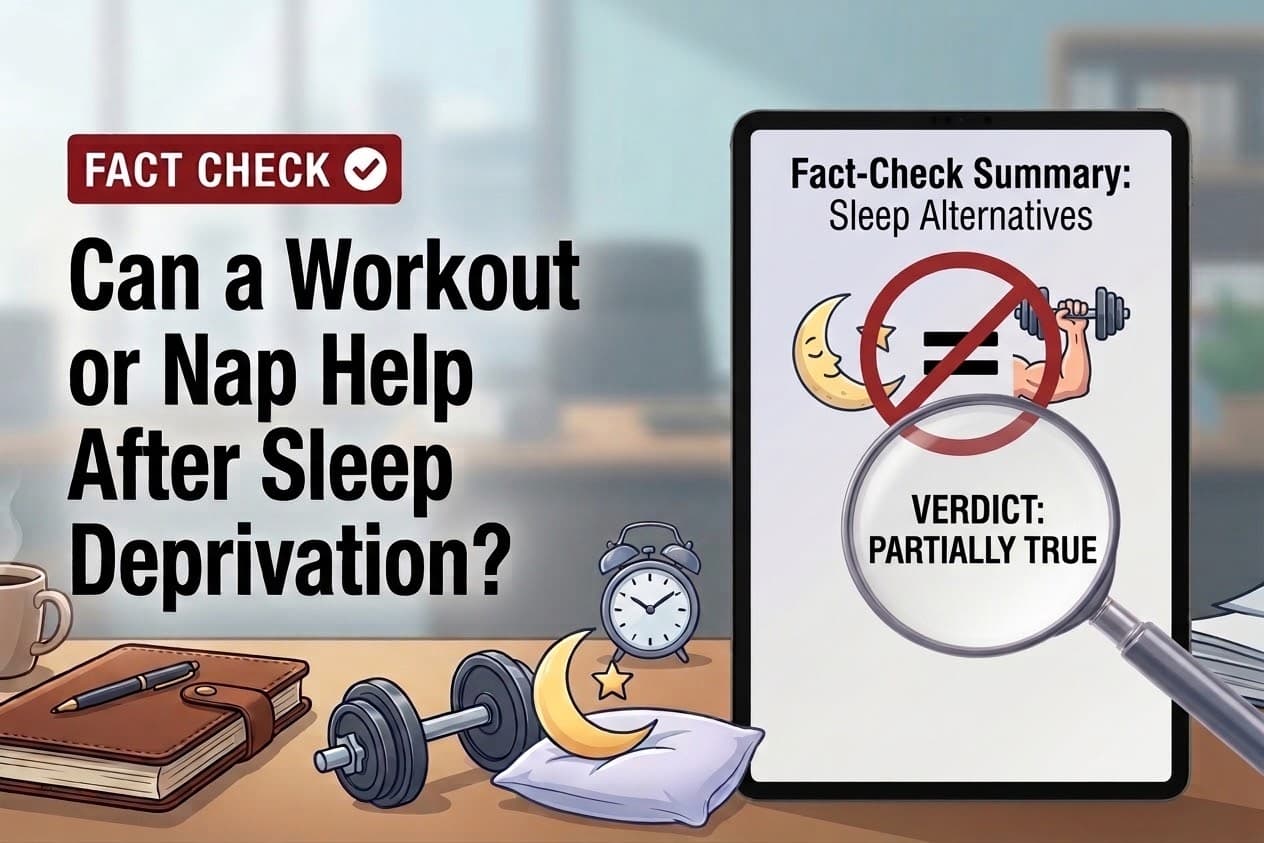
Yes, according to the study, although the finding is much narrower than “exercise or naps can replace sleep.”
Researchers found that both a 20-minute bout of aerobic exercise and a 90-minute nap helped preserve episodic memory after participants had been awake for 30 hours. Average memory performance was about 22% higher in both intervention groups than in the no-intervention control group.
The research was published in PNAS in August 2026. You can read the full peer-reviewed study in PNAS for the researchers’ methodology, results and analysis.
The finding was also reported by McGill University, whose researchers were involved in the study. McGill’s report on the research provides a useful plain-language explanation of what the researchers found.
What exactly did the researchers test?
The study involved 54 healthy young adults who remained awake for 30 consecutive hours under laboratory supervision. After the sleep-deprivation period, participants were assigned to one of three groups: 20 minutes of aerobic exercise, a 90-minute nap, or a control condition in which they did neither.
The exercise wasn’t simply a leisurely stroll around the block. Participants cycled for 20 minutes at about 80% of their maximum heart rate, making this a genuine bout of moderate-to-vigorous exercise.
The nap group, meanwhile, was given a 90-minute opportunity to sleep. Researchers then tested the participants’ ability to encode new episodic memories by having them study images. Their memory for those images was tested three days later.
The published study found that both the exercise and nap groups remembered significantly more of the images than the control group, with average memory performance about 22% higher.
That’s the core finding behind the viral claim that Soval assessed.
Why would exercise help a sleep-deprived brain?
The interesting part is that the workout didn’t appear to work simply because participants felt more awake afterward.
Researchers used electroencephalography, or EEG, to examine brain activity during the memory task. Their analysis suggested that exercise and napping were associated with different neural mechanisms, despite producing a similar memory benefit.
According to the researchers, exercise appeared to help the sleep-deprived brain use its remaining resources more efficiently, while napping helped create a brain state that was more conducive to learning and memory.
The PNAS research goes into considerably more detail about these mechanisms.
That distinction matters because the finding isn’t simply “exercise wakes you up, therefore you’ll remember things better.” Instead, it suggests that even after prolonged sleep deprivation has disrupted normal cognitive function, a short period of exercise may help the brain retain some of its ability to form memories.
It’s a considerably more interesting result than simply discovering that exercise can make you feel a little less miserable after a bad night.
What about the 90-minute nap?
The nap produced a similar memory benefit in the study.
There is a fairly intuitive explanation for why this might happen. Sleep plays an important role in learning and memory, so giving a sleep-deprived brain an opportunity to recover could help restore some of the processes disrupted by prolonged wakefulness.
But there is an important distinction between what the study showed and what someone might conclude from a headline.
The participants weren’t taking a 90-minute nap after an ordinary bad night. They had been awake for 30 consecutive hours under controlled laboratory conditions.
That’s an unusually severe degree of sleep deprivation, and the result shouldn’t automatically be applied to every situation involving a late night or a few hours of lost sleep.
In other words, the study tells us something interesting about what happens when the brain is pushed to an extreme. It doesn’t establish that a 90-minute nap is a universal cognitive reset button.
Can a 20-minute workout replace a good night’s sleep?
No. This is where the viral version of the story needs some context.
The researchers found that exercise and napping helped protect a specific aspect of memory following severe sleep deprivation. They did not find that either intervention provided all of the benefits associated with normal sleep.
The authors themselves note that their laboratory-induced acute sleep deprivation may not fully represent the chronic sleep insufficiency experienced in everyday life or by shift workers. The study therefore shouldn’t be interpreted as evidence that people can routinely function on less sleep by exercising or taking naps.
As McGill University explains in its coverage of the study, the researchers see exercise as a potentially useful way to help people function when getting enough sleep isn’t possible. They do not describe it as a replacement for sleep.
Think of it less like repairing a dead phone battery and more like keeping a damaged system running long enough to finish an important task. The intervention may help with one particular function, but that doesn’t mean everything else has returned to normal.
Is a nap better than exercise for your memory?
The study doesn’t really give us a reason to declare a winner.
Both interventions produced a similar improvement in the measured memory outcome compared with the control group, while the researchers found evidence that they influenced the brain in different ways.
So the practical answer is fairly simple: both may help, depending on the circumstances, but neither should be viewed as a replacement for sleep.
And if you’re exhausted and have the opportunity to sleep, nothing in this study suggests you should skip the bed in favor of a stationary bike.
So, is the viral claim true?
The core claim is well-supported, but it needs to be stated precisely.
The underlying study found that, after 30 hours without sleep, participants who either completed 20 minutes of aerobic exercise or took a 90-minute nap performed better on measures of episodic memory than participants who received no intervention. The difference was approximately 22%.
But the evidence supports a narrower conclusion than a viral headline might suggest:
A short workout or a 90-minute nap may help protect memory after severe sleep deprivation. Neither is a replacement for adequate sleep.
That distinction is important because social-media posts often strip away the experimental conditions that make a scientific finding meaningful. “Workout or nap helps your brain after 30 hours without sleep” is an interesting finding. “You don’t need sleep if you exercise or nap” would be a very different claim, and this study doesn’t support it.
The bottom line
A 20-minute workout or a 90-minute nap may give your sleep-deprived brain a meaningful helping hand. In this 2026 study, both interventions helped preserve episodic memory after participants had been awake for 30 hours.
Just don’t mistake a helping hand for a replacement part. If your brain is asking for sleep, this research isn’t giving you permission to ignore it.
Want to see exactly how the claim was evaluated?
5 sources analyzed · 4 support · 1 neutral
- 1.pnas.orgpeer-reviewedsupports
- 2.pubmed.ncbi.nlm.nih.govpeer-reviewedsupports
- 3.mcgill.caofficial bodysupports
- 4.cnn.commediasupports
- 5.journals.lww.commedianeutral