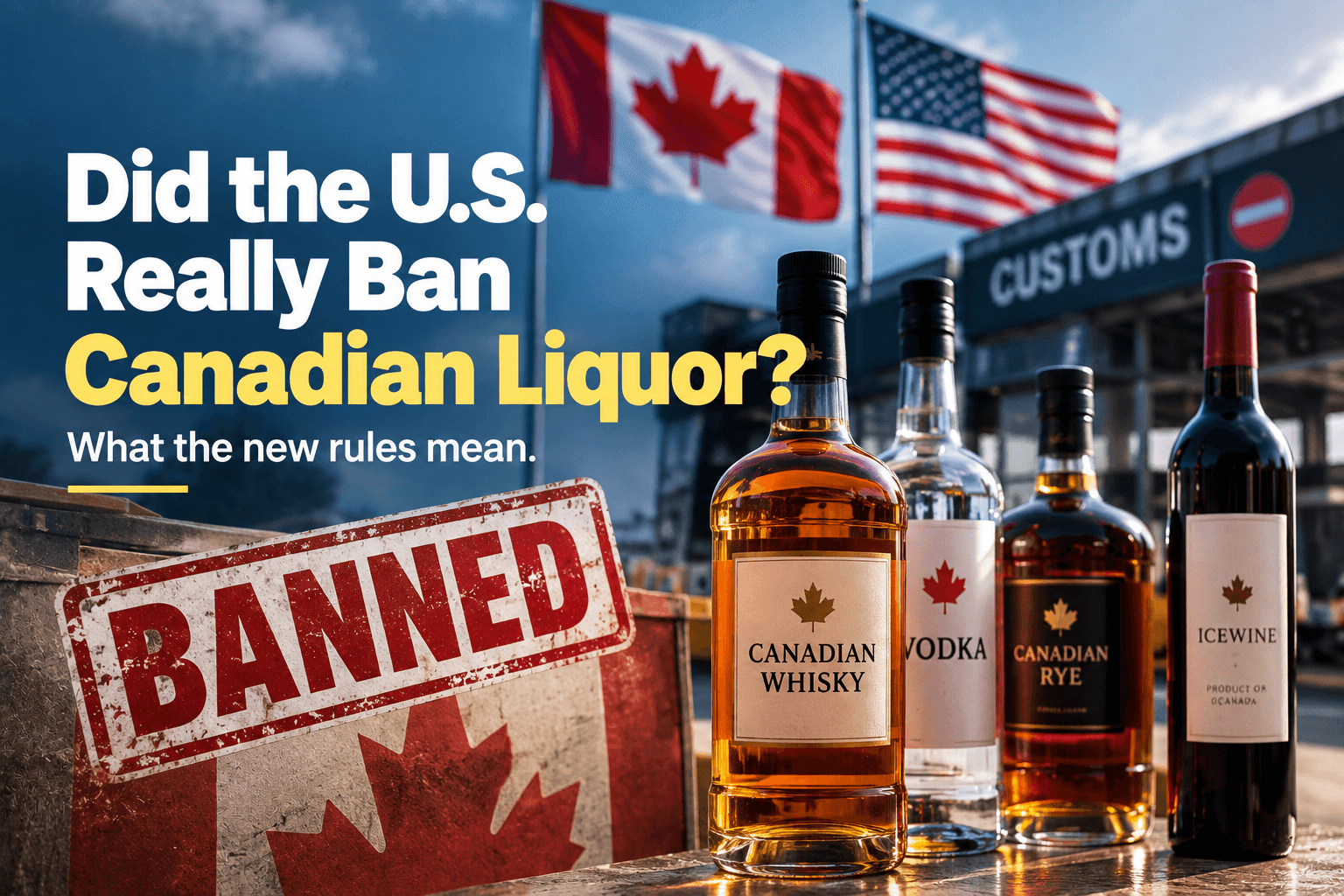
Did the U.S. administration ban Canadian liquor
The U.S. has begun blocking certain Canadian alcoholic beverages from entering the country. Here’s what the new restrictions cover, why they were introduced and what the evidence says about the claim that America “banned Canadian liquor.”
athen
Soval Editorial
Well-supported — high-quality sources agree
5 sources · 5 support
See all evidence →Key takeaways
- Yes, certain Canadian alcohol is now banned as the ongoing U.S.-Canada trade war continues.
- Not all Canadian liquor is affected, and some products remain available to American buyers.
- The restrictions took effect September 29 amid escalating trade tensions between the two countries.
Did the U.S. Ban Canadian Liquor? Here’s What the New Import Restrictions Actually Do
A headline saying the United States has “banned Canadian liquor” sounds fairly definitive. And as of September 29, 2026, there is a real U.S. import ban on certain Canadian alcoholic beverages.
But there is an important detail hiding in that headline: the United States did not ban every Canadian liquor product.
The Trump administration issued a proclamation excluding certain Canadian alcoholic beverages from importation into the United States, effective at 12:01 a.m. Eastern time on September 29. Reuters, the Associated Press, BBC and CBC have all reported on the measure. Soval reviewed five sources, including the White House proclamation, and found that all five support the core claim. (Soval)
So, did the U.S. ban Canadian liquor?
Yes, but not all Canadian liquor. The U.S. ban applies to specified Canadian alcoholic beverages, with exemptions.
What exactly did the U.S. ban?
On September 8, President Donald Trump issued a proclamation titled “Excluding Certain Canadian Alcoholic Beverages from Importation into the United States.”
The proclamation says that certain Canadian alcoholic beverages listed in its annex would be excluded from U.S. imports beginning September 29, 2026. It also directs U.S. Customs and Border Protection to administer the import ban. (The White House)
Reuters reported that the restrictions cover a broad range of Canadian alcoholic beverages, including beer and various types of wine, whisky, rum, vodka, vermouth, tequila, mezcal and brandy. Reuters also noted that some products are subject to tariffs rather than an outright ban. (Reuters)
That distinction matters.
The viral version of the story can easily become “America banned Canadian alcohol.” The more precise version is that the U.S. prohibited imports of specified Canadian alcoholic beverages covered by the presidential proclamation.
When did the Canadian liquor ban take effect?
The import restrictions took effect at 12:01 a.m. Eastern time on September 29, 2026.
The White House proclamation was signed on September 8 and gave businesses several weeks before the import ban became effective. Products covered by the ban that had already been imported but had not yet been entered for consumption before September 29 remained subject to the previous 50% duty instead. (The White House)
Reuters reported the same effective date when the restrictions were announced. (Reuters)
Why did the U.S. ban Canadian alcohol?
The Trump administration says the measure is a response to what it describes as Canadian discrimination against U.S. alcoholic beverages.
The White House proclamation points specifically to Canadian provincial restrictions on the purchase, distribution or retailing of U.S. alcoholic beverages. It argues that those measures disadvantage U.S. commerce compared with products from other countries. (The White House)
The proclamation says the U.S. had previously imposed additional duties on certain Canadian alcoholic beverages and that Canada had maintained or increased the measures that the administration considered discriminatory.
The new action therefore changed certain products from being subject to the additional duty to being excluded from importation altogether. (The White House)
Reuters described the move as another escalation in the wider Canada-U.S. trade dispute, following Canadian retaliatory tariffs on U.S. goods. (Reuters)
Is all Canadian alcohol banned in the U.S.?
No.
This is probably the most important clarification.
The proclamation applies to certain alcoholic beverages from Canada, not every alcoholic product made in Canada.
The White House document contains an annex specifying the products covered by the exclusion. It also explicitly states that the proclamation does not otherwise change the products that remain subject to the separate 50% additional duty. (The White House)
Reuters similarly reported that the measures cover a broad range of alcohol products but that other Canadian products remain subject to tariffs rather than an outright prohibition. (Reuters)
So the statement “Canadian liquor is banned in America” is directionally describing a real policy, but it is too broad if interpreted to mean every Canadian alcoholic beverage.
Can Americans still buy Canadian whisky?
It depends on the specific product.
Canadian whisky and other Canadian spirits are among the types of alcoholic beverages covered by the new restrictions, but the proclamation’s scope is determined by the specific products listed in its annex and the applicable customs classifications. (The White House)
That means a blanket statement such as “all Canadian whisky is now illegal to import into the U.S.” would go beyond what the evidence establishes.
The safest answer is to check whether a particular product falls within the categories covered by the proclamation.
How much Canadian liquor is affected?
The financial significance is substantial for the Canadian alcohol industry even though the restrictions affect only a portion of overall Canada-U.S. trade.
Current reporting puts the value of Canadian liquor exports to the United States at nearly C$1 billion.
Global News reported that Canada exported nearly C$1 billion in liquor to the U.S. in 2025, with about 93% of Canadian liquor exports going to the American market. (Operativ Məlumat Mərkəzi)
That helps explain why the new restrictions matter disproportionately to Canadian producers and exporters.
For some companies, the U.S. market is not a side business. It is a major destination for their products.
Why is Canada banning American alcohol too?
The U.S. restrictions are part of a broader cycle of trade measures between the two countries.
The Trump administration has pointed to Canadian restrictions on U.S. alcoholic beverages as part of the justification for its actions.
Canada, meanwhile, has imposed retaliatory measures of its own during the escalating trade dispute. Reuters reported that Canadian counter-tariffs covering about $20 billion in U.S. goods took effect earlier in September. (Reuters)
The situation is therefore not simply a one-way ban. It is part of a broader series of tariffs, import restrictions and retaliatory measures between the two countries.
Is the U.S. ban on Canadian liquor real?
Yes.
There is a signed presidential proclamation directing that specified Canadian alcoholic beverages be excluded from U.S. imports beginning September 29, 2026.
That is not merely a social-media rumor or an interpretation of a tariff announcement. The White House published the proclamation itself, and major news organizations including Reuters, AP, BBC and CBC independently reported on the resulting import restrictions. (The White House)
Soval’s assessment reached the same conclusion.
The assessment is currently marked “Well-supported,” with five sources supporting the claim and no sources contradicting it. Soval’s evidence also makes the important qualification that the measure covers a broad range of Canadian alcoholic beverages but does not necessarily cover every liquor product. (Soval)
The bottom line
Did the U.S. administration ban Canadian liquor?
Yes, but the precise answer is more useful than the headline.
The United States has imposed an outright import ban on certain Canadian alcoholic beverages, effective September 29, 2026. The measure covers a broad range of products, but it does not mean every Canadian alcoholic beverage has been banned from entering the United States. Some products remain subject to tariffs or other trade measures instead. (The White House)
The ban is part of an escalating Canada-U.S. trade dispute in which both countries have imposed tariffs and other restrictions on each other’s goods.
For anyone seeing posts claiming that “the U.S. just banned all Canadian liquor,” the core story is real. The important correction is the word all.
Soval’s full assessment tracks the underlying evidence and will be re-checked as the situation develops. (Soval)
This article reflects information available as of September 29, 2026. The scope of the restrictions may change as the trade dispute develops.
5 sources analyzed · 5 support
- 1.whitehouse.govofficial bodysupports
- 2.reuters.commediasupports
- 3.apnews.commediasupports
- 4.bbc.commediasupports
- 5.cbc.camediasupports