Did Trump Use Taxpayer Money for the “Love Me” TV Ad? Here’s What We Know
A Trump TV advertisement featuring JMSN’s “Love Me” has sparked questions over who paid for it. Multiple major news organizations report that the ad was funded by the U.S. government. Here’s what the evidence shows, what remains disputed and why the distinction matters.
athen
Soval Editorial
Well-supported — high-quality sources agree
9 sources · 9 support
See all evidence →Key takeaways
- The advertisement itself states that it was “Paid for by the U.S. Government,” a detail supported by multiple independent news reports.
- Reported spending has increased as the advertising campaign expanded, so there is no single definitive total cost yet.
- Evidence supports that government funds paid for the ads, while whether that spending violates federal rules remains disputed.
Did Trump Use Taxpayer Money for the “Love Me” TV Ad? Here’s What We Know
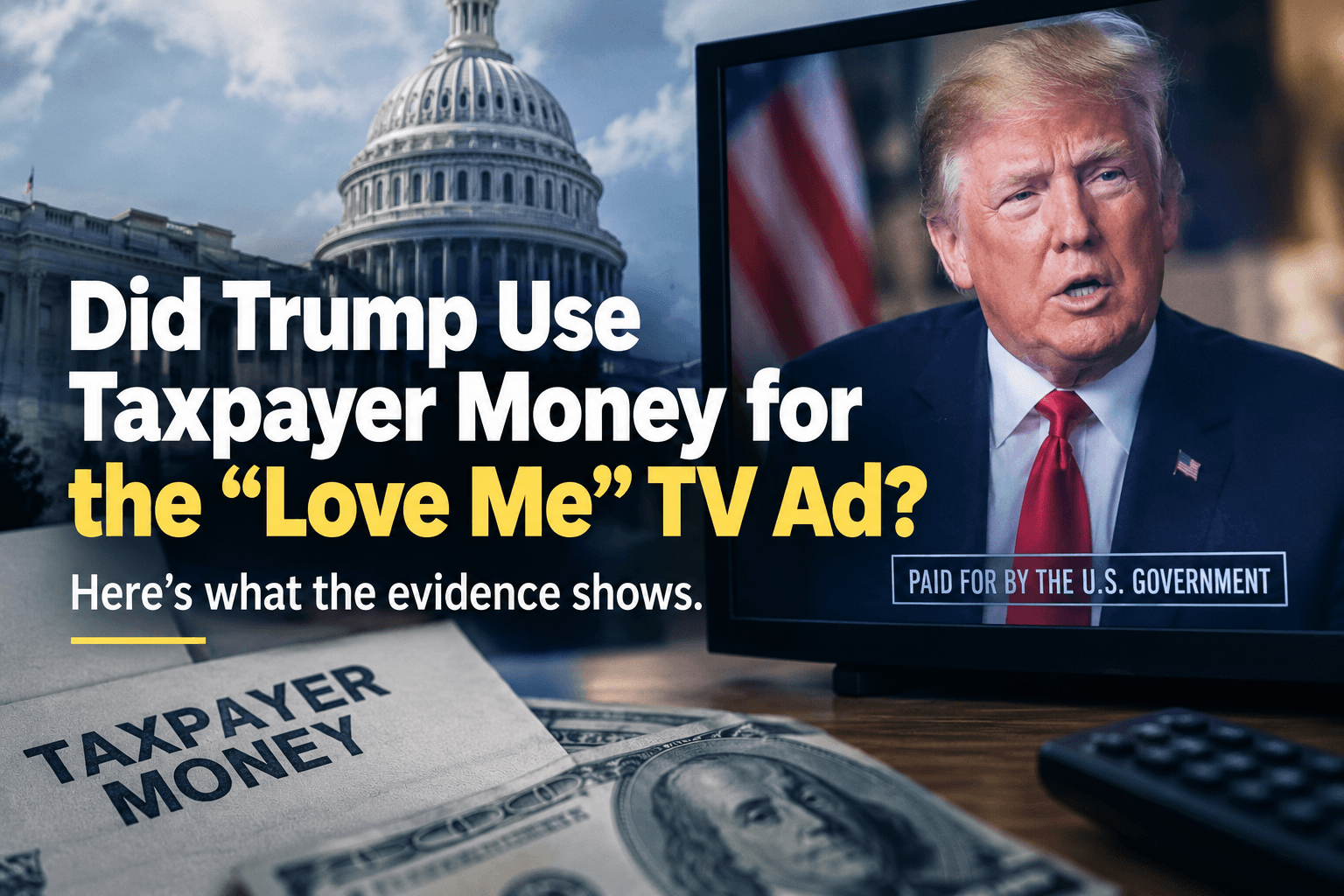
A strange television advertisement featuring Donald Trump, a chorus repeatedly singing “love me,” and a small line reading “Paid for by the U.S. Government” has raised a very straightforward question: did American taxpayers actually pay for it?
According to multiple major news organizations, yes. The Trump administration has aired a series of television advertisements featuring the president and his policies that carry a disclosure saying they were paid for by the U.S. government. Soval reviewed the reporting from nine sources and found that they agreed on the core claim, although some details about the amount spent and which government agency funded the advertising differ. Read Soval’s full evidence-based assessment
The story gets more complicated when you ask what the advertisements are supposed to be.
Did the U.S. government really pay for the Trump “Love Me” ad?
Yes. The advertisement itself says it was “Paid for by the U.S. Government,” and reporting from multiple major outlets confirms that the Trump administration produced the advertisement and used federal funds to pay for its television placement.
The first 30-second advertisement began airing in September 2026. It features footage and photographs of Trump, including references to his administration’s policies, while Trump says that America will defeat communism, socialism and Marxism. Text appearing throughout the spot promotes themes including tax cuts, American manufacturing and law enforcement.
The soundtrack is perhaps the most unusual part. It uses JMSN’s song “Love Me,” with the words “love me” repeated throughout the advertisement. CBS News reported that the U.S. government produced the content and paid for its airtime through an advertising agency. CBS News report on the “Love Me” ad
The Associated Press likewise reported that the advertisement ended with the disclosure “Paid for by the U.S. Government.” Associated Press report
Soval’s assessment currently lists nine sources, with all nine supporting the core claim that the Trump administration aired the advertisement, that it carried the government-funded disclosure and that it featured JMSN’s “Love Me.” See the sources reviewed by Soval
What was in the Trump “Love Me” commercial?
The advertisement looks much more like a political campaign spot than the sort of government announcement most viewers are used to seeing.
Trump appears throughout the 30-second video, alongside rapidly changing images from his presidency. The messaging includes statements about defeating communism and references to tax cuts, manufacturing and law enforcement.
The advertisement ends with a message identifying the U.S. government as its payer.
There is another unusual detail: the song.
What song is in Trump’s “Love Me” ad?
The song is “Love Me” by JMSN.
CBS News reported that JMSN said he did not authorize the use of his music for a political agenda or campaign and indicated that he had not been asked for permission. CBS News coverage of the ad and music dispute
The music itself is not what establishes whether the advertisement was government-funded, but it helps explain why the particular commercial quickly attracted attention online.
How much did the Trump taxpayer-funded ad cost?
This is where the answer needs a little more caution.
There is not one definitive number for the total cost of the advertising campaign.
Early reporting put the cost of the first advertisement at about $14,000 for its initial placements. As the campaign expanded, however, reported spending increased substantially.
The Associated Press reported on September 25 that spending on the first advertisement had reached at least $443,000. The campaign was also expanding to additional advertisements and markets. Associated Press coverage of the expanding campaign
That is why Soval’s assessment does not treat one particular dollar figure as the central fact. The amount reported has changed as more advertising has aired, while the underlying fact that the advertisements carried a government-funded disclosure has remained consistent across the reporting reviewed.
In other words, “How much did the ad cost?” is a moving question. “Was it identified as being paid for by the U.S. government?” is much easier to answer.
Is the Trump ad a political advertisement or a public service announcement?
This is where the story moves from a relatively straightforward factual question into a disputed one.
The White House says the advertisements are public service announcements, not campaign advertisements.
A White House spokesperson said the ads were intended to remind Americans to love their country and understand what makes it worth defending. The administration also pointed out that Trump is not personally on the ballot in the November 2026 midterm elections and that the advertisements do not contain a direct call for viewers to vote for him. Associated Press report on the White House’s position
That explanation has not ended the controversy.
Lawmakers from both parties have questioned whether government money can be used for advertisements that feature a sitting president and closely resemble campaign messaging. Some have pointed to federal restrictions on the use of government funds for publicity or propaganda. Associated Press reporting on the bipartisan criticism
The Washington Post has also reported on the federal restrictions governing government-funded publicity and propaganda, as well as arguments over whether the advertisement falls within those restrictions. Washington Post coverage of the legal dispute
Those are separate questions from whether the advertisement was paid for with government funds.
Does taxpayer-funded mean the ad was illegal?
Not necessarily.
This is an important distinction.
The available reporting establishes that the advertisement was identified as being paid for by the U.S. government. It also establishes that lawmakers and legal experts have raised questions about whether the use of federal funds for this type of messaging complies with federal restrictions.
But saying “the government paid for the advertisement” is a factual claim. Saying “the government illegally paid for the advertisement” is a legal conclusion.
Those should not be treated as the same thing.
The White House disputes the characterization of the advertisements as political advertising and says they are public service announcements. Critics, including lawmakers, argue that their content and timing make them political. The legal question therefore depends on how the advertisements are classified under the applicable federal rules and how those rules are applied. Soval’s evidence-based assessment and source trail
Why is this story getting so much attention?
Part of the answer is that the advertisement sits in an unusual space between government communications and political advertising.
Government agencies routinely pay for public information campaigns. The White House has pointed to examples from previous administrations, including public service campaigns involving health, government programs and other issues.
What makes these advertisements different in the eyes of critics is their focus on a sitting president. The first spot prominently features Trump himself, uses messaging associated with his political agenda and aired shortly before the November midterm elections.
That combination has prompted questions from lawmakers and political observers about where the boundary lies between informing the public about government policy and promoting the president.
There is also the simple fact that the advertisement is difficult to ignore. Trump appears on screen, the messaging is highly dramatic, and a chorus repeatedly sings “Love Me” in the background before the words “Paid for by the U.S. Government” appear.
It is an unusual combination for a government-funded television announcement.
So, did Trump’s administration use tax dollars to pay for the TV ad?
The evidence reviewed by Soval supports the claim.
Multiple major news organizations reported that the Trump administration aired the advertisement, that it featured Trump and his administration’s messaging, that it used JMSN’s “Love Me,” and that the advertisement disclosed that it was paid for by the U.S. government.
Soval’s assessment currently rates the claim “Well-supported,” with nine sources supporting the core proposition. The assessment also flags an important limitation: reporting differs on the amount spent and the precise government agency responsible for the funding. View the complete Soval assessment and evidence trail
Disclaimer: This article reflects the evidence available as of September 28, 2026.
9 sources analyzed · 9 support
- 1.apnews.commediasupports
- 2.nbcnews.commediasupports
- 3.cnn.commediasupports
- 4.nytimes.commediasupports
- 5.npr.orgmediasupports
- 6.politico.commediasupports
- 7.usatoday.commediasupports
- 8.cnbc.commediasupports
- 9.cbsnews.commediasupports