Are Political Ads Pushing Fake Government Benefit Checks Ahead of the Midterms?
Scammers are using social media ads using AI-generated deepfakes of political figures to promise nonexistent stimulus checks and benefits. Here is how these election-season fraud networks operate and how to verify legitimate government relief before handing over your personal data.
athen
Soval Editorial
Well-supported — high-quality sources agree
5 sources · 5 support
See all evidence →Key takeaways
- Scammers use manipulated videos of politicians to push fake government checks on social media.
- Scams appear legitimate by tying fake payment links to real political debates about taxes and Medicare.
- Best practice is to always verify social media claims directly on official government websites.
On this page
- Fake Government Checks Are Showing Up in Political Ads. Here’s How the Scam Works
- The claim: Are fake election benefit checks circulating? Here’s what Soval’s assessment told us.
- Why political figures make effective scam bait
- The IRS is specifically warning about fake stimulus payments
- Five questions to ask before you claim a “government payment”
Fake Government Checks Are Showing Up in Political Ads. Here’s How the Scam Works
A Soval fact check found strong evidence that scammers are using political figures, deepfake videos and fake government benefits to lure people into fraudulent offers. The danger isn’t just that the check doesn’t exist. It’s that the entire ad can be designed to look official.
A video appears in your Facebook feed. A familiar politician is speaking directly to the camera. They tell you that a new government payment is available. Maybe it’s a stimulus check. Maybe it’s a spending card. Maybe it’s a Medicare benefit. There’s an official-looking logo. There’s a deadline.
And there’s a button telling you to claim your money now. It looks convincing.
It can also be completely fake.
Soval investigated the claim that fake election-related benefit and check offers are circulating on social media ahead of the midterm elections. The evidence supports it.
The IRS specifically warns that scammers use email, text messages and social media to promote fake tax credits and stimulus payments. Separately, an investigation by the Tech Transparency Project found political advertisements using deepfake videos of Donald Trump, Elon Musk and other politicians to promote fictitious government benefits. ProPublica documented a broader network of deceptive political advertising on Facebook and Instagram. (Internal Revenue Service)
But there’s an important distinction:
The evidence shows that fake offers exist. It does not mean every government payment or benefit being discussed online is fake.
That distinction is exactly where things get dangerous.
The claim: Are fake election benefit checks circulating? Here’s what Soval’s assessment told us.
Soval verdict: Consensus — well-supported.
Soval’s assessment reviewed five sources, with all five supporting the core claim. The strongest evidence includes direct guidance from the IRS and investigations documenting fraudulent political advertising promoting nonexistent government payments. (Soval)
The evidence is particularly striking because these scams aren’t necessarily crude emails with obvious spelling mistakes.
Some are professionally produced advertisements.
Some use political figures.
Some use artificial intelligence to make those figures appear to say things they never said.
And some are distributed through the same social-media platforms people already use to follow politics and news.
This is bigger than a fake check
The most important finding isn’t simply that scammers are inventing government payments.
It’s how they’re making those payments appear legitimate.
The Tech Transparency Project identified 63 scam advertisers that collectively ran more than 150,000 political ads on Meta platforms, spending approximately $49 million. Some of those advertisements used deepfake videos of political figures to promote fake stimulus checks, government spending cards and Medicare-related benefits. (Tech Transparency Project)
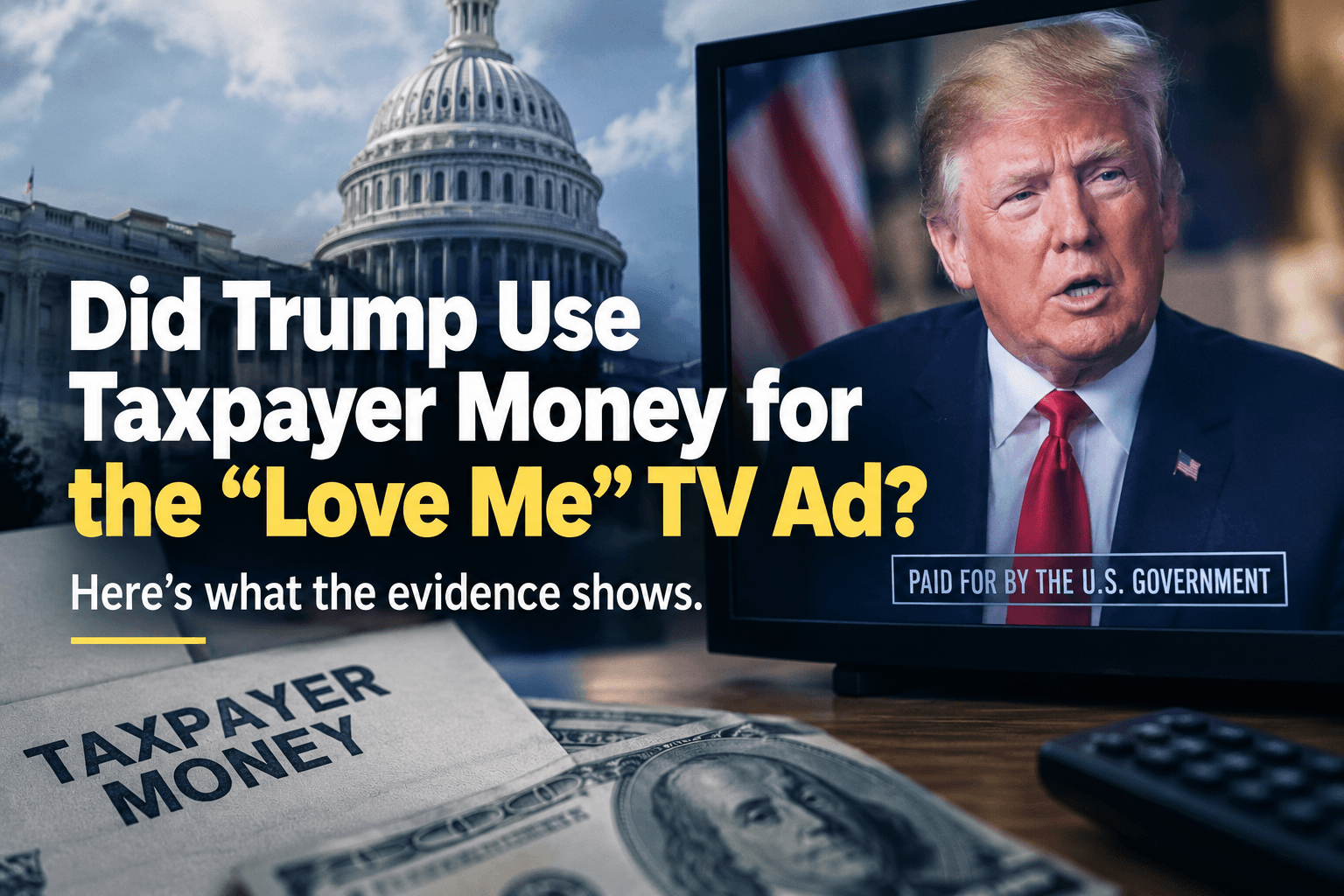
In one example, a deepfake video made it appear that Donald Trump was promising Americans a $5,000 stimulus check. Another campaign used manipulated videos featuring Elon Musk.
Other ads used deepfakes of figures including Alexandria Ocasio-Cortez, Elizabeth Warren, Bernie Sanders and then-White House press secretary Karoline Leavitt to promote fictitious government benefits. (Tech Transparency Project)
This changes the way people need to think about online verification.
The question isn’t only:
“Does this government benefit exist?”
It is also:
“Did this person actually say this?”
And:
“Is this website really connected to the government?”
And:
“Who is actually behind this advertisement?”
The fake government check doesn’t have to look fake
That’s what makes these scams particularly effective.
In its investigation, the Tech Transparency Project found an advertisement that used a deepfake of Trump appearing to promote a $5,000 government payment. The video was constructed from real footage of Trump, but the words attributed to him did not match what he actually said at the event. (Tech Transparency Project)
Another campaign used a manipulated video of Musk appearing to promote direct stimulus payments.
The ads then sent people toward websites where they could supposedly claim the money. One such advertisement reportedly reached an estimated audience of more than one million people before Meta removed it. (Tech Transparency Project)
That’s an important distinction from the old idea of a scam being something that arrives in an obviously suspicious email.
Today, the scam can begin with something that looks like a political advertisement.
Why political figures make effective scam bait
A familiar face can function as a shortcut for trust.
If you already recognize the person in the video, you may spend less time questioning whether the message itself is authentic.
The scammers documented by the Tech Transparency Project exploited exactly that dynamic, using recognizable political figures to make fictitious government programs appear credible. (Tech Transparency Project)
And the political context makes the offers easier to construct.
People already see genuine announcements about taxes, Medicare, Social Security, tariffs, rebates and other government programs.
A scammer doesn’t necessarily need to invent an entirely unfamiliar story.
They can take a real policy discussion and attach a fake payment, fake eligibility rule or fake application website to it.
That’s where a plausible-looking scam can become much harder to spot.
The IRS is specifically warning about fake stimulus payments
This isn’t just a conclusion drawn from social-media investigations.
The IRS itself warns taxpayers about fake messages involving “tax credits” and “stimulus payments.” It says scammers may pose as IRS accounts on social media or send messages directing people toward fraudulent links that claim to be IRS websites or online tools. (Internal Revenue Service)
The IRS also says that its first contact with a taxpayer is generally by letter or notice, rather than an unsolicited social-media message.
If someone contacts you online claiming to be the IRS and asks you to click a link to claim a payment, that’s a reason to stop and verify the claim independently. (Internal Revenue Service)
Five questions to ask before you claim a “government payment”
You don’t need to be an AI expert to protect yourself.
You need to slow down long enough to verify the claim.
1. Who actually announced the payment?
A Facebook page isn’t a government agency.
Neither is a political influencer.
Find the actual government agency responsible for the program and look for an announcement there.
2. Did the politician actually say it?
This matters more than ever.
A video can contain a real politician, a real voice and real footage while still being manipulated.
The Tech Transparency Project documented multiple examples in which political figures appeared to promote benefits they had never actually endorsed. (Tech Transparency Project)
If the offer depends on a politician saying something extraordinary, look for the original speech, interview or official account. It’s easy to create lookalike accounts on social media, even reusing the same profile image and name of the official account with minor tweaks. Don’t let yourself be taken advantage of by cheap scams.
3. Does the benefit actually exist?
Search for the program independently. Do not use the link in the advertisement. If you can’t find the benefit on an authoritative government website, that’s a major warning sign.
4. Are you being pressured to act immediately?
The scam advertisements documented by TTP repeatedly used urgency. One fake Trump payment ad told people to claim the money before a deadline. Another fictitious benefit urged people to apply quickly because the offer could disappear. (Tech Transparency Project)
Urgency isn’t proof of fraud. But urgency plus an unsolicited government-money offer plus a request for personal information should make you stop.
5. What information are they asking for?
Be especially careful when an unexpected offer asks for:
your Social Security number
bank-account information
credit-card information
passwords
copies of identification
payment for a processing fee
The IRS specifically warns about fraudulent links and fake refund or stimulus-payment messages. (Internal Revenue Service)
The most dangerous scams may contain a grain of truth
This may be the most important lesson from the investigation. A scam doesn’t have to invent an obviously ridiculous story. It can take something people have already heard about and bend it.
A real government program becomes:
“Everyone qualifies.”
A proposed payment becomes:
“Your check is ready.”
A politician’s real speech becomes:
“The president just announced a new stimulus.”
A government website becomes:
a convincing copycat site asking you to enter your information.
That means simply recognizing the topic isn’t enough.
You have to verify the specific claim.
And political advertising can make that harder
The Tech Transparency Project’s investigation found that some of the advertisers promoting fake government benefits were among the highest-spending political advertisers on Meta during the periods examined. Collectively, the identified scam advertisers spent tens of millions of dollars on political ads. (Tech Transparency Project)
ProPublica separately investigated deceptive political advertising on Facebook and Instagram in the run-up to an election, documenting how misleading political ads could exploit the platform’s advertising infrastructure. (ProPublica)
The implication is important for voters:
Seeing something as a sponsored political ad does not establish that the underlying claim is true.
An advertisement can be paid for, professionally produced and widely distributed and still contain a false claim.
The safest approach is to find the underlying announcement, check the responsible government agency and verify that the payment, eligibility rules and application process actually exist.
That’s also the reason Soval shows the evidence behind its assessments rather than asking users to simply trust a verdict. Learn how Soval’s evidence-based fact checking works.
And if you encounter a suspicious political video, screenshot or government-benefit offer, submit the claim to Soval and see what the evidence says. Then, ensure you are not just taking the assessment at face value and explore the cited sources. Soval can help you understand where the scam might have originated from by tracing the sources and high authority agency and media coverage that might exist around the viral claim.
Bottom line: Fake government benefit and stimulus offers are real, documented scams. Some are sophisticated enough to use deepfake political figures and large-scale social-media advertising. Before you click, apply or share, verify the program independently.
5 sources analyzed · 5 support
- 1.irs.govofficial bodysupports
- 2.techtransparencyproject.orgmediasupports
- 3.propublica.orgmediasupports
- 4.washingtontimes.commediasupports
- 5.ndtv.commediasupports