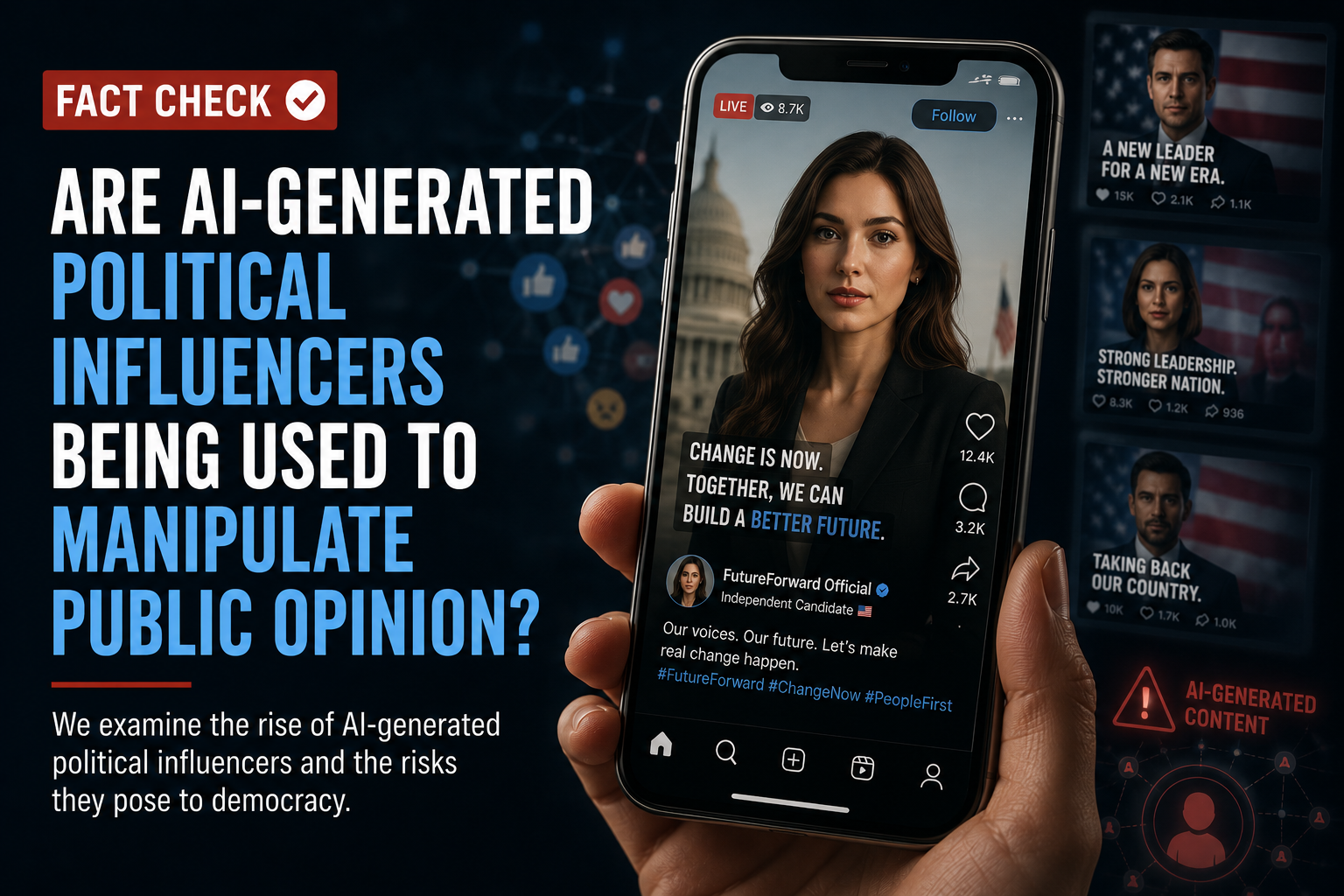
Fact Check: Are AI-Generated Political Influencers Being Used to Manipulate Public Opinion
Credible sources genuinely disagree — both sides shown
Checked Jul 31, 2026
View the full evidence ledger →As global elections face unprecedented technological shifts, a new kind of political operative has emerged: the AI influencer. From hyper realistic avatars to autonomous bot networks, synthetic media is moving beyond simple deepfakes and into the realm of coordinated political messaging.
This rapid evolution has led to viral claims that AI generated political influencers are actively manipulating mass public opinion and swaying election outcomes. But is the digital manipulation actually working, or is it just creating noise?
Before we assume that algorithms are dictating the vote, it is crucial to analyze the verifiable evidence from recent electoral campaigns.
Have you encountered a suspicious political video, robocall, or claim you want to verify?
Submit it to our automated verification framework and get instant context.
The Rise of Autonomous Propaganda
The fear of AI in elections is no longer hypothetical. Research and real world events have demonstrated that the technical capability for mass manipulation already exists.
AI enabled tools, particularly generative models and engagement optimization algorithms, play a central role in the production and amplification of disinformation. Today's state of the art large language models can produce politically relevant false news content that humans often cannot distinguish from real news. AI systems can now mimic real individuals with uncanny realism, imitating the style of politicians with greater perceived authenticity than their actual statements. Furthermore, a network linked to an Iranian influence operation sought to use chatbots to generate election disinformation and created fake website domains masquerading as domestic US news outlets to cater to different voter demographics.
Real World Testing: The 2026 Hungarian Election
The theoretical threats identified by researchers were actively tested during the 2026 Hungarian elections, which served as a laboratory for AI driven election manipulation.
Political campaigns deployed AI generated content to appeal to voters' fears, such as claims that a party's victory would lead to war, weaponizing geopolitical anxieties. This emotional content coexisted with satire and low quality AI slop featuring caricatures of candidates, creating a blended information environment where authentic and synthetic content reinforced one another.
One notable incident involved an eight second video posted on Facebook in November 2025 appearing to depict Péter Magyar, then an opposition candidate, expressing exaggerated frustration over the use of robocalls. The video appeared to be AI generated due to inauthentic facial expressions and speaking style. The incident raised broader concerns about how synthetic media can shape electoral discourse, and the role of online political influencers, particularly coordinated networks, in shaping public opinion.
The Limits of AI Manipulation
Despite the extensive use of AI driven tactics, evidence suggests that their actual impact on swaying public opinion may be more limited than feared.
A CETaS Research Report investigating the impact of AI generated disinformation on the 2024 US election revealed no conclusive evidence that such content manipulated the results. The report found a lack of evidence that AI enabled disinformation had a measurable impact on the results, noting that while social media metrics provide insights on engagement, more research is needed to understand the influence on large scale voting intentions. The CETaS project consistently found no evidence that AI enabled disinformation had measurably altered an election result in jurisdictions including the UK, the European Union, Taiwan, and India.
Furthermore, an article discussing a paper written for the Knight First Amendment Institute argues that the impact of GenAI on elections has been overblown. Reasons include the inherent challenges of mass persuasion, the complexity of media effects, the difficulty of reaching target audiences, and the limited effectiveness of AI driven microtargeting.
The Verdict
The claim that AI generated political influencers and synthetic media are being used to manipulate public opinion is contested.
While there is overwhelming evidence that coordinated AI campaigns are being deployed to distort information and manufacture consensus, credible research suggests their real world influence on decisive election outcomes remains limited. The technology is rapidly advancing, but traditional media, human influencers, and public skepticism continue to play dominant roles in shaping the vote.
12 sources analyzed · 11 support · 1 contradict
- 1.edmo.eusupports · aggregator
- 2.straitstimes.comsupports · media
- 3.pmc.ncbi.nlm.nih.govsupports · peer-reviewed
- 4.online-d11.thedailystar.netsupports · media
- 5.arxiv.orgsupports · media
- 6.nbcnews.comsupports · media
- 7.freedomhouse.orgsupports · media
- 8.ned.orgsupports · media
- 9.misinforeview.hks.harvard.edusupports · media
- 10.law.temple.edusupports · media
- 11.en.wikipedia.orgsupports · aggregator
- 12.knightcolumbia.orgcontradicts · media