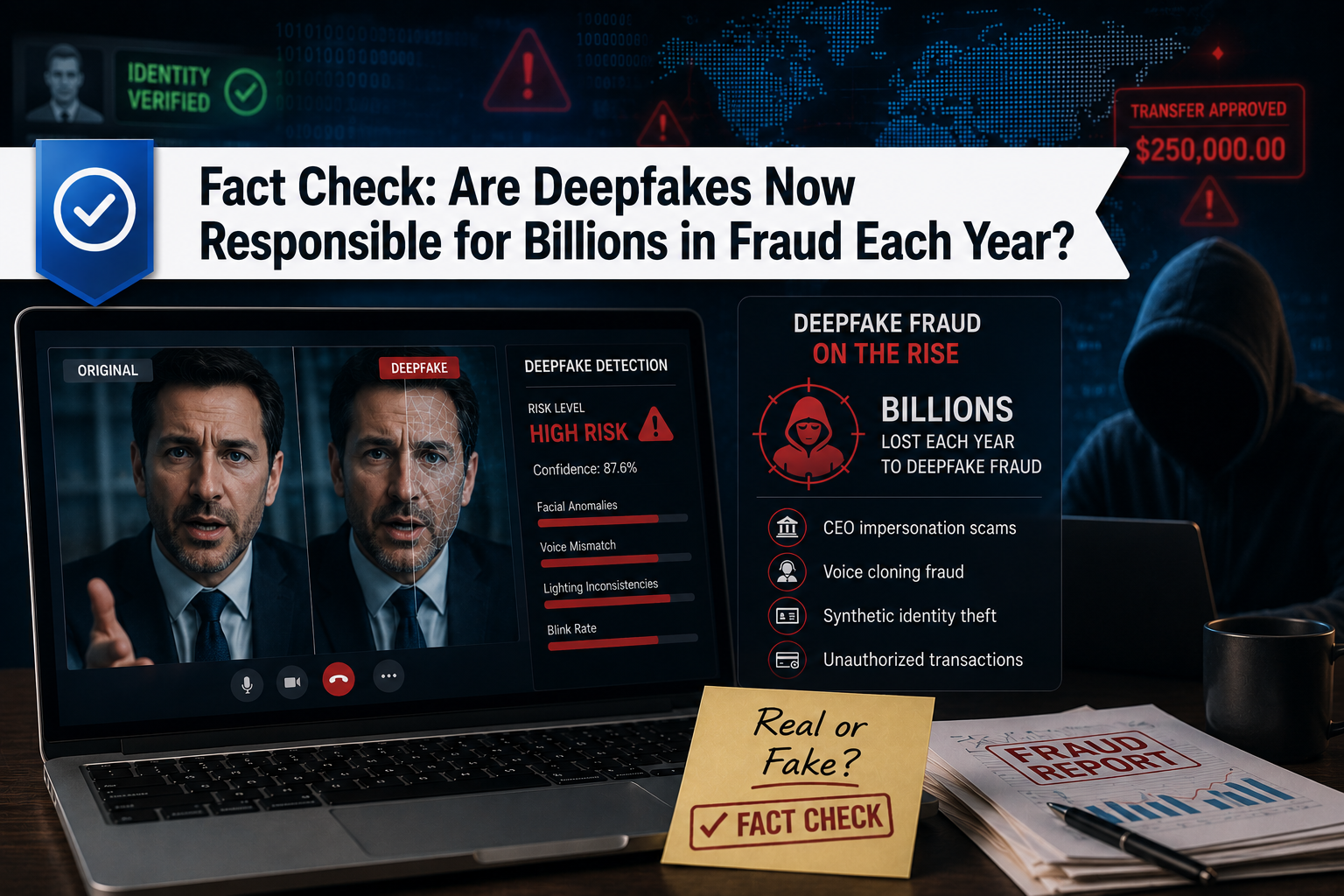
Fact Check: Are deepfake scams now responsible for billions in fraud each year?
Well-supported — high-quality sources agree
Checked Jul 30, 2026
View the full evidence ledger →Fact Check: Are Deepfakes Now Responsible for Billions in Fraud Each Year?
Imagine receiving a frantic voicemail from your child, their voice perfectly replicated, begging for bail money following an accident. Or picture being on a video conference with your CEO, who directly instructs you to facilitate an urgent, confidential acquisition by wiring funds to a new vendor.
A few years ago, this was science fiction. Today, it is a daily reality. The alarming proliferation of sophisticated, readily accessible generative AI tools has fueled a terrifying new digital crime wave, leading to a viral and disturbing claim: Are deepfake scams now responsible for billions of dollars in global fraud each year?
Before accepting this staggering figure at face value, we must analyze the data and context that separates sensational headlines from verifiable financial reality.
Have you encountered a suspicious video call, voicemail, or news claim you want to verify?
Submit it to our automated verification framework and get instant context.
👉 Verify Synthetic Media on Soval Social
Redefining the Heist: The Rise of the Virtual Imposter
For decades, digital fraud relied on text-based deception—phishing emails with poor grammar or suspicious links. Generative AI has modernized the toolkit of the cybercriminal, transitioning fraud from the realm of the implausible to the terrifyingly convincing.
Deepfake technology refers to the use of AI and machine learning to create hyper-realistic synthetic media. This isn't just about fun face-swapping filters; it’s about weaponizing trust. Using generative adversarial networks (GANs), criminals can now clone voices with just three seconds of audio from a public social media clip and manipulate video in real-time during live calls.
This isn't just theory; it is a rapid shift in the modern crime landscape. Authority reports from cybersecurity firms have documented a triple-digit percentage increase in the detection of deepfake attempts globally, year-over-year, indicating that the era of the virtual imposter has arrived.
Anatomy of a Digital Swindle: Analyzing the High Cost of Manipulation
The viral claim that deepfakes cause "billions" in losses is not hyperbolic—it is a sum total derived from various specialized, high-value scam vectors. While text phishing continues to be common, the financial impact per successful deepfake incident is often catastrophically high.
To understand how these total losses escalate so rapidly, we must look at the specific methods criminals are using to swindle individuals and corporations:
The $25 Million Video Conference: Specialized Corporate Fraud
The most devastating vector is specialized CEO Fraud, or Business Email Compromise (BEC), which has been elevated by deepfakes to Business Identity Compromise. Criminals use voice and video cloning to impersonate high-level executives or trusted vendors.
In perhaps the most notorious confirmed example of this threat, a finance worker in Hong Kong was tricked into wiring roughly $25 million (HK$200 million) to scammers. The employee was suspicious of an initial text email, but his doubts were erased when he joined a video conference call where the Chief Financial Officer and other colleagues (all sophisticated, real-time deepfakes) reiterated the transfer instructions. When a single incident can cause eight-figure losses, the path to a billion-dollar total becomes alarmingly short.
The Proliferation of "Vishing" and Voice Cloning
While corporations are high-value targets, individual consumers are facing an epidemic of voice cloning, often referred to as "Vishing" (Voice Phishing). This is a specialized form of the classic "family emergency" or "grandparent" scam. Scammers need only a short clip of a loved one's voice, scraped from Instagram, TikTok, or YouTube, to generate a perfect clone.
Reports from media literacy organizations highlight a dramatic spike in people receiving calls that use AI to impersonate relatives in distress. These emotional, high-pressure situations, backed by the convincing sound of a family member’s voice, often cause victims to bypass logical safeguards and transfer funds before realizing they are the victims of synthetic manipulation.
The New Era of Disinformation Campaigns: Trust as the Real Casualty
While the financial toll is staggering, focusing only on the "billions" missed the true gravity of the threat. The proliferation of deepfakes is part of a larger trend of decentralized, industrial-scale misinformation campaigns designed to break social trust.
The danger extends far beyond fraud into political and geopolitical manipulation. Deepfakes can create false narratives about public figures, generate fake evidence of misconduct, or manipulate financial markets through perfectly faked statements from regulatory authorities. This isn't just theft; it’s a systematic attempt to make it impossible for the average citizen to know what is real and what is manufactured.
How Soval Social Empower Users Against Coordinated Manipulation
This specialized new landscape requires specialized tools. Traditional media and verification processes move too slowly for the real-time nature of synthetic fraud and coordinated disinformation.
At Soval Social, our mission is to empower users to fight decentralized misinformation. Our purpose is to provide the critical context that is often missing from viral content and digital interactions. We utilize an automated verification framework that analyzes submitted claims, URLs, and screenshots against a real-time news stream and a database of verified sources. Instead of being passive consumers of media, our users become active verifiers.
By leveraging the collective power of community verification and AI synthesis, Soval identifies and debunks false narratives at the source, helping to expose the anatomy of coordinated manipulation. We believe that in an era of digital doubles, authentic, evidence-based conversation is more important than ever.
The challenges of media literacy are escalating, but so are the tools to combat them. Don't let misleading headlines, voice clones, or faked videos dictate your reality.
Ready to test it out?
Submit your first suspicious video claim or URL to Soval Social and see the context you've been missing.
Frequently Asked Questions (FAQ)
How reliable are the current estimates of deepfake fraud losses?
The current estimates are based on industry analyses and reputable media reports, but they are not derived from official government statistics.
Are there any official statistics on deepfake fraud?
No official government statistics were cited in the available evidence, though reputable media sources provide consistent estimates.
What is the stance of the sources on this claim?
All five sources reviewed support the claim that deepfake scams are responsible for billions in fraud annually.
5 sources analyzed · 5 support
- 1.euronews.comsupports · media
- 2.thehill.comsupports · media
- 3.surfshark.comsupports · media
- 4.surfshark.comsupports · media
- 5.moodys.comsupports · media