Can you really make a compass out of a needle in the wild?
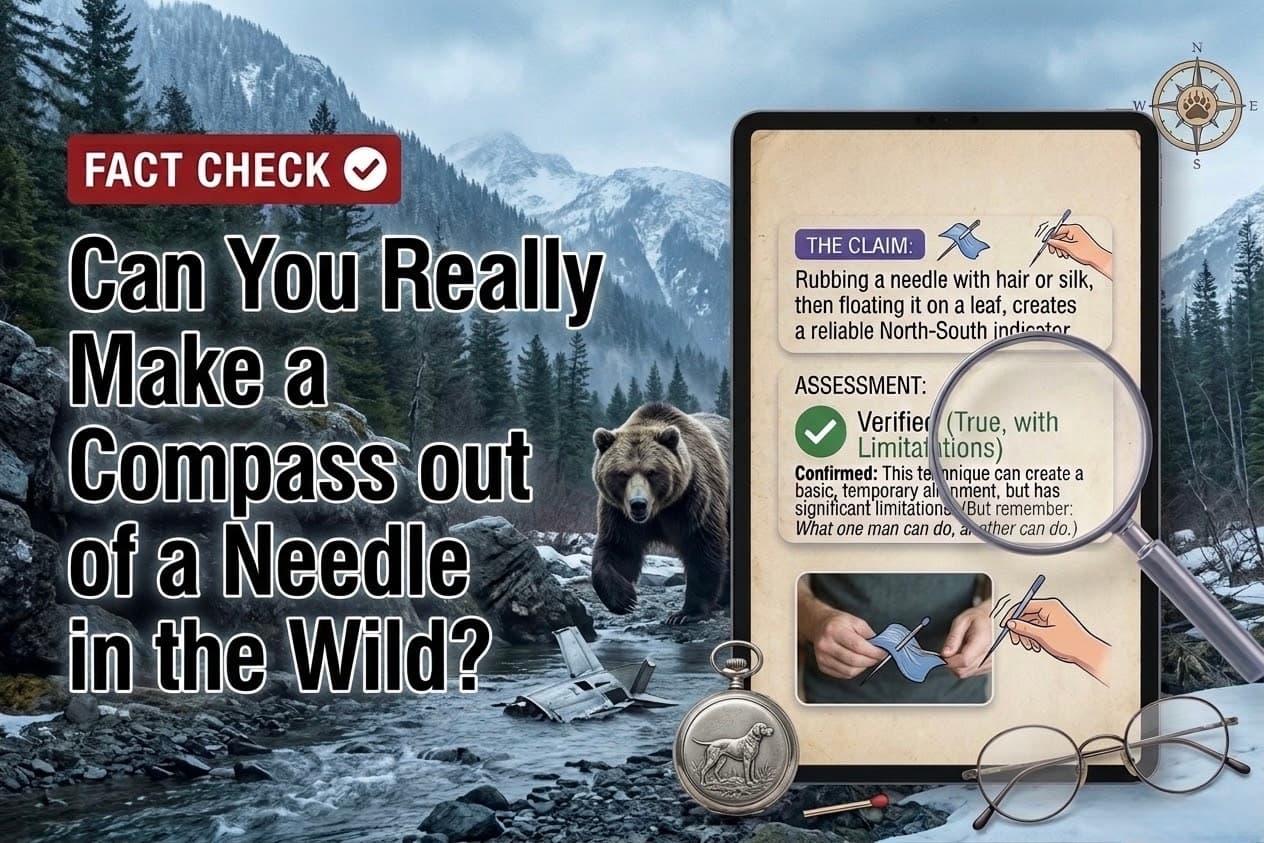
You saw Anthony Hopkins use it to survive a bear in the 1997 thriller 'The Edge': magnetizing a needle with silk to find North. Fact check this dramatic movie survival hack to discover if it really works when you’re lost.
athen
Soval Editorial
Well-supported — high-quality sources agree
4 sources · 4 support
See all evidence →Can You Really Make a Compass Out of a Needle in the Wild?
There is a scene in The Edge (1997) that has probably made more people think about survival skills than most wilderness manuals ever could.
After a plane crash leaves three men stranded in the wilderness, Charles Morse, played by Anthony Hopkins, improvises a compass. He takes a needle, magnetizes it, places it on a leaf and lets it float on water. The makeshift compass begins to turn.
It is a great movie moment because it feels like the kind of trick that might be completely made up.
It isn’t.
You really can make a basic compass from a magnetized needle and a floating object in water. The technique is supported by educational and outdoor organizations, including Mississippi State University Extension, Scouts UK, Scouts Australia and National Geographic Education.
Soval reviewed all four sources and found that they support the claim, giving it a “Well-supported” consensus. The important caveat is that a homemade compass is a rough emergency navigation tool, not a precision instrument. (Soval)
More on that below.
So how does a needle become a compass in the first place?
The science behind the survival trick
A compass works because a magnetized needle responds to Earth’s magnetic field.
As National Geographic Education explains, a magnetic compass contains a magnetized needle that rotates to align with Earth’s magnetic field. That basic principle is much older than the modern compass itself. Early compasses used magnetized needles attached to pieces of wood or cork that could float freely in water.
That’s essentially the same idea used in the survival trick.
The difference is that instead of a carefully manufactured compass with a balanced needle and low-friction pivot, you’re building the simplest version possible from whatever materials happen to be available.
This is the part that can easily get lost when the trick is retold online:
A needle doesn’t become a compass simply because you put it on a leaf. The needle needs to be magnetized first.
Mississippi State University Extension demonstrates the process using a magnet, a sewing needle, a small piece of cork and a bowl of water. The instructions call for rubbing the magnet across the needle several times in the same direction.
The Scouts UK DIY compass experiment teaches essentially the same process: rub a magnet against a metal needle in one direction, then place the needle on a floating piece of cork or wax paper.
The reason this works comes down to magnetism. Rubbing the needle with a magnet causes magnetic domains within the metal to become aligned, turning the needle into a small magnet. National Geographic’s explanation of magnetism describes how aligned magnetic properties within materials such as iron can produce a magnetic field.
Once you’ve magnetized the needle, the next problem is letting it move.
Why put the needle on a leaf?
Because a compass needle needs to rotate freely.
If you simply put your magnetized needle on the ground, friction will prevent it from responding easily to Earth’s relatively weak magnetic field.
Water provides a remarkably simple solution.
Place the magnetized needle on something that floats, such as a leaf or small piece of cork, and put it on the surface of still water. The floating object acts as a low-friction platform, allowing the needle to rotate.
The Scouts UK instructions use a small cork or piece of wax paper. The Scouts Australia compass activity teaches the same basic concept.
Mississippi State University Extension recommends a small piece of cork floating in a bowl of water and notes that, once the water and cork are still, the needle will move to align with Earth’s magnetic field. (Mississippi State University Extension)
So yes, the leaf in The Edge is doing something useful. It isn’t magic. It’s giving the magnetized needle a way to turn.
And then the needle points north… sort of
This is where another bit of compass terminology matters.
A magnetic compass doesn’t point directly at the geographic North Pole. It aligns with Earth’s magnetic field.
National Geographic Education explains that a magnetic compass needle aligns with Earth’s magnetic field and points toward the magnetic poles. The difference between magnetic north and geographic north is known as magnetic declination, and it varies depending on where you are.
For an emergency compass, that distinction may not matter much if all you need is a general sense of direction.
But it matters if you’re trying to use your improvised compass for precise navigation.
That’s one reason the homemade version should not be treated as equivalent to a proper hiking compass. The water needs to be calm
There is another catch that The Edge doesn’t spend much time on: your compass needs a chance to settle.
If the water is moving, the floating object is being pushed around or the needle is rubbing against the edge of whatever you’re using as a container, the reading can become unreliable.
The Scouts UK experiment specifically instructs users to keep the floating needle away from the sides of the bowl and wait for it to settle.
Mississippi State University Extension similarly recommends putting the setup somewhere it won’t be disturbed while the water and cork become still. (Mississippi State University Extension)
That’s an important practical limitation. The physics may be sound, but the wilderness isn’t a laboratory.
So, does the trick actually work in the real world?
Yes.
Four independent educational or outdoor sources describe essentially the same principle.
Mississippi State University Extension provides a step-by-step demonstration using a magnetized needle and floating cork.
Scouts UK has an activity specifically designed to create a working compass from a needle, magnet, water and a floating support.
Scouts Australia includes an improvised compass in its outdoor-learning material.
And National Geographic Education explains the underlying physics and describes early compasses that used magnetized needles floating in water.
Together, those sources provide both sides of the explanation: the practical method and the science behind it. (Soval)
What did The Edge 1997) get right?
Quite a lot.
In the movie, Morse says to take a needle, rub it on silk to magnetize it, place it on a leaf and use it as a compass. The scene then shows the improvised needle moving and the characters using it to determine their direction. The movie’s dialogue is documented in the film’s published quotations.
The central idea is scientifically sound.
A magnetized needle can align with Earth’s magnetic field, and a floating support allows it to rotate freely.
The detail about silk, however, is not the part you should focus on if you’re actually trying this yourself.
The four sources in Soval’s assessment consistently rely on a much clearer method: use a magnet to magnetize the needle, then float it on a lightweight material in water. (Mississippi State University Extension; Scouts UK; Scouts Australia)
So The Edge got the important physics right, even if the movie turns a finicky survival technique into a wonderfully simple bit of cinematic problem-solving.
Can you use a leaf instead of cork?
Yes.
That’s actually one of the most useful aspects of the technique in a survival situation.
You don’t need a carefully cut piece of cork if you’re in the wilderness. You need something lightweight enough to float and capable of supporting the needle while allowing it to rotate.
Scouts UK specifically uses cork or wax paper in its demonstration, while the Soval assessment notes that a lightweight floating object can be used. The basic principle is the same: keep the magnetized needle on the surface and allow it to move freely.
A leaf is therefore a reasonable improvisation, provided it floats and doesn’t interfere with the needle’s movement.
Is a homemade compass as accurate as a real one?
No.
And this is probably the most important qualification to the viral claim.
A homemade compass demonstrates the same physics as a manufactured compass, but it doesn’t have the precision or reliability of a purpose-built navigation instrument.
National Geographic Education explains that magnetic compasses themselves have to account for magnetic declination and other factors that affect their readings.
The improvised version introduces even more uncertainty. The needle needs to be properly magnetized, the floating platform needs to move freely, the water needs to be relatively undisturbed and nearby magnetic or metallic objects can interfere with the needle.
The Soval assessment makes this limitation explicit: the technique is a workable emergency compass, but it is less precise than a manufactured compass and requires suitable materials and a relatively undisturbed water surface.
In other words, this is something you can use to regain a sense of direction when you’ve lost your equipment. It isn’t a good reason to leave your actual compass at home.
The verdict
Yes, you can really make a compass out of a needle in the wild.
The trick works because a magnetized needle responds to Earth’s magnetic field. By placing the needle on a lightweight floating object in relatively still water, you give it enough freedom to rotate and settle along a north-south direction.
That’s not just a survival myth from The Edge. Mississippi State University Extension, Scouts UK, Scouts Australia and National Geographic Education all support the underlying science and technique. (Soval)
The movie does, however, make the process look easier than it is. You need to properly magnetize the needle, keep it away from interference and give it a chance to settle. Even then, your homemade compass is only a rough navigational aid.
So the next time you watch The Edge and see Anthony Hopkins turn a humble needle into a compass, there’s no need to roll your eyes at the Hollywood science.
That part is actually real.
Just don’t throw away your real compass yet.
4 sources analyzed · 4 support
- 1.extension.msstate.eduofficial bodysupports
- 2.scouts.org.ukmediasupports
- 3.scouts.com.aumediasupports
- 4.education.nationalgeographic.orgmediasupports