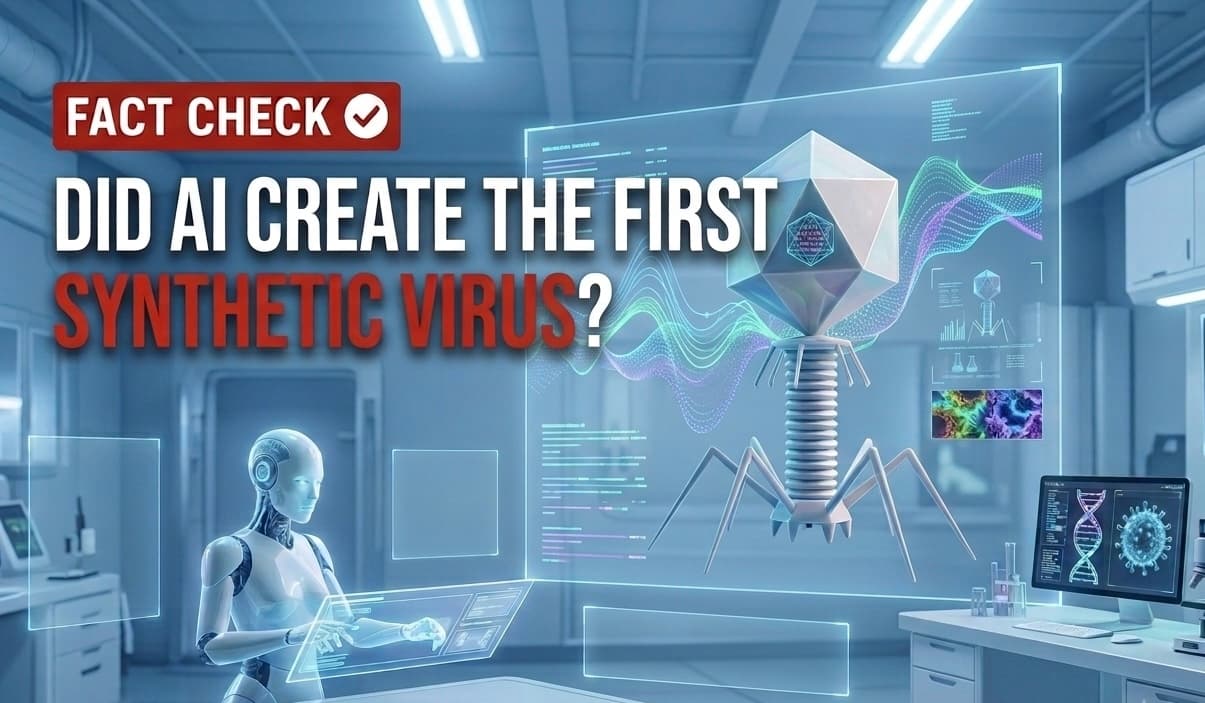
Did AI create the first synthetic virus
Breakthroughs in generative AI have crossed into the realm of biology. Viral reports claim scientists used AI to create the first synthetic virus. We investigate the scientific findings to clarify what was actually created and what it means for the future.
athen
Soval Editorial
Well-supported — high-quality sources agree
11 sources · 10 support · 1 neutral
See all evidence →Fact Check: Did AI Create the First Synthetic Virus?
Quick Verdict: The claim that AI created the first synthetic virus is highly supported when specifically referring to viruses designed from scratch by artificial intelligence. However, human scientists have been synthesizing laboratory copies of natural viruses for over two decades.
The convergence of artificial intelligence and biotechnology has entered a transformative era. Headlines across major global news outlets have surfaced with a striking claim: scientists have successfully used AI to design and synthesize functional viruses that have never existed in nature.
Given long standing public concerns around biosecurity and artificial life, this claim has raised both intrigue and anxiety. We reviewed scientific literature and reporting from leading global outlets, including The New York Times, Nature, and The Guardian, to separate breakthrough reality from science fiction.
Key Takeaways
Stanford University researchers used an artificial intelligence model named Evo 2 to write entirely new viral genomes.
The AI generated hundreds of synthetic genetic sequences distinct from any found in the natural world.
In laboratory experiments, sixteen of these AI designed bacteriophages successfully infected E. coli bacteria.
The breakthrough has raised serious biosecurity warnings regarding the future potential for generating dangerous human pathogens.
Have you encountered a suspicious scientific claim or health news update you want to verify?
Submit it to our automated verification framework and get instant context.
How Generative AI Wrote Biological Code
The viral claims are rooted in real world scientific achievements. Researchers utilized a generative AI model that was trained on millions of existing genomes. Rather than modifying existing biological structures, the AI suggested entirely novel DNA sequences.
These AI designed genetic blueprints were then chemically synthesized in a laboratory. The resulting synthetic creations were bacteriophages, which are small viruses that specifically target and infect bacteria. In lab tests, the synthetic viruses successfully infected their target host cells, and three variants even outcompeted the original natural virus strain. This demonstrated that artificial intelligence can write functional biological code capable of sustaining life processes.
Synthetic Viruses vs. AI Designed Viruses
To evaluate the claim accurately, it is essential to distinguish between a synthetic virus and an AI designed synthetic virus.
Synthetic biology has existed for decades. Scientists assembled the very first chemically synthesized whole genome from scratch in 2003. Therefore, AI did not create the first synthetic virus in human history.
What makes this milestone historic is that AI designed functional viruses never found in nature. Rather than humans copying an existing biological sequence, the generative model learned the underlying rules of viral architecture and generated brand new functional genomes.
Biosecurity Fears and Future Potential
The creation of AI designed viruses represents a major leap forward for medicine. Scientists point out that tailored bacteriophages could lead to powerful new treatments against drug resistant superbugs, offering an alternative to traditional antibiotics. Several of the newly synthesized viruses successfully overcame natural bacterial resistance during the laboratory tests.
However, the achievement has also triggered serious safety and biosecurity concerns. Experts warn that this capability proves AI can generate viable non natural viruses. While the current research focused exclusively on bacteria and utilized non pathogenic strains for safety, the underlying technology could eventually be used to engineer harmful human pathogens far more efficiently than before.
Frequently Asked Questions (FAQ)
Did AI create the first synthetic virus in history?
No, scientists synthesized the first whole viral genome in 2003. However, this recent study marks the first time artificial intelligence generated functional viral genomes from scratch.
What kind of virus did the AI design?
The AI designed bacteriophages, which are small viruses that exclusively infect bacteria. They do not infect human cells.
Why are scientists using AI to make viruses?
Researchers hope that AI designed bacteriophages can be used in phage therapy to treat dangerous antibiotic resistant bacterial infections in humans.
11 sources analyzed · 10 support · 1 neutral
- 1.nytimes.commediasupports
- 2.theguardian.commediasupports
- 3.nature.commediasupports
- 4.axios.commediasupports
- 5.businesstoday.inmediasupports
- 6.testbiotech.orgmediasupports
- 7.pubmed.ncbi.nlm.nih.govmediasupports
- 8.washingtonpost.commediasupports
- 9.telegraph.co.ukmediasupports
- 10.sciencesprings.wordpress.commediasupports
- 11.ncbi.nlm.nih.govofficial bodyneutral