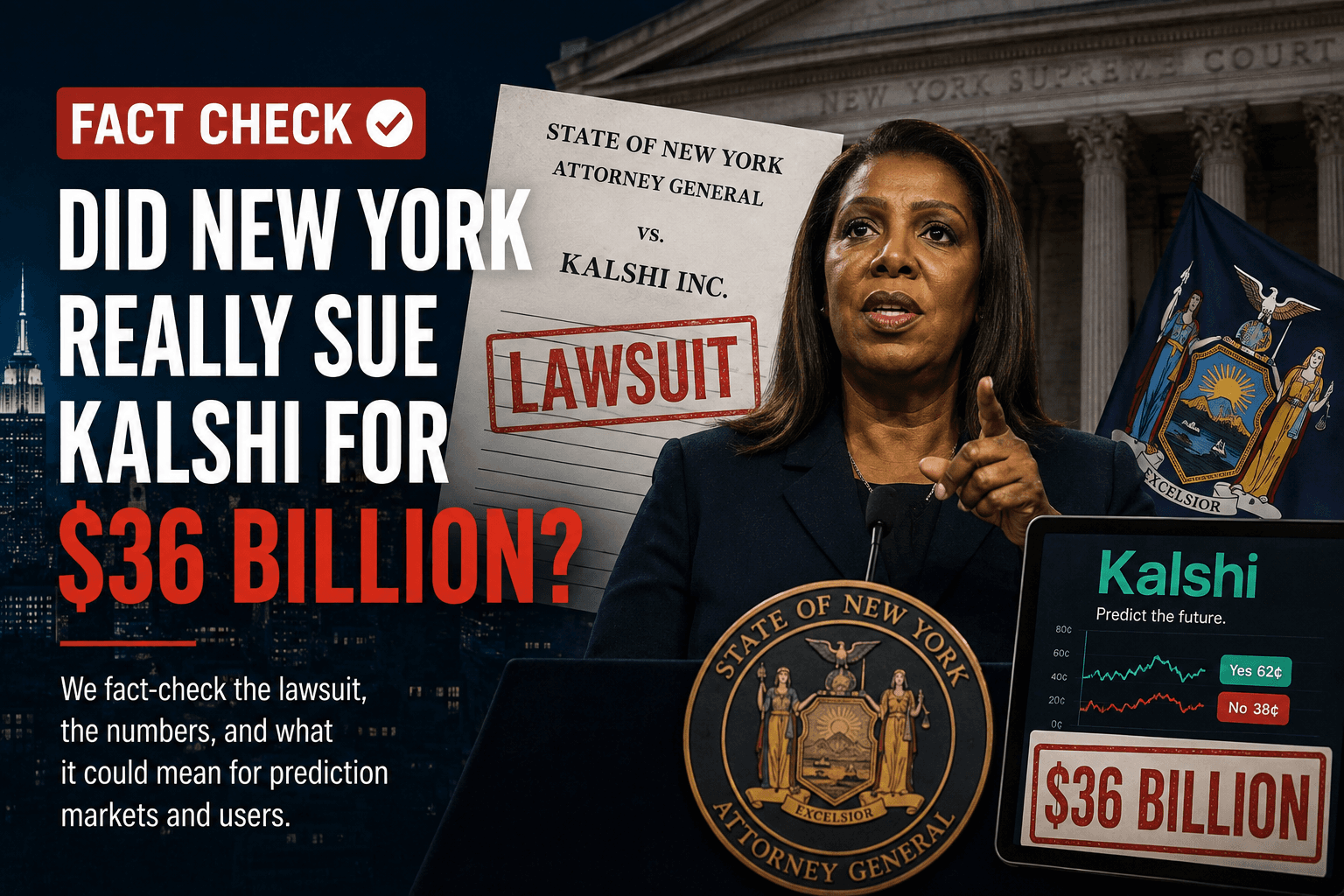
Did New York Really Sue Kalshi for $36 Billion
New York Attorney General Letitia James has sued Kalshi for operating an alleged illegal gambling business. We examine the lawsuit's details and where the $36 billion demand originated. Find out on Soval.
athen
Soval Editorial
Well-supported — high-quality sources agree
11 sources · 11 support
See all evidence →Fact Check: Did New York Really Sue Kalshi for $36 Billion?
Social media is buzzing with news that New York State has sued the prediction market Kalshi for a staggering 36 billion dollars. Given the rise of event based trading platforms, this lawsuit has significant implications for the industry.
However, the widely shared number requires important context. It is not a court judgment or a fine that Kalshi has been ordered to pay. Instead, it represents the state's estimated maximum penalties outlined in its legal complaint. We look at the official filings to separate the requested figures from the final facts.
Have you encountered a suspicious financial news claim or lawsuit detail you want to verify?
Submit it to our automated verification framework and get instant context
What Is Kalshi?
Kalshi is a federally regulated prediction market that allows users to trade contracts based on the outcome of future events. Rather than betting directly on sports or politics, users buy and sell contracts tied to questions such as whether inflation will rise, an election outcome will occur, or a economic metric will be met.
Supporters argue these markets provide valuable forecasting data and are regulated financial products. Critics, including New York State, argue that some of Kalshi's markets closely resemble traditional sports betting. This fundamental disagreement sits at the heart of the lawsuit.
Why Is New York Suing Kalshi?
According to the complaint filed in New York Supreme Court, New York alleges that Kalshi offered prediction markets to residents without obtaining the licenses required to operate sports betting or gambling services in the state.
The Attorney General’s office claims these offerings violated New York gambling laws and is seeking several forms of financial relief. This relief includes civil penalties, restitution, the recovery of alleged revenues, and additional damages permitted under state law. The state effectively seeks to stop what it deems an illegal gambling business within its borders.
Kalshi disputes these allegations. The company maintains that its event contracts are federally regulated financial products under the oversight of the Commodity Futures Trading Commission or CFTC. They argue that federal regulation should take precedence over state gambling laws and believe state regulators cannot prohibit markets that fall under federal oversight.
Where Did the "36 Billion" Figure Come From?
This is where many social media posts lose important context. The lawsuit does not claim that Kalshi has already been ordered to pay 36 billion dollars.
Instead, the figure comes from calculations included in New York’s legal filing. The state estimates potential penalties based on civil fines for each alleged unauthorized betting offer, triple damages based on alleged revenue, and other statutory penalties.
Because those calculations are based on legal claims rather than a court ruling, the final amount, if New York prevails, could be significantly different. In other words, 36 billion dollars represents what New York is seeking as a maximum estimated penalty, not what Kalshi owes today.
The Verdict
The claim that New York sued Kalshi for 36 billion dollars is True with Important Context.
High quality news sources and court filings confirm that New York Attorney General Letitia James has filed a lawsuit against prediction market platform Kalshi alleging the company operated an illegal unlicensed gambling business. The state is seeking approximately 36 billion dollars in damages and civil penalties. However, that figure is not a judgment, settlement, or fine that Kalshi has been ordered to pay. It is the amount New York says it is entitled to seek under its legal claims. The courts will ultimately determine whether the allegations have merit and whether any damages are awarded.
11 sources analyzed · 11 support
- 1.cnbc.commediasupports
- 2.reuters.commediasupports
- 3.fortune.commediasupports
- 4.reason.commediasupports
- 5.insurancejournal.commediasupports
- 6.apnews.commediasupports
- 7.cnn.commediasupports
- 8.finance.yahoo.commediasupports
- 9.crypto.newsmediasupports
- 10.nbcsports.commediasupports
- 11.brobible.comaggregatorsupports