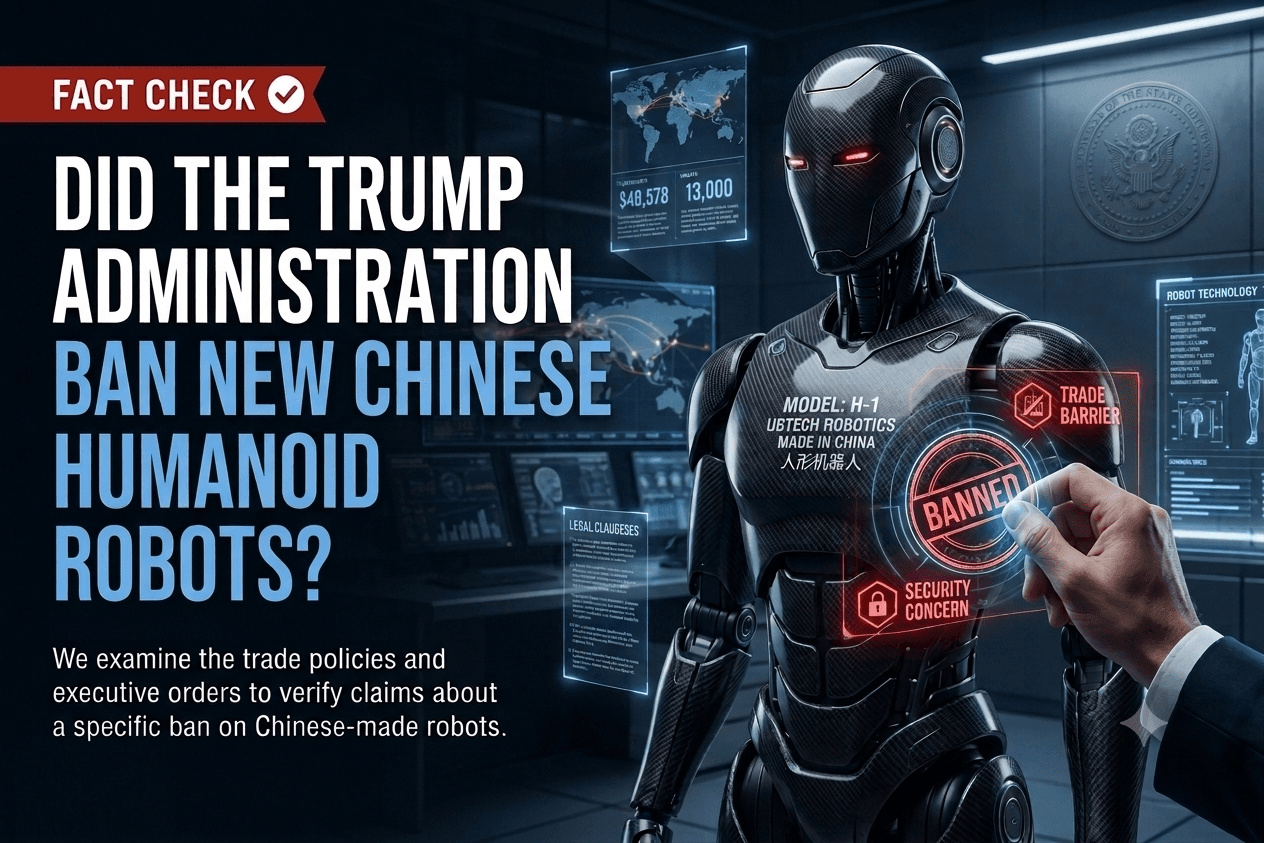
Did the Trump administration ban new Chinese humanoid robots?
Viral claims suggest that the US government has officially banned the import of new Chinese humanoid robots. We investigate the recent Federal Communications Commission (FCC) ruling to see if this is true and what it means for the global robotics market. Read the verdict on Soval.
athen
Soval Editorial
Well-supported — high-quality sources agree
7 sources · 7 support
See all evidence →Did the U.S. Administration Ban New Chinese Humanoid Robots?
As the race for artificial intelligence dominance accelerates, the physical embodiment of that AI humanoid robots has become a new frontier in geopolitical tension. Recent headlines have been dominated by claims that the US government, under the Trump administration, has officially banned the import of new Chinese humanoid robots.
But is this a blanket ban on all robots, or are the headlines oversimplifying a complex trade policy? We look at the official rulings to separate fact from fiction.
Have you encountered a suspicious news claim or policy update you want to verify?
Submit it to our automated verification framework and get instant context.
The FCC Ruling: Targeting Unacceptable Risks
The claims surrounding a US ban are rooted in a recent official action. On Tuesday, July 28, 2026, the Federal Communications Commission announced new restrictions, adding certain items to its Covered List, a register of goods and services deemed a risk to US national security.
The new rules explicitly ban the import of new foreign produced advanced robotic devices, which the FCC defines as including humanoid robots and animal like quadrupeds often referred to as robot dogs. In addition to robots, the ban also covers connected power inverters, which are crucial for linking renewable energy and battery storage to power grids.
FCC Chairman Brendan Carr stated that the agency is acting to secure America's critical supply chains. The administration cited concerns that these advanced, connected devices could create supply chain vulnerabilities that could disrupt US economic and national security and could create a cybersecurity risk that threatened American critical infrastructure. Specifically, officials warned that advanced robotic devices collect data that could be leveraged by malign actors to surveil Americans, enhance the capabilities of foreign intelligence services, or to remotely commandeer the robots.
Not Just China, But Aimed at China
While the wording of the ban applies broadly to foreign made robots, analysts and media reports widely agree that the measure is directly aimed at China.
China currently dominates the global market for humanoid robots. According to Barclays PLC, Chinese companies account for an estimated 85 percent of the global market share. Companies like Unitree and Agibot are shipping thousands of units, vastly outpacing their US counterparts like Tesla and Figure AI. The restrictions are seen as a move by the Trump administration to protect the US AI supply chain, foster domestic manufacturing, and protect US developers from price competition.
The FCC is expected to grant exemptions to many non Chinese suppliers, a precedent set by previous similar bans involving foreign made drones and networking equipment.
What the Ban Doesn't Cover
It is important to note the limitations of the ruling. The ban applies only to imports of new systems and models that have not yet been approved for sale in the United States. It does not prevent the sale, import, or use of any existing models that were previously authorized by the FCC.
However, the FCC does retain the authority to revoke prior authorizations for products already approved for sale, though it has not done so yet.
The Chinese government has strongly criticized the move, accusing the US of overstretching the concept of national security to suppress Chinese companies. The Chinese Embassy in Washington warned that Beijing will take all necessary measures to defend the legitimate rights and interests of Chinese businesses and to respond to any action that causes material harm to its interests.
The Verdict
The claim that the Trump administration and the FCC banned new Chinese humanoid robots is: Consensus. The claim is well-supported by high authority evidence.
Multiple quality sources confirm that the FCC has imposed a ban on the import of new, foreign made advanced robotic devices, including humanoids and quadrupeds, citing national security and cybersecurity risks. While technically applying to foreign made devices, the ban is widely understood to target Chinese manufacturers, who dominate the market. The ban only applies to new models seeking authorization and does not immediately affect robots already approved or in use.
7 sources analyzed · 7 support
- 1.reuters.commediasupports
- 2.washingtonpost.commediasupports
- 3.bbc.co.ukmediasupports
- 4.dw.commediasupports
- 5.politico.commediasupports
- 6.thehill.commediasupports
- 7.gigazine.netaggregatorsupports