Fact Check: Did Trump Ban Bombardier From Selling Planes in the U.S.?
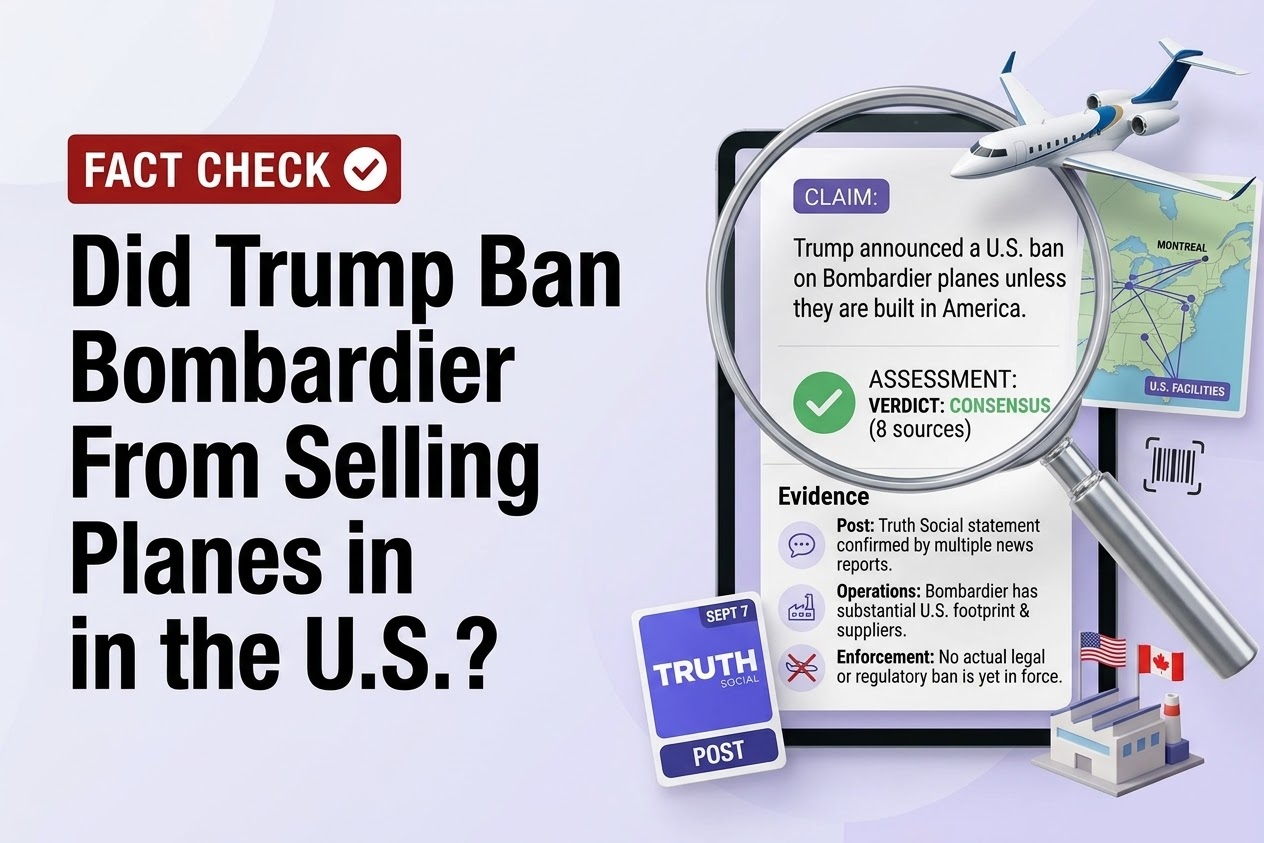
Well-supported — high-quality sources agree
Checked Sep 7, 2026
View the full evidence ledger →Did Trump Ban Bombardier From Selling Planes in the U.S.? What He Actually Announced
President Donald Trump said Monday that Canadian aircraft manufacturer Bombardier would no longer be allowed to sell its planes in the United States unless it manufactures them there.
“NO MORE SELLING BOMBARDIER IN THE UNITED STATES!” Trump wrote in a post on Truth Social, adding that Bombardier would have to build in the U.S. if it wanted access to the American market.
So, did the U.S. administration announce a ban on Bombardier?
Yes, in the sense that Trump publicly announced that Bombardier sales in the U.S. should be blocked unless the company moves production there. What remains unclear is how that restriction would actually be implemented. Reuters reported that the White House had not explained what steps it would take to stop Bombardier aircraft from being sold or delivered in the United States.
What did Trump actually announce?
Trump said Canadian aircraft manufacturer Bombardier would have to build its planes in the United States if it wanted to keep selling them there. Read the reporting on Trump's announcement.
The statement came amid a broader deterioration in U.S. and Canadian trade relations. Canada was preparing retaliatory tariffs on U.S. goods, while the Trump administration has increasingly used tariffs and restrictions to pressure foreign manufacturers to produce inside the United States.
That makes the wording important. Trump did not announce that Bombardier had stopped selling aircraft immediately. He announced that it would no longer be allowed to sell in the U.S. unless it met a new manufacturing condition.
Is Bombardier actually banned from the U.S.?
This is where the story becomes less straightforward.
Trump announced the restriction, but there was no accompanying explanation from the White House detailing how it would be enforced.
Reuters reported that the White House had not immediately said what steps would be taken to prevent Bombardier aircraft from being sold in the United States, including what would happen to aircraft that had already received approval from the Federal Aviation Administration.
There is also a practical complication:
Bombardier Already Has a Surprisingly Large American Footprint
There is an obvious complication to Trump’s demand that Bombardier build in America: Bombardier already does business there at a substantial scale.
The company employs more than 3,000 people across nine U.S. facilities.
It works with roughly 2,800 American suppliers.
It operates U.S. service centres and other facilities.
About half of Bombardier’s revenue comes from U.S. sources.
And the aircraft themselves are not purely Canadian products. Bombardier uses engines and parts made by American companies. That makes the idea of simply shutting the door on Bombardier considerably more complicated than Trump’s post makes it sound.
So Can the U.S. Actually Stop Bombardier From Selling Planes?
Possibly. But the administration has not said how.
Reporting indicates that the White House has not immediately explained what steps it would take to enforce Trump’s announcement. This leaves an important gap between the announcement and its implementation.
A president can announce a trade policy or direct an administration to pursue one. Turning that announcement into a restriction that prevents aircraft from being imported, certified, delivered, or sold involves relevant regulatory and legal mechanisms. Those details had not been made public when Trump made his announcement.
For now, the announcement is real; the enforcement mechanism is not yet clear.
This Fight Has Been Building for Months
The Bombardier dispute did not begin on September 7.
In January 2026, Trump threatened another dramatic move against the Canadian manufacturer. He said the United States would decertify Bombardier Global Express business jets and threatened a 50% tariff on aircraft made in Canada.
The dispute was connected to Canada’s certification of aircraft made by American manufacturer Gulfstream. At the time, a White House official clarified that Trump was not proposing to decertify Canadian-built aircraft that were already in operation. Read the January 2026 reporting on the Bombardier dispute.
That confrontation eventually subsided without the threatened measures taking effect as originally described. Now Bombardier is back in the middle of the dispute, only this time Trump’s demand is more explicit: build in America or lose access to American buyers.
What Makes the Latest Announcement Different?
The wording.
The January dispute centred on aircraft certification and threatened tariffs. Trump’s September statement goes directly after Bombardier’s ability to sell into the U.S. market.
His message was not that Bombardier’s aircraft were suddenly unsafe or that existing aircraft would be grounded. It was a demand that the company change where it manufactures aircraft if it wants continued access to American customers.
That distinction is important for anyone trying to interpret the headlines. A headline saying “Trump bans Bombardier” captures the direction of the announcement, but it can also imply something more sweeping than what has actually happened.
There is no evidence at this point that Bombardier aircraft already operating in the United States are being grounded, that existing owners are being forced to remove them, or that every Bombardier aircraft already approved by the FAA has suddenly become illegal to operate. The immediate issue is future access to the U.S. market.
What Does Bombardier Say?
At the time of the initial reporting, Bombardier had not issued a public response to Trump’s September 7 announcement.
That leaves several practical questions unanswered:
Would the U.S. restrict new aircraft certifications?
Would it impose tariffs?
Would the administration try to block imports?
Would Bombardier be expected to move final assembly to the United States, or would its existing American operations satisfy some version of the requirement?
None of that was specified in Trump’s announcement. And those details could ultimately determine whether this becomes a major disruption for Bombardier or primarily another escalation in the broader U.S.–Canada trade fight.
So, Did the U.S. Announce a Bombardier Ban?
Yes, with an important qualification.
On September 7, Trump publicly announced that Bombardier would no longer be allowed to sell aircraft in the United States unless it manufactures them there. Multiple news organizations reported the announcement, and Soval’s evidence assessment currently rates the claim as Consensus.
What has not been established is that a fully implemented legal ban is already in force, or exactly how the administration intends to enforce Trump’s order.
For now, the clearest description is that Trump has announced an intended restriction on Bombardier’s access to the U.S. market. The mechanics of turning that announcement into an enforceable ban remain unclear. That distinction could become much less important if the administration publishes specific rules or regulatory action in the coming days.
Soval’s assessment will be rechecked as the story develops. Follow the live Soval evidence assessment and learn more about how we determine our Evidence States.
Frequently Asked Questions (FAQ)
Did Trump ban Bombardier from selling planes in the United States?
Trump announced that Bombardier would no longer be allowed to sell aircraft in the United States unless it manufactures them there. The administration has not yet publicly detailed how that restriction would be enforced. Read more on CBC.
Why is Trump targeting Bombardier?
The announcement comes amid escalating trade tensions between the United States and Canada and follows an earlier dispute involving Canada’s certification of Gulfstream aircraft.
Does Bombardier already operate in the United States?
Yes. Bombardier employs thousands of people across nine facilities in the U.S. and works with thousands of American suppliers.
Is this the first time Trump has threatened Bombardier?
No. Trump threatened to decertify Bombardier Global Express aircraft and impose a 50% tariff on Canadian-made aircraft in January 2026. Those measures did not ultimately take effect as originally threatened. Read the January 2026 report.
Are Bombardier planes already operating in the U.S. banned?
There is no indication that Bombardier aircraft already operating in the United States are being grounded. The September announcement concerns Bombardier’s continued ability to sell aircraft in the U.S. market.
8 sources analyzed · 6 support · 2 neutral
- 1.reuters.comsupports · media
- 2.airlive.netsupports · aggregator
- 3.bloomberg.comsupports · media
- 4.au.finance.yahoo.comsupports · media
- 5.aa.com.trsupports · media
- 6.travelandtourworld.comsupports · aggregator
- 7.manufacturing.netneutral · media
- 8.bbc.comneutral · media