Fact Check: Do Collagen Serums Reduce Fine Lines?
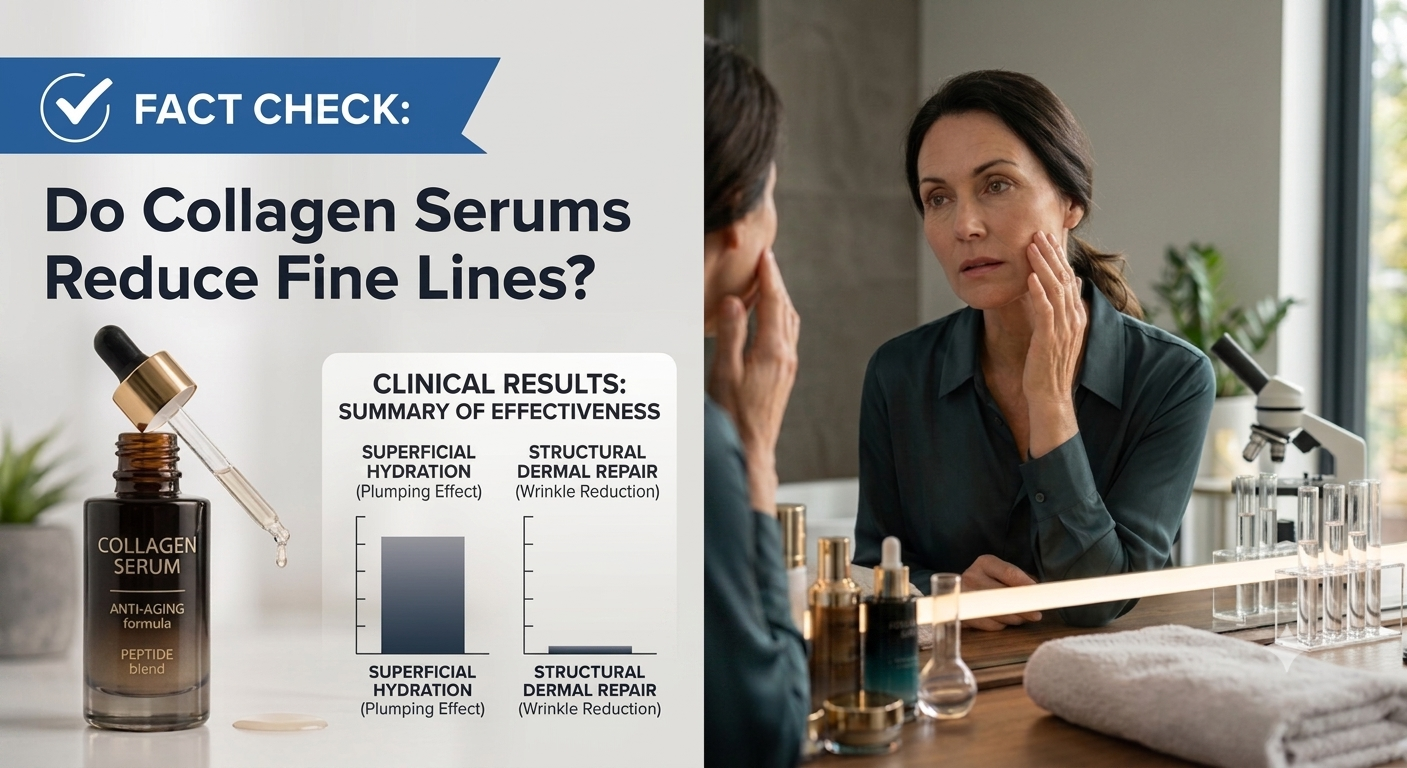
Fact Check: Do Collagen Serums Actually Reduce Fine Lines?
🛡️ SOVAL VERDICT: Contested (Credible sources genuinely disagree)
Checked July 25, 2026 · We'll re-check as this develops
Evidence indicates that collagen serums can modestly reduce the appearance of fine lines by improving hydration and barrier function, but they do not directly replace lost collagen or deeply treat wrinkles where they form.
🔗 View the full evidence ledger and verified claim data here
Do topical collagen serums actually reduce fine lines?
The claim is only partly correct: collagen serums offer temporary, appearance-focused improvements rather than structural wrinkle reversal.
Studies and reviews on topical collagen formulations report clinical improvements in skin moisture, elasticity, and fine-line scores over weeks of use. However, dermatology-focused explanations stress that collagen molecules are generally too large to penetrate into the dermis. Therefore, any visible line reduction is superficial—driven primarily by intense hydration—and is strictly contingent on continued use.
The Medical Consensus vs. Industry Claims
There is a significant split between cautious, evidence-focused medical commentary and highly optimistic, product-linked marketing claims.
Credible Dissent (Medical Authorities)
Core Argument: It is still unclear whether topical collagen products provide meaningful anti‑aging benefits beyond general moisturization. Collagen likely does not boost reserves in the deeper dermis where true wrinkles form.
Source Examples: Mayo Clinic, Peer-Reviewed Medical Journals
Majority View (Dermatology Consensus)
Core Argument: Visible improvements in fine lines are real but strictly superficial. They act as excellent humectants to plump the skin via hydration, but cannot structurally rebuild the skin matrix.
Source Examples: Independent Dermatologists, Science Aggregators (e.g., Science Insights, Curology, Clearstem)
Industry & Brand Claims
Core Argument: Serums are highly effective for improving fine lines and wrinkles, sometimes citing substantial percentage reductions in wrinkle depth based on internal testing.
Source Examples: Skincare Brands (e.g., Clinique, Neutriherbs), Sponsored Clinics & Trials (e.g., SWC of USA, CollaVita Health)
Why is topical collagen highly contested?
The controversy stems from basic human biology. True structural wrinkles form in the dermis (the deeper layer of the skin). Most over-the-counter collagen molecules are too large to pass through the epidermis (the outer barrier).
While many industry-sponsored and small-scale studies highlight drastic reductions in wrinkles, independent experts note that these studies often overstate structural benefits. They emphasize that more high‑quality, independent research is required to prove that topical applications do anything more than trap moisture on the skin's surface to temporarily plump fine lines.
📚 Primary Verified Sources
1. Peer-Reviewed Medical Journals (pmc.ncbi.nlm.nih.gov) – Supports Medical Dissent
2. Mayo Clinic News Network (newsnetwork.mayoclinic.org) – Official (Neutral)
3. Health & Medical Media (health.com, clinique.com) – Media (Contradicts / Neutral)
4. Skincare & Science Aggregators (curology.com, clearstem.com, swcofusa.com, neutriherbs.com) – Aggregators (Supports Industry Claims)
5. Cosmopolitan (cosmopolitan.com) – Media (Neutral)
🔔 Stay Updated
Think this verdict is wrong?
Submit evidence and reasoning for review on the official claim page.
💬 Discussion
Share your thoughts on this claim...