Fact Check: Is 70MM the Same as IMAX?
Fact Check: Is 70MM the Same as IMAX?
🛡️SOVAL VERDICT: Debunked (Contradicted by strong evidence)
Checked July 26, 2026 · We'll re-check as this develops
IMAX is a proprietary large‑format cinema system that can use a special horizontal 70mm film format (IMAX 15/70), but standard 70mm film presentations and IMAX are not the same; IMAX involves distinct film geometry, projection technology, screen design, and sound. Not all 70mm screenings are IMAX, and not all IMAX screenings use 70mm film.
🔗 View the full evidence ledger and verified claim data here
The Claim and The Evidence
With the record-breaking 2026 theatrical release of Christopher Nolan’s adaptation of the Greek epic The Odyssey, the internet is once again fiercely debating the best way to see the film. As audiences scramble for premium tickets, a persistent and confusing claim has gone viral: that any "70mm" screening is exactly the same as an "IMAX" screening.
To clear up the ticketing confusion, we ran the claim through the Soval assessment engine, analyzing authoritative sources across cinema technology media.
The consensus is unanimous: all 8 sources directly contradict the claim. While they are related, standard 70mm and IMAX are fundamentally different projection formats with vastly different visual results.
The Physical Difference: Vertical vs. Horizontal
To understand the difference, you have to look at the physical film itself.
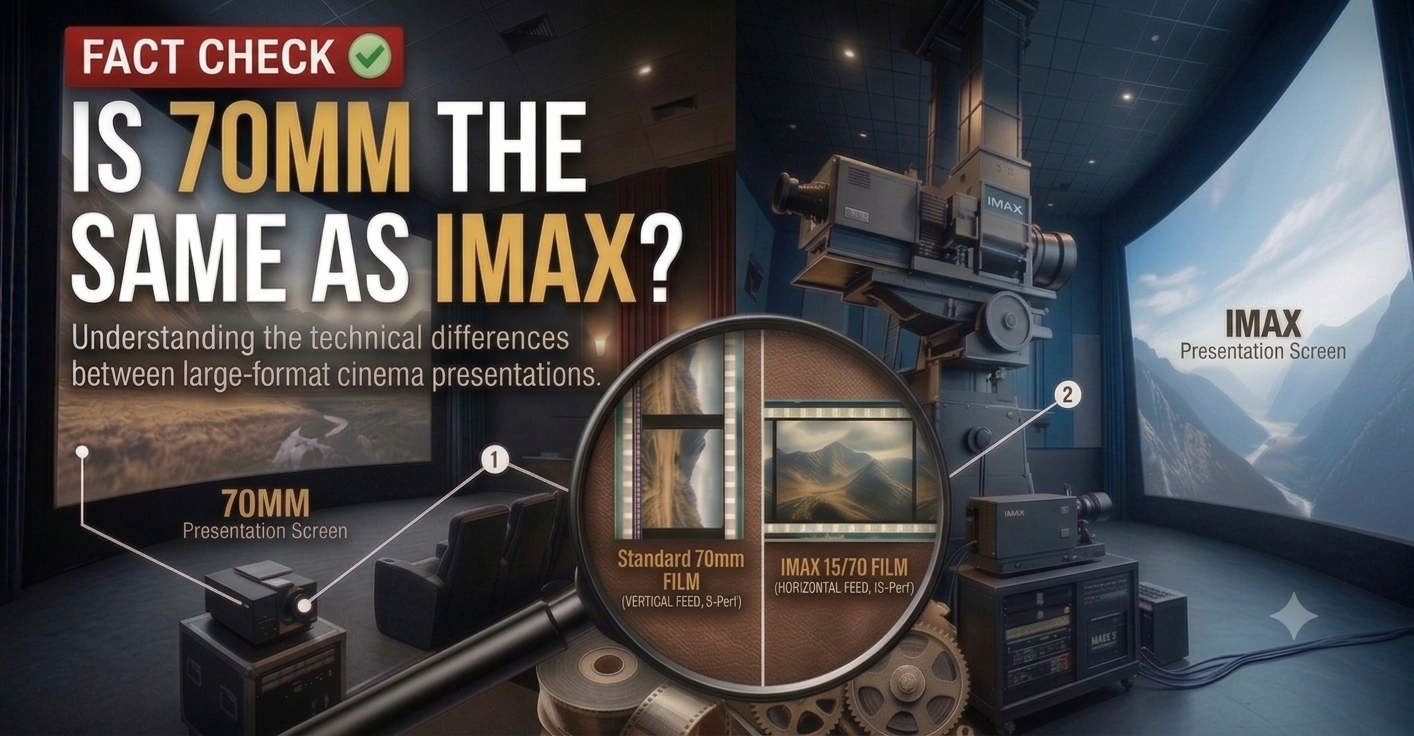
Standard 70mm: This film runs vertically through the projector and is typically five perforations (sprocket holes) tall per frame. It offers stunning resolution and a much wider, brighter picture than standard 35mm film, usually projected at a 2.20:1 aspect ratio.
IMAX 15/70mm: This is what Christopher Nolan heavily utilizes for his biggest sequences. The film is technically 70mm wide, but it runs horizontally through the projector. Each frame is a massive 15 perforations wide. This format offers a towering, immersive 1.43:1 aspect ratio and an estimated equivalent of 18K digital resolution—the highest quality image capture currently in existence.
To further complicate things, most modern IMAX theaters are completely digital (often dubbed "Lie-MAX" by cinephiles) and do not project physical 70mm film at all, utilizing dual-laser or xenon digital projectors instead.
A Brief History of 70mm and Its Meaningful Comeback
The confusion between these formats ignores a rich cinematic history. The standard 70mm format dates back to the mid-20th century, reaching its golden age in the 1950s and 60s. Epics like Lawrence of Arabia, Ben-Hur, and 2001: A Space Odyssey utilized large-format 70mm to offer audiences a spectacular, ultra-wide canvas that their new television sets at home couldn't possibly match.
By the 1990s and 2000s, the industry heavily favored the cheaper 35mm format, and eventually transitioned to digital projection, leaving 70mm nearly extinct. However, the 2010s sparked a modern resurgence. Aided by purist filmmakers like Quentin Tarantino (who revived Ultra Panavision 70 for The Hateful Eight), Paul Thomas Anderson (The Master), and Christopher Nolan, the format was saved from the brink.
Why is the comeback of 70MM cinema screens meaningful in 2026?
In an era where media is overwhelmingly compressed, streamed, and viewed on smartphones, a 70mm print represents a tactile, photochemical marvel. It treats moviegoing not as disposable content, but as an irreplaceable, premium event. Whether you are watching a standard 5-perf 70mm print or the towering 15/70 IMAX presentation of The Odyssey, you are witnessing a massive, physical strip of art running through a mechanical marvel, projecting light the way the director originally intended.
📚 Primary Verified Sources
Cinema & Technology Media (engadget.com) – Contradicts the claim, detailing the mechanical differences in projection.
Official Databases (britannica.com) – Contradicts the claim, providing historical distinction of IMAX technology.
Industry Aggregators (allinthedifference.com, oreateai.com, en.wikipedia.org, lfexaminer.com) – Contradicts the claim, confirming IMAX geometry and standard 70mm specifications.
Stay Updated
🔔 Notify me if this develops
Think this verdict is wrong?
Submit evidence and reasoning for review on the official claim page.
⚖️ Appeal verdict
💬 Discussion
Share your thoughts on this claim...
Comment