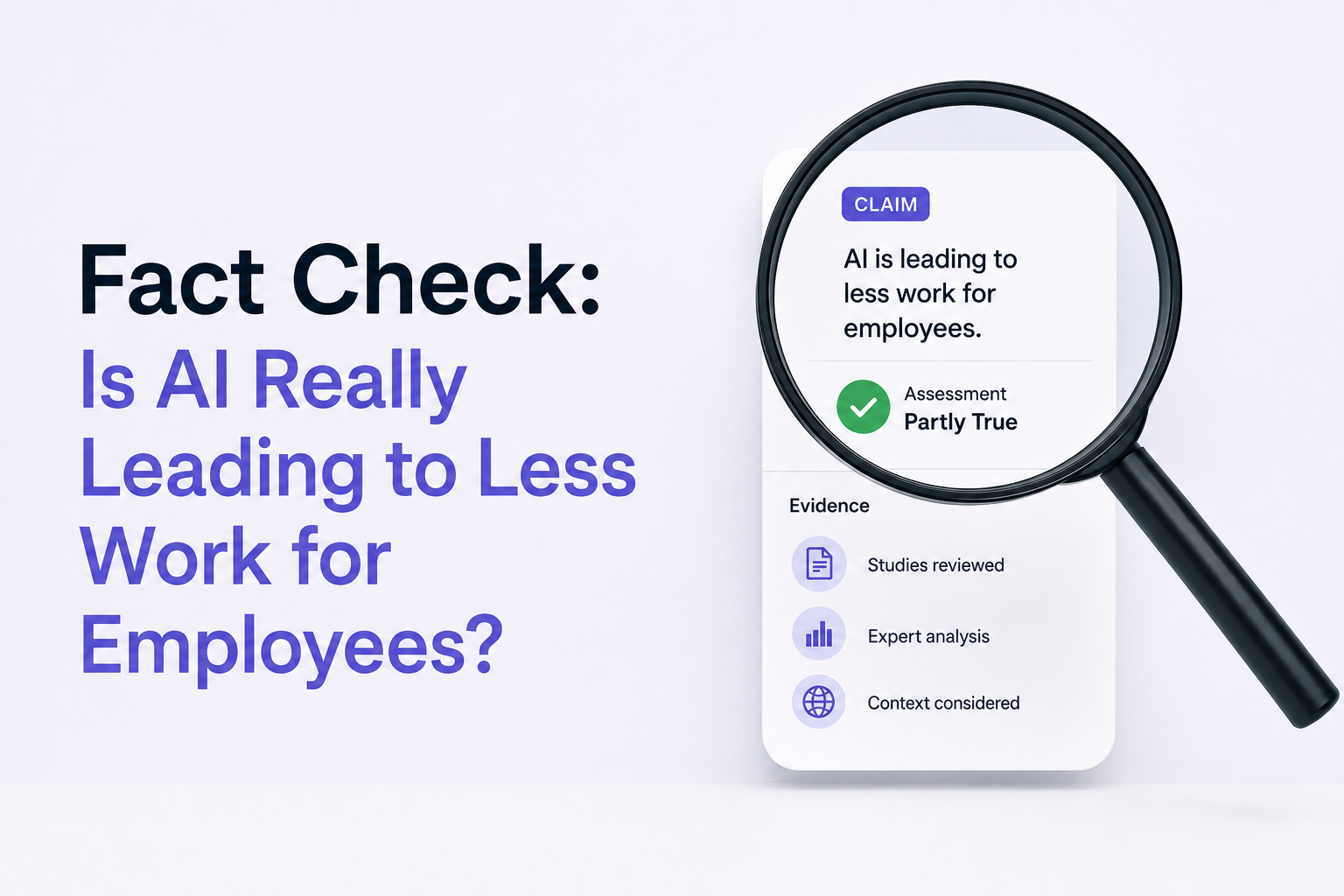
Fact Check: Is AI Really Leading to Less Work for Employees?
Credible sources genuinely disagree — both sides shown
Checked Aug 10, 2026
View the full evidence ledger →Is AI Really Leading to Less Work for Employees?
The central promise of integrating artificial intelligence into large companies and the tech sector is often framed around transformative efficiency. Tech leaders claim that AI will lead to less work, often predicting a future where autonomous software agents handle mundane tasks, freeing up human workers for more complex, creative efforts.
However, a conflicting narrative is emerging from the ground floor. Many employees in these same sectors report that AI adoption has not reduced their workload; instead, it has reconfigured or even increased productivity pressure. We investigate the competing views to determine if AI is really reducing how much employees at tech companies work or simply changing the nature of the daily grind.
Tech Leaders' Prediction: A Future of Automated Ease
The foundational argument for AI reducing work hours is rooted in automation's historical trajectory. Proponents argue that Large Language Models (LLMs) and autonomous agents will eventually take over multi-step, routine digital tasks currently performed by humans.
According to a general industry view, if AI increases productivity exponentially, human workers will need fewer hours to achieve the same or superior output. This optimization is sometimes pitched as a catalyst for new labor standards, like the "four-day workweek." Furthermore, some economic studies suggest that firms adopting AI do not necessarily need to shed workers; they can instead grow and utilize their existing workforce more efficiently through active task reallocation.
The Employees' Reality: Productivity Pressure and Layoffs
The narrative from the workforce, however, is significantly more pessimistic. Employees and labor analysts observe several trends that contradict the promise of reduced work:
The Productivity Paradox: Rather than reducing hours, AI is often used to raise the baseline for output. A recent survey by Ipsos and the Groundwork Collaborative found that two-thirds of workers believe AI adoption will make their work harder by increasing pressure and eliminating jobs, rather than freeing up time.
Reconfigured Workload, Not Less: As AI automates the simplest tasks, it leaves humans with the most complex, mentally taxing responsibilities. Furthermore, research on modern AI agents indicates they have a long way to go before operating reliably; one benchmark found that AI agents fail to produce professionally acceptable work more than 19 times out of 20, meaning human workers must intensively review, verify, and monitor the synthetic outputs.
Layoffs as "AI Efficiency": The most acute form of harm to workers is not a longer shift, but job loss. Over the past year, major tech firms like Microsoft and Amazon have laid off tens of thousands of workers, with companies like Block cutting staff heavily and directly attributing the workforce reductions to AI shifts.
The Verdict: Mixed
The current impact of AI on work hours remains heavily contested.
The assertion that AI leads to less work for employees is a future-oriented prediction strongly promoted by industry executives. However, current data from employee surveys and labor market observations confirm that the immediate impact has been mixed: some roles are optimized, but many others face increased productivity pressure, reconfigured complexity, and job displacement. Because current AI tools still require extensive human oversight to meet professional standards, the technology largely augments the workload for many rather than eliminating it.
10 sources analyzed · 3 support · 7 contradict
- 1.theregister.comcontradicts · media
- 2.cepr.orgcontradicts · media
- 3.nber.orgcontradicts · official body
- 4.newsroom.haas.berkeley.educontradicts · media
- 5.latimes.comcontradicts · media
- 6.fortune.comcontradicts · media
- 7.scientificamerican.comcontradicts · media
- 8.stlouisfed.orgsupports · official body
- 9.fortune.comsupports · media
- 10.goldmansachs.comsupports · media