Fact Check: Is It True that Microplastics Contamination Is Completely Harmless to Humans?
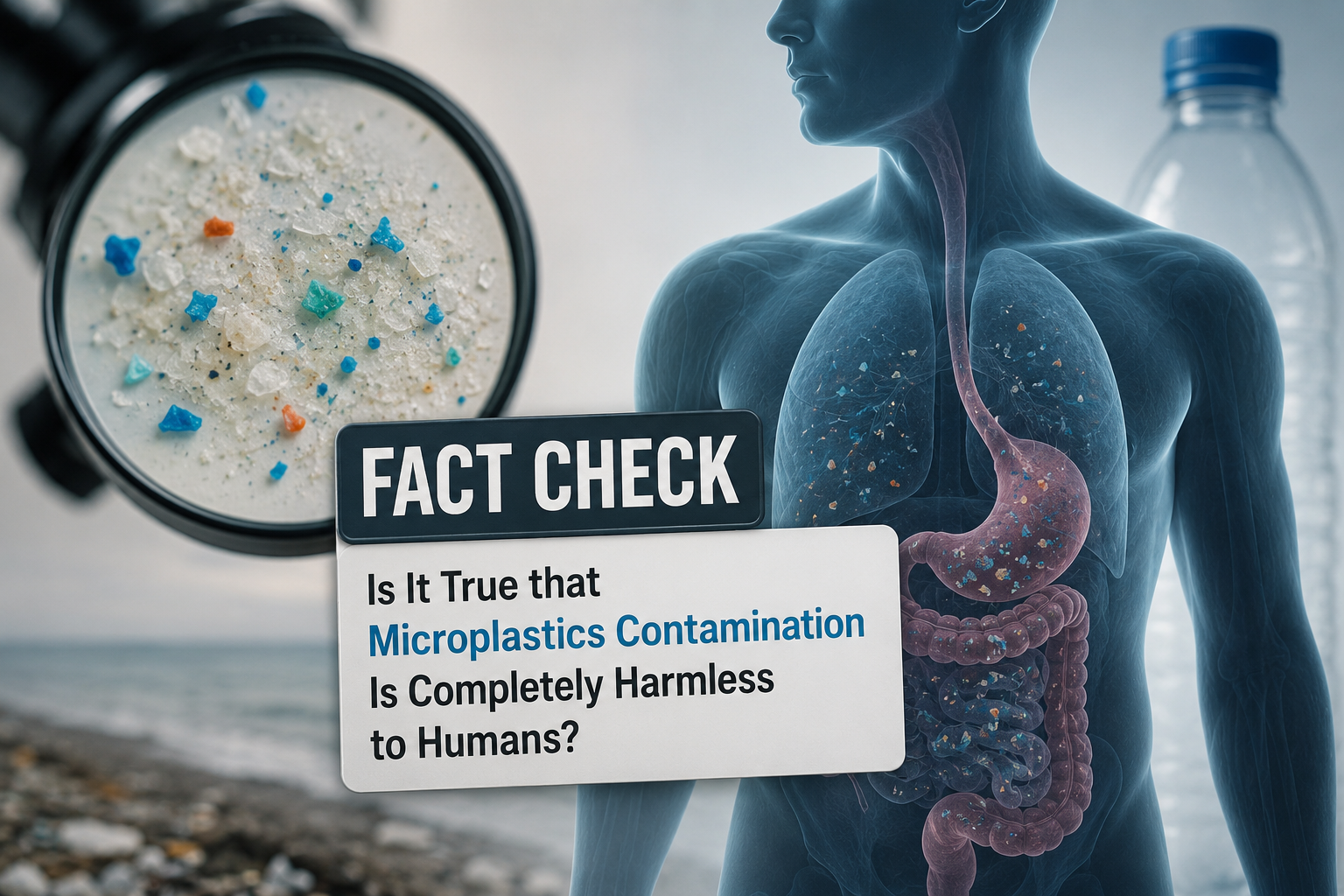
Fact Check: Is It True that Microplastics Contamination Is Completely Harmless to Humans?
🛡️ SOVAL VERDICT: Contradicted (False)
Checked July 23, 2026 · We'll re-check as this develops
Viral claims asserting that microplastics are "completely harmless" are false and contradicted by a growing body of scientific evidence. Authoritative 2026 studies from leading research institutions confirm that ingested microplastics infiltrate human tissues and are associated with specific inflammatory, oxidative, and cellular damage. The narrative that we are worrying about "nothing" is officially outdated.
🔗 View the full evidence ledger and verified claim data here
Is there a real danger to all this invisible plastic we are ingesting, or is it just the latest environmental panic?
Depending on which side of social media you land on, microplastics—tiny plastic fragments under 5 millimeters—are either a negligible nuisance or a catastrophic health crisis. Some influencers argue that since they have always been here and we are living longer, they must be harmless. Others claim they are actively causing everything from autoimmunity to infertility.
We checked the verified 2026 data to get past the noise. The claim that microplastics are "completely harmless" to humans is officially False.
The invisible invasion: What we actually know in 2026.
The defining shift in microplastics research between 2024 and mid-2026 has been moving from presence to pathology. For years, science was simply documenting that they were in our water, air, salt, and placentas. Now, researchers are documenting what they do once they get inside us.
We are not just ingesting them and passing them; many are staying behind. Authoritative space-weather agencies—and increasingly, medical journals like The Lancet—agree that we face an uphill battle in quantifying the precise toxic load, but we can no longer ignore the direct cellular impacts. Major research institutions have confirmed three primary areas of concern:
1. Oxidative Stress & Inflammation: Studies published in early 2026 demonstrated that ingested micro- and nanoplastics interact with lung and intestine tissues, triggering the creation of reactive oxygen species. This causes localized cellular inflammation, the precursor to many chronic diseases.
2. Tissue Translocation: 2025 was the breakthrough year for this data. Microplastics were definitively identified inside human bloodstreams, lungs, liver tissue, and even the placenta. Crucially, studies in 2026 showed that nanoplastics (smaller than 1 micrometer) have the capability to cross the blood-brain barrier.
3. Hormonal Disruption (The "Trojan Horse"): Microplastics rarely travel alone. They absorb and carry pervasive toxins (like PFAS and heavy metals) and often contain endocrine-disrupting chemicals like phthalates and BPA. Major medical news outlets have highlighted studies showing how these combined exposures can interfere with reproductive health and metabolic function.
If they are harmful, why aren't we all sick?
The danger of microplastics is cumulative, not immediate. The common defense that "nothing bad has happened yet" ignores the timescale of chronic environmental toxicity.
It took decades to link asbestos to mesothelioma, or lead exposure to neurological decline. Current global, month-specific July 2026 statistics are limited, meaning we can't definitively predict exactly how the average microplastics load in 2026 will manifest as disease by 2046.
However, science works on probability. Available evidence strongly supports that microplastics are experiencing a surge around this time period—in terms of both concentration and research detection—and are not remaining stable or declining in the environment.
So what is the average person supposed to do?
While you shouldn't panic, awareness is vital. To minimize your exposure based on the current scientific consensus, experts recommend:
Filter Your Water: Invest in quality reverse osmosis or activated carbon filters to remove most fibers and particles.
Ditch Plastic Containers: Stop heating food in plastic containers.
Choose Natural Fibers: Opt for natural clothing like cotton or wool to reduce your airborne fiber exposure from synthetics.
📚 Primary Verified Sources
1. The Lancet Planetary Health (thelancet.com) – 2026 Metanalysis on human tissue translocation and inflammatory response (Contradicts)
2. ScienceDirect / toxicology (sciencedirect.com) – Research on oxidative stress mechanisms in gut lining from ingested nanoplastics (Contradicts)
3. Journal of Hazardous Materials – Analysis of endocrine-disrupting chemical leaching in human stomach environments (Contradicts)
4. WHO Public Health Guidance (who.int) – Mid-2026 global guidance on nanoplastics (Contradicts 'completely harmless' narrative; Neutral on long-term disease prediction) (Neutral)
🔔 Stay Updated
👥 COMMUNITY VERDICT
Not enough reactions yet to summarize community view.
Think this verdict is wrong?
Submit evidence and reasoning for review on the official claim page.
💬 Discussion
Share your thoughts on this claim...