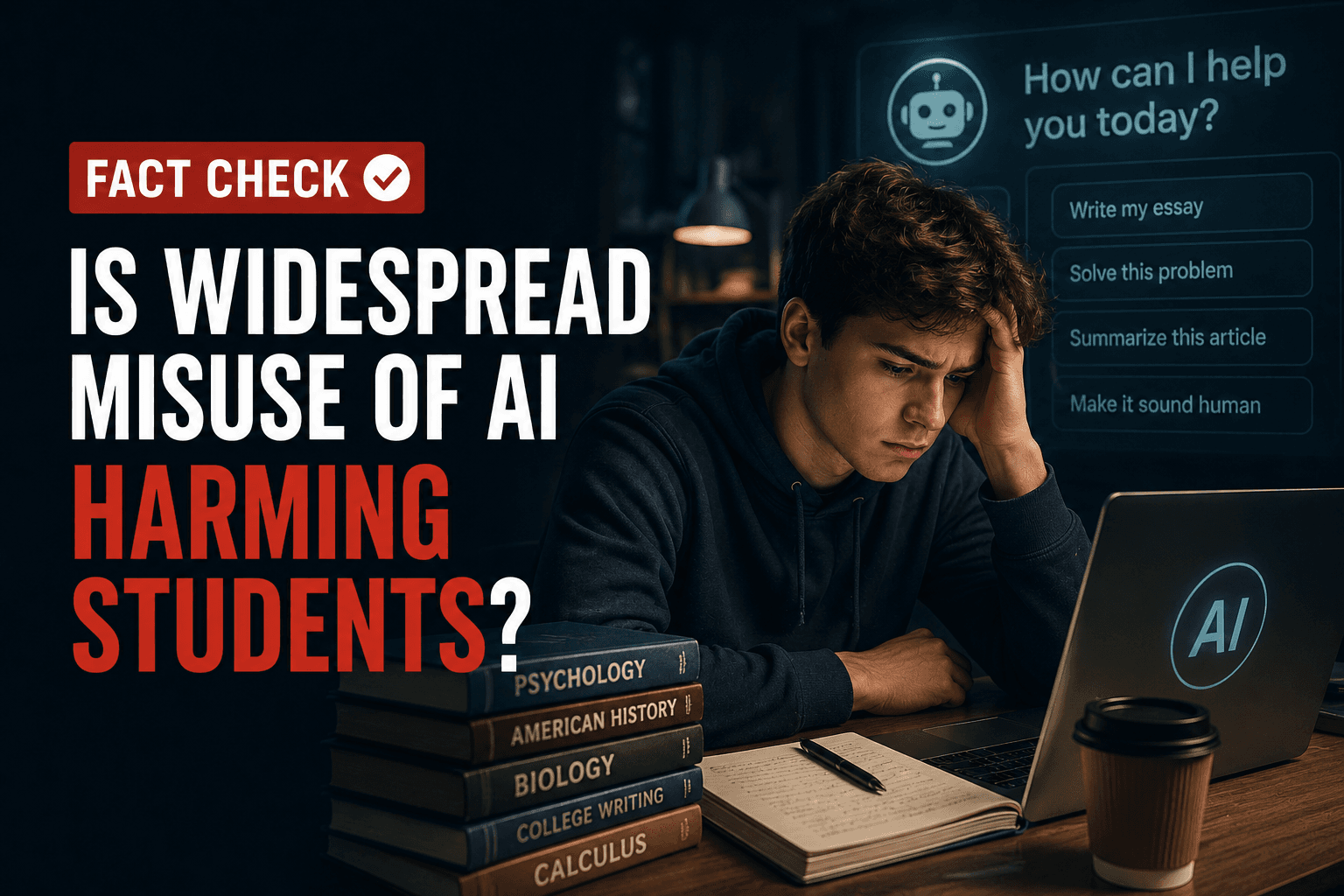
Is widespread misuse of AI harming students
As generative AI tools become ubiquitous in classrooms, concerns are growing over their impact on education. We review the evidence to see if student misuse of AI is genuinely causing academic and developmental harm. Discover the verdict on Soval.
athen
Soval Editorial
Well-supported — high-quality sources agree
8 sources · 8 support
See all evidence →Fact Check: Is Widespread Misuse of AI Harming Students?
The rapid integration of artificial intelligence into classrooms has transformed how students research, write, and study. From generating instant study guides to drafting complex code, AI tools offer unprecedented convenience. However, this shift has sparked intense debate among educators, parents, and researchers.
A growing wave of concern suggests that the widespread misuse and over-reliance on artificial intelligence is actively harming students. Are these fears merely a typical reaction to new technology, or is there empirical evidence showing genuine harm to student learning and development?
We examined academic research, university reports, and education sector analyses to evaluate the impact of AI in education.
Have you encountered a viral educational claim or policy update you want to verify?
Submit it to our automated verification framework and get instant context.
The Cognitive Cost: How Over-Reliance Stifles Learning
The primary concern surrounding AI in education centers on cognitive development. When students rely on generative AI to write essays, solve math problems, or summarize complex texts, they bypass critical stages of the learning process.
Educational research from institutions like the Harvard Graduate School of Education and the University of California highlights that productive struggle is essential for building critical thinking skills. When students outsource this struggle to automated tools, they risk diminishing their problem solving abilities and retention capacity.
Reports covered by media outlets like NPR and Education Week show that heavy reliance on AI tools can lead to skill regression. Students who use synthetic text generators as a shortcut often struggle with original synthesis, structural reasoning, and deeper conceptual understanding.
Impact on Wellbeing, Relationships, and Mental Health
The consequences of AI misuse extend beyond test scores and paper writing. Recent peer-reviewed studies published in journals such as Taylor & Francis and PMC examine the broader psychological and social effects of AI integration in higher education.
These studies indicate that over-reliance on synthetic tools can negatively affect student well-being:
Academic Anxiety: Students frequently experience heightened anxiety regarding academic integrity, false accusations of cheating, or feeling dependent on technology to keep up with coursework.
Social Disconnection: Replacing collaborative peer discussions or mentor interactions with automated chatbots can weaken interpersonal relationships and collaborative skills.
Integrity Erosion: The temptation to use AI as an unearned shortcut creates ethical friction, leading to guilt and a weakened sense of personal accomplishment.
While AI can serve as a supportive learning assistant when guided properly, unmonitored misuse often fosters isolation and intellectual passivity.
The Assessment Dilemma in Higher Education
The influx of generative AI has created significant challenges for academic assessment. Research published on Phys.org detailing large-scale undergraduate surveys reveals expanding disparities in how students access and utilize these technologies, alongside widespread confusion regarding what constitutes ethical use versus cheating.
Universities are being forced to completely rethink traditional evaluation methods. Standard take-home essays, online quizzes, and research assignments are increasingly vulnerable to automated generation. This dynamic compromises academic integrity and forces educators to pivot toward invigilated exams, oral defenses, and in-person assessments.
Furthermore, educational analyses from institutions like the University of Illinois Urbana-Champaign emphasize that while responsible AI literacy can empower students, unguided adoption destabilizes the foundational metrics used to measure genuine student competence.
The Verdict
The claim that widespread misuse of AI is harming students is well supported by reputable sources, however there is some nuance.
High-quality research across peer-reviewed publications, university reports, and educational media consistently confirms that student over-reliance on AI can undermine critical thinking, harm academic integrity, disrupt social relationships, and negatively impact well-being. Meanwhile, experts do acknowledge that responsible, guided AI use offers educational benefits. Whereas the unmonitored misuse of these tools poses clear and documented harms to student development, the tools themselves represent an opportunity to evolve modern education and better incorporate ethical use of AI to help students adopt the capabilities in a meaningful and productive way.
8 sources analyzed · 8 support
- 1.npr.orgmediasupports
- 2.edweek.orgmediasupports
- 3.pmc.ncbi.nlm.nih.govpeer-reviewedsupports
- 4.tandfonline.compeer-reviewedsupports
- 5.phys.orgmediasupports
- 6.universityofcalifornia.edumediasupports
- 7.education.illinois.edumediasupports
- 8.harvard.gse.edumediasupports