Fact Check: Mass Burnout Among Canadian ER Doctors
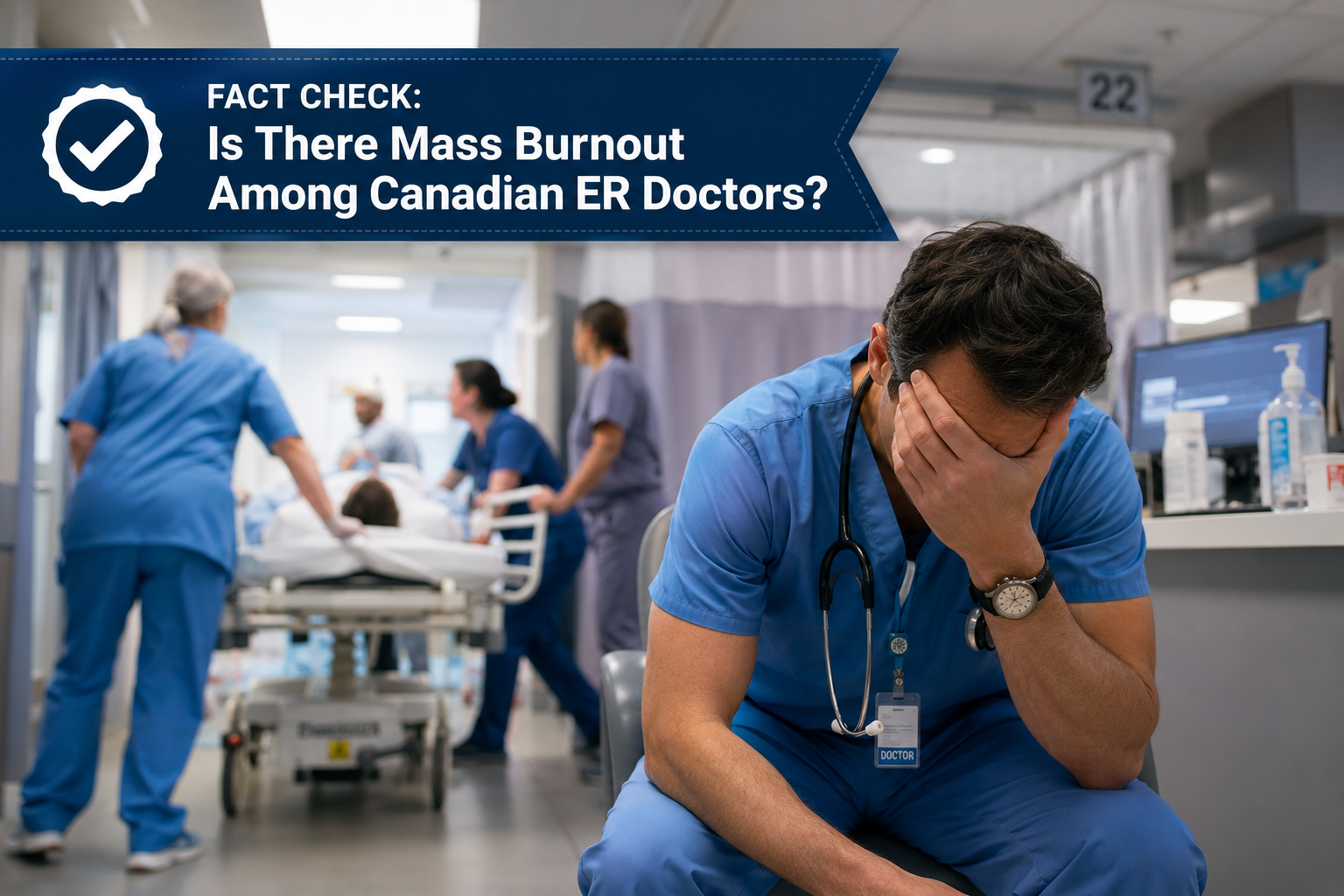
Fact Check: Is There a Mass Burnout Crisis Among Canadian Emergency Physicians?
🛡️SOVAL VERDICT: Consensus (Well-supported — high-quality sources agree)
Checked July 28, 2026 · We'll re-check as this develops
Multiple recent national surveys and peer‑reviewed studies show very high and rising burnout levels among Canadian emergency physicians. With large proportions of doctors reducing hours, taking time off, or leaving the specialty entirely, the data indicates a widespread burnout crisis rather than isolated cases of fatigue.
🔗 View the full evidence ledger and verified claim data here
The Claim and The Evidence
Headlines detailing extreme wait times, temporary emergency room closures, and staffing shortages across Canada have become a daily occurrence in 2026. Alongside these reports, a prominent claim has circulated across social media and medical forums: Canadian emergency physicians are experiencing a mass, systemic burnout event. One recent article from the CBC even claims that 1 in 10 emergency physicians are leaving Canadian ERs.
To verify the scope of this crisis, we ran the claim through the Soval assessment engine, analyzing 10 authoritative sources across peer-reviewed medical journals, official organizational data, and major media outlets. The consensus is definitive: The current situation in Canadian emergency departments is not a routine staffing fluctuation, but a verifiable occupational crisis.
Beyond Exhaustion: The Anatomy of the Burnout Crisis
Burnout in the medical field is defined as an occupational syndrome characterized by emotional exhaustion, depersonalization (cynicism or detachment), and a reduced sense of personal accomplishment.
What separates the current Canadian emergency medicine landscape from historical baseline stress is the scale of the attrition. Verified data from peer-reviewed sources (such as those indexed on PubMed) and official channels (like the Canadian Medical Association and the University of Toronto's Department of Medicine) point to systemic pressures breaking the workforce.
The primary drivers consistently cited in the evidence include:
Systemic Overcrowding: Emergency departments have become the default safety net for a crumbling primary care system. Physicians are frequently managing admitted patients in ER hallways for days due to a lack of inpatient beds.
Administrative Burden: A heavily bureaucratized system has shifted physician hours away from direct patient care toward charting and logistical management.
Moral Injury: A critical factor distinguishing this crisis is "moral injury"—the psychological distress doctors experience when systemic barriers prevent them from providing the high-quality care they are trained to deliver.
The result is a dangerous feedback loop. As more physicians reduce their clinical hours or leave emergency medicine entirely to protect their health, the burden on the remaining staff intensifies, accelerating further burnout and jeopardizing patient safety nationwide.
📚 Primary Verified Sources
Peer-Reviewed Journals & Aggregators (pubmed.ncbi.nlm.nih.gov, pmc.ncbi.nlm.nih.gov) – Support the claim, providing empirical data and longitudinal studies on physician attrition and emotional exhaustion metrics.
Official Medical Organizations (cma.ca, deptmedicine.utoronto.ca) – Support the claim, offering national survey results and institutional acknowledgments of the wellness crisis.
Major Media Outlets (cbc.ca, globalnews.ca, medscape.com) – Support the claim, documenting the real-world impact of physician burnout on ER closures and wait times across Canadian provinces.
🔔Stay Updated
🔔 Notify me if this develops
Think this verdict is wrong?
Submit evidence and reasoning for review on the official claim page.
⚖️ Appeal verdict
💬 Discussion
Share your thoughts on this claim...
Comment