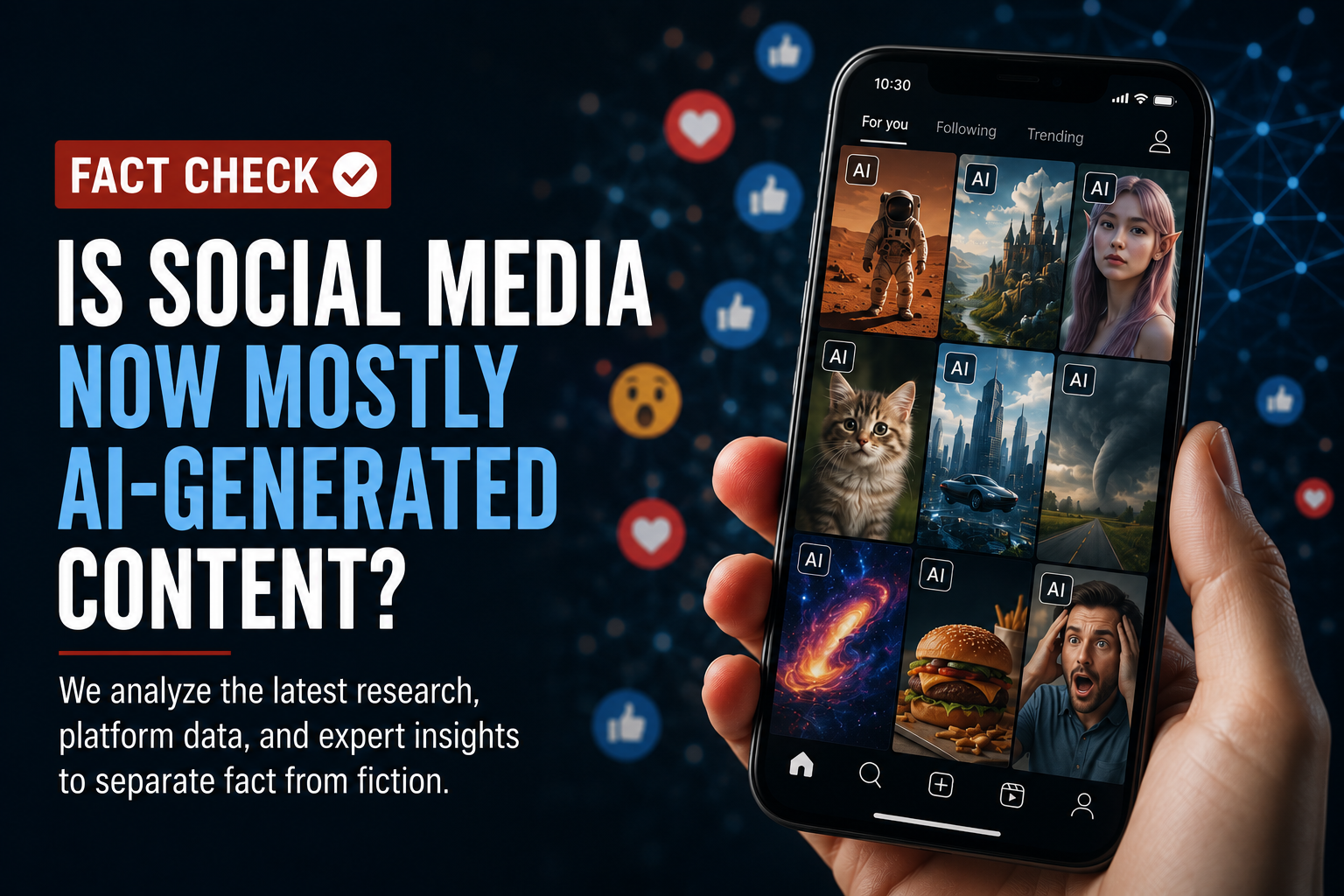
Fact Check: Is Social Media Now Mostly AI-Generated Content?
Credible sources genuinely disagree — both sides shown
Checked Jul 30, 2026
View the full evidence ledger →If you have spent any time scrolling through your feeds recently, you have likely felt a shift. Impossibly pristine travel photos, artificially polished essays, and eerily repetitive comment threads are becoming everyday encounters. This influx has revived intense interest in the Dead Internet Theory, the idea that human activity on the web has been quietly eclipsed by bots and automated language models.
This raises an essential question for digital culture. Has synthetic media officially passed the tipping point, making social media mostly AI generated?
Before accepting that human creation is a relic of the past, we need to analyze the data that separates measured reality from sensational headlines.
Are you suspicious that an article, image, or account might be a bot?
Submit it to our automated verification framework and get instant context.
The Fifty Percent Threshold: What the High Estimates Claim
The idea that artificial intelligence now dominates social media is not without backing. Several AI detection firms, industry reports, and tech publications have published startling statistics. Some estimates indicate that 52 percent to 71 percent of online content and social media images are already synthetic.
Looking ahead, a frequently cited forecast suggests that up to 90 percent of online content could be generated by AI. Proponents of these high figures point out that generative AI models have dropped the cost of producing text and images to essentially zero. Automated bots and synthetic content creators can publish continuously without sleeping, taking breaks, or experiencing creative block.
However, researchers who urge caution point out an important caveat in these eye popping numbers. Many of these studies combine general web pages with social media feeds, focus exclusively on specific formats like long form text, or rely on automated AI detectors that carry known error rates.
The Nuanced Reality: Niche Dominance Versus Overall Majority
When researchers examine broader data, including studies highlighted in peer reviewed publications such as Nature and the Harvard Kennedy School Misinformation Review, a more complex picture emerges. There is universal agreement among experts that synthetic media has achieved double digit percentages on every major social platform. AI content is unquestionably pervasive, rapidly expanding, and heavily influential.
Instead of a total takeover of all content across every platform, AI tends to dominate specific formats and visual niches:
Professional Writing: On platforms like LinkedIn, long form posts show a massive spike in AI language traits, where automated tools help write polished career updates.
Visual Communities: On platforms like Facebook, specific interest groups and image channels are flooded with synthetic images, sometimes outnumbering real photos.
Engagement Loops: Automated accounts interact with one another, creating dense pockets of synthetic engagement that algorithms amplify.
Despite this rapid growth, cautious analyses emphasize that a verifiable majority of all social media posts across every category remains human created. While synthetic media is dominating particular corners of the web, human participation continues to form the baseline of global social interaction.
Why Digital Discernment Matters More Than Ever
The ongoing debate among researchers highlights a critical truth. Whether the true figure is 40 percent or 60 percent, the volume of synthetic media has reached a level where distinguishing reality from automation requires active effort.
Algorithmic feeds are engineered to maximize engagement, and synthetic media is often tailored to trigger emotional responses. As automated tools become more sophisticated, reliance on automated detectors alone will not be enough. Navigating modern social platforms requires cross referencing sources, checking background context, and questioning viral trends before sharing them.
The Verdict
The claim that social media is now mostly AI generated remains contested. While synthetic content has reached double digit shares across all major platforms and dominates specific niches like professional writing and digital imagery, rigorous evidence does not yet prove that a clear majority of all social media posts are synthetic. However, with AI content (affectionally called “AI slop” by many) accelerating rapidly, the line between human and artificial voices online will only continue to narrow.
15 sources analyzed · 5 support · 10 neutral
- 1.sqmagazine.co.ukneutral · aggregator
- 2.aibusinessweekly.netsupports · aggregator
- 3.sqmagazine.co.uksupports · aggregator
- 4.artsmart.aisupports · aggregator
- 5.amraandelma.comsupports · aggregator
- 6.pangram.comneutral · aggregator
- 7.en.cryptonomist.chneutral · media
- 8.dailynexus.comsupports · aggregator
- 9.timesnownews.comneutral · aggregator
- 10.sgmk.edu.plneutral · aggregator
- 11.bbc.comneutral · media
- 12.pbs.orgneutral · media
- 13.nature.comneutral · peer-reviewed
- 14.misinforeview.hks.harvard.eduneutral · peer-reviewed
- 15.arkansasradio.comneutral · media