The Role of AI and Social Media in Foreign Influence Operations
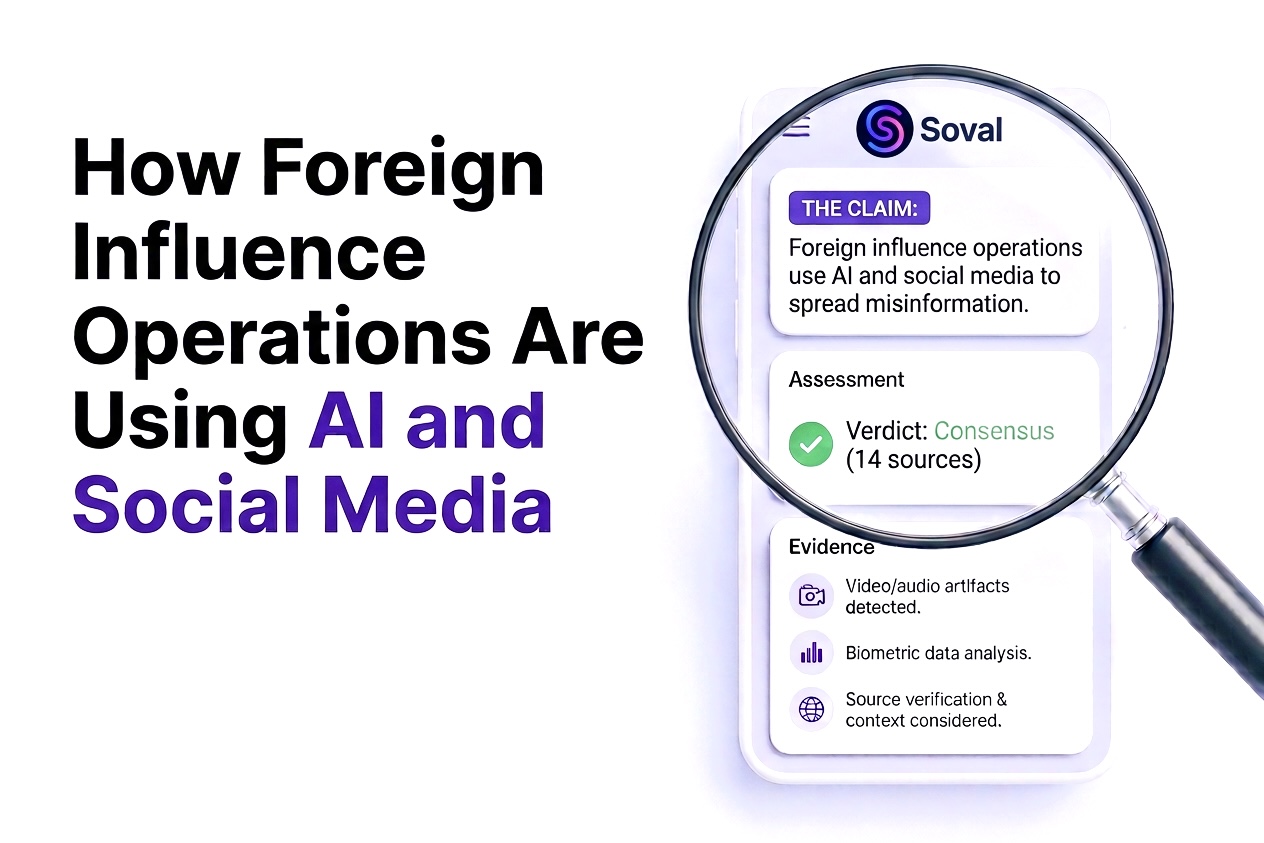
Well-supported — high-quality sources agree
Checked Aug 15, 2026
View the full evidence ledger →Foreign Influence Operations, AI, and Social Media: What the Evidence Shows
Understanding modern influence campaigns requires looking past individual viral posts to examine the broader research, technical architecture, and behavioral patterns at play. As artificial intelligence tools become more widely accessible and social media distribution continues to evolve, researchers, intelligence analysts, and open source investigators have increasingly focused on how state-aligned networks adapt to these technologies.
Rather than relying on assumptions or sensational headlines, analyzing these trends demands a careful aggregation of documented evidence across multiple independent disciplines. To help make sense of these complex shifts, Soval operates as an AI enabled platform built to combat misinformation through transparent evidence trails and community backed discussions.
As part of our ongoing research into emerging information trends, we recently evaluated the evidence surrounding the specific claim that foreign threats are using AI and social media to spread misinformation.
Are Foreign Influence Operations Using AI and Social Media to Spread Misinformation?
When evaluating this question through an empirical lens, the documented evidence points to clear consensus. Based on Soval’s fact check of foreign threats using AI and social media, our verification system reached a Consensus verdict after analyzing 14 distinct supporting sources. These sources encompass public threat intelligence assessments, academic studies, and independent cybersecurity analyses. The significance of this assessment lies not in a simple count of references, but in the methodological alignment across independent institutions investigating different facets of the problem. Cross-disciplinary research consistently documents state-sponsored actors actively integrating generative AI and social media platforms into their influence operations.
What Is a Foreign Influence Operation?
In intelligence and academic literature, a foreign influence operation refers to an organized effort by a government or its proxies to influence foreign public opinion, polarize political discourse, or alter strategic outcomes in another country. A common misconception is that these operations primarily aim to convince an entire population to believe a single fabricated story. In practice, researchers observe that campaigns more often seek to amplify existing domestic grievances, degrade institutional trust, and generate pervasive cynicism so that establishing basic factual consensus becomes difficult. The Cybersecurity and Infrastructure Security Agency explicitly warns that foreign actors frequently deploy these influence strategies to weaken public confidence in democratic processes and social cohesion.
How Is AI Changing Foreign Influence Operations?
Research across cybersecurity and machine learning organizations reveals that generative AI primarily alters the speed, economics, and scalability of online influence campaigns. Historically, producing convincing cross-cultural influence material required multilingual personnel with nuanced regional knowledge and substantial time. Today, large language models allow operators to generate contextually fluent text across dozens of languages almost instantly. Concurrently, generative image and audio tools facilitate the creation of realistic synthetic photos, altered video footage, and cloned voice notes. A detailed Microsoft Threat Intelligence report illustrates how threat networks leverage these technologies to automate localized, emotionally resonant content across multiple platforms simultaneously.
AI Does Not Have to Invent the Story to Manipulate It
One of the key findings in misinformation research is that effective manipulation rarely relies on complete fabrication. Threat actors frequently repurpose entirely genuine media presented out of context, knowing that authentic material is harder for automated systems and human reviewers to flag immediately. Examples include pairing a real photograph from an older crisis with a misleading caption about an ongoing event, or clipping a legitimate quote from a public official to reverse its original meaning. In other cases, authentic economic statistics are presented alongside deceptive interpretations designed to provoke outrage. Recognizing these nuanced distortions is central to Soval’s evidence based verification process, which assesses contextual integrity alongside factual accuracy.
How Do Foreign Influence Campaigns Use Social Media?
Social media networks provide the distribution pathways that make modern influence campaigns effective. Platform algorithms designed to maximize user engagement frequently amplify content that elicits strong emotional reactions, such as surprise, anger, or moral indignation. Influence operators study these dynamics, deploying coordinated clusters of accounts to boost specific narratives into recommendation feeds. They often construct detailed personas with AI-generated profile photos to assimilate into organic interest groups before gradually introducing polarizing content. Ongoing research from the Stanford Internet Observatory demonstrates how coordinated multi-platform campaigns bypass individual platform moderation policies, creating the impression of organic grassroots agreement around targeted themes.
Why Breaking News Creates an Opportunity for Misinformation
During crises, disasters, and breaking news events, public demand for information consistently outpaces the availability of verified facts. This period of uncertainty creates an information vacuum that influence operations can exploit. Before official updates or thorough investigations can conclude, unverified rumors, speculative claims, and manipulated media circulate widely. In Soval’s taxonomy, claims evaluated during these fast-moving phases are classified under the Emerging state within Soval’s five evidence states. This categorization signals that the factual record remains incomplete, helping observers navigate unfolding events without mistaking early speculation for established consensus.
How Can You Tell If a Social Media Narrative Is Being Manipulated?
While attributing an influence campaign to a specific foreign entity requires specialized investigative tools, analysts point to several observable behavioral patterns that indicate coordinated manipulation:
Identical or slightly varied phrasing appearing simultaneously across seemingly unrelated accounts.
Recently created profiles aggressively promoting divisive topics while displaying minimal organic personal interaction.
Previously inactive accounts, or accounts that posted about unrelated lifestyle topics, abruptly pivoting to intense geopolitical commentary.
Highly synchronized posting intervals and repetitive hashtag promotion that suggest automation or scheduled coordination.
None of these patterns alone definitively proves a foreign state operation, but they serve as clear signals that the narrative warrants deeper verification.
Does AI Generated Content Automatically Mean Something Is Misinformation?
No. The presence of synthetic or AI-generated media does not automatically make content deceptive or harmful. Artificial intelligence is widely utilized for legitimate applications, including image enhancement, translation assistance, data visualization, and creative illustration. Misinformation occurs when synthetic content is used to deceive an audience about factual reality, such as fabricating an image of a military strike or forging a voice recording to simulate a public figure making unauthorized statements. The distinguishing factors are intent, transparency, and contextual truthfulness.
How Can You Verify Information During a Misinformation Campaign?
Navigating complex information environments requires a systematic method for evaluating claims. When encountering unexpected or emotionally charged assertions online, researchers recommend following these structured steps:
1. Isolate the specific factual claim from the commentary or emotional framing around it.
2. Trace the claim back to its original source rather than relying on secondary quotes or screenshots.
3. Check the publication date and timestamp to ensure historical material is not being presented as current news.
4. Review the full context of quotes, interviews, and video clips to identify deliberate omissions.
5. Use reverse image search tools to examine visual media for earlier instances of publication.
6. Look for independent corroboration across reputable, established news and research organizations.
7. Evaluate the authority and methodology of the sources supporting the claim.
8. Check whether subject matter experts express credible disagreement with the central conclusion.
9. Determine whether the situation is actively developing and treat early assertions with appropriate caution.
10. Refrain from sharing until the available evidence provides solid support for the assertion.
For practical walkthroughs, you can review our guide on how to fact check a social media post as well as our guide on how to fact check a news article.
What Does Soval’s Fact Check Actually Show?
Soval’s assessment of foreign threats using AI and social media provides a clear case study in how to evaluate consensus through structured evidence. The Consensus verdict is supported by 14 independent sources encompassing government advisories, intelligence updates, and academic literature. The goal of this assessment is not simply to assign a final label, but to assemble an open evidence trail where readers can inspect the specific reports, methodologies, and documented findings behind the claim. By focusing on source quality and empirical corroboration, this approach illustrates how knowledge sharing can replace subjective impressions with verifiable data.
Why Evidence Matters More Than a Simple True or False
Binary true or false ratings often oversimplify the nuances of modern information ecosystems. High engagement metrics do not indicate factual accuracy, and multiple accounts repeating the same narrative often stem from a single unverified claim rather than multiple independent verifications. Similarly, identifying uncertainty during an evolving story does not mean the information is entirely false. Transparent verification requires acknowledging what the evidence supports, what remains unproven, and where legitimate disagreements exist. This perspective shapes Soval’s focus on transparent evidence trails and community backed discussions, giving readers the context needed to challenge questionable content and make informed decisions about what they share.
What Should You Do When You Encounter Suspicious Information?
When encountering viral claims or sensational narratives, the most productive first step is to pause before amplifying the content. Check whether independent researchers or fact checking organizations have evaluated the claim, and review the posting history of the account sharing it. Engaging critically with evidence before participating in online discussions helps prevent the inadvertent spread of coordinated manipulation. To explore how diverse sources and evidence trails are compiled across active topics, you can browse assessments of viral claims directly on Soval.
The Information War Is Also a Verification Problem
Foreign influence operations do not necessarily need to compromise secure computer systems to create disruption. By leveraging generative AI to craft localized narratives and utilizing social media algorithms for rapid distribution, influence campaigns exploit natural human cognitive tendencies. Addressing this challenge requires an accessible, evidence-driven approach that prioritizes transparent methodology over arbitrary conclusions. By sharing research, tracking evidence trails, and fostering informed community discussions, we can collectively build a more resilient information environment where claims can be scrutinized on their merits.
Frequently Asked Questions
How are foreign influence operations using AI?
Foreign influence operations use artificial intelligence to automate the generation of convincing text, synthetic images, voice clones, and fictitious online personas. These tools reduce production costs and allow state actors to mimic local cultural nuances at scale.
How is AI used to spread misinformation?
AI is used to manufacture realistic media depicting events that did not occur, as well as to alter the context of authentic material. Automated text generators can also produce numerous variations of a specific narrative to flood search results and social feeds simultaneously.
How do foreign actors use social media to spread disinformation?
Foreign actors exploit engagement-driven algorithms by deploying coordinated networks of automated accounts and fabricated personas. These networks amplify divisive discussions across multiple platforms, generating the perception of widespread public support for specific talking points.
How can you identify foreign disinformation?
Identifying foreign disinformation involves observing patterns such as identical talking points shared across disconnected accounts, newly created accounts focusing exclusively on polarising topics, or dormant accounts abruptly shifting to political commentary.
Does AI generated content automatically mean misinformation?
No. AI generated content is not inherently misinformation. It becomes misinformation only when it is deployed with deceptive intent to misrepresent facts or manipulate public perception of real-world events.
Can a fact checking tool detect foreign influence operations?
While no single tool can uncover entire state-backed networks on its own, evidence based fact checking neutralizes these efforts by evaluating the factual accuracy of the specific claims being promoted and mapping out the supporting evidence.
What does Soval say about foreign threats using AI and social media?
Soval evaluated the claim that foreign threats use AI and social media to spread misinformation and reached a Consensus verdict. The assessment is corroborated by 14 independent sources, including government intelligence reports, cybersecurity advisories, and academic analyses.
14 sources analyzed · 14 support
- 1.justice.govsupports · official body
- 2.nextgov.comsupports · official body
- 3.ic3.govsupports · official body
- 4.forbes.comsupports · media
- 5.theguardian.comsupports · media
- 6.bbc.comsupports · media
- 7.fdd.orgsupports · media
- 8.washingtontimes.comsupports · media
- 9.hybridcoe.fisupports · media
- 10.cset.georgetown.edusupports · media
- 11.dhs.govsupports · official body
- 12.un.orgsupports · official body
- 13.afpc.orgsupports · media
- 14.scholarship.law.unc.edusupports · peer-reviewed