Election Misinformation: How to Fact-Check Political Claims Online
Election misinformation can spread globally in seconds, often before anyone checks where a claim came from or whether the evidence supports it. With foreign interference, AI generated content and viral social posts complicating the information landscape, learn how to trace political claims, assess the evidence and quickly fact-check what you see online with Soval.
athen
Soval Editorial
Key takeaways
- Foreign interference was detected in 30% of 63 national elections studied in 2024, affecting 60% of the world’s voting population.
- Social media and fake news websites were among the most common channels for foreign election interference, according to Princeton researchers.
- Misinformation and disinformation ranked as the world’s second most important risk over the next two years, according to the WEF’s 2026 Global Risks Report.
On this page
- Election Misinformation: How to Fact-Check Political Claims Online
- Why is election misinformation so difficult to spot?
- How do you fact-check a political claim online?
- What changes when AI gets involved?
- How can you quickly fact-check something you see online?
- How to Fact-check claims without leaving the page
- What should you check before sharing an election claim?
- Election misinformation is a verification problem
Election Misinformation: How to Fact-Check Political Claims Online
Election seasons have always been fertile ground for rumors, misleading headlines and political spin. Social media has made the problem considerably harder to navigate. A claim can move from an obscure account to thousands of people in minutes, often before anyone has established where it came from or whether the underlying evidence supports it.
And 2026 is no exception. Elections and political campaigns are taking place across countries and regions around the world, while AI makes it easier to create convincing text, images, audio and video at a scale that was previously difficult to achieve.
The World Economic Forum’s Global Risks Report 2026 ranks misinformation and disinformation as the second most important risk over the next two years, based on its survey of more than 1,300 experts. The report also notes that distinguishing authentic from synthetic information online is becoming increasingly difficult.
The challenge for voters is not simply avoiding obviously fake stories. It is figuring out which parts of an online claim are supported by evidence, which are missing context, and which may have originated somewhere very different from where they appear today.
Why is election misinformation so difficult to spot?
Political misinformation rarely arrives with a convenient warning label.
A genuine photograph can be paired with a false caption. An authentic quote can be clipped from a longer interview. An old news story can suddenly resurface as if it happened yesterday. A legitimate statistic can be presented without the context needed to understand it. And an unfamiliar website can repeat a claim that originated on social media until the repetition itself makes it appear credible.
Foreign influence campaigns can make this even harder to identify.
A 2026 study from Princeton University examining all 63 national-level executive and legislative elections held during the 2024 global “year of elections” found clear evidence of foreign interference in 30% of those elections, affecting countries representing approximately 60% of the world’s voting population. Researchers found that social media and fake news websites were among the most common channels used.
That does not mean that every suspicious political post is part of a foreign operation. It does mean that the information surrounding elections deserves scrutiny, particularly when a claim is spreading rapidly without a clear original source.
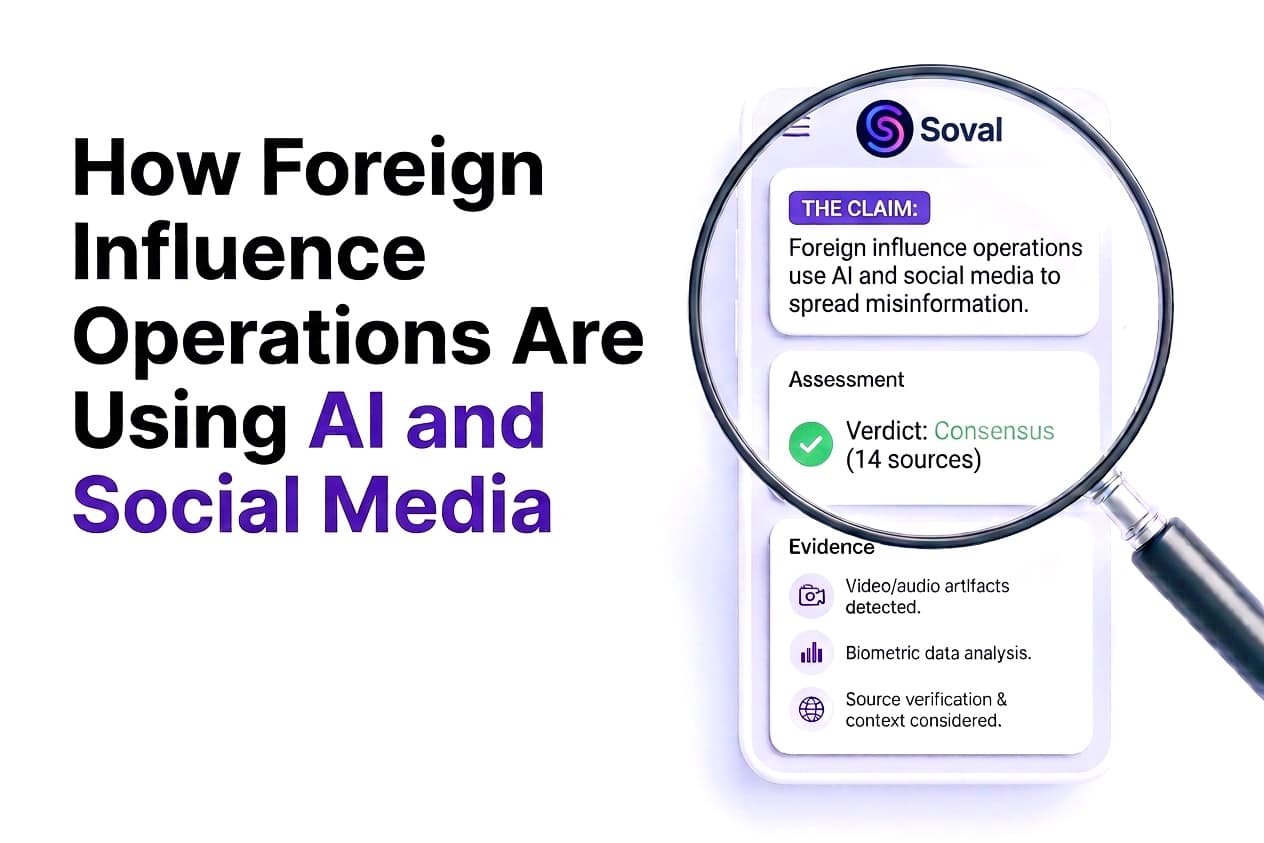
Soval previously examined this broader phenomenon in its assessment of how foreign influence operations use AI and social media to spread misinformation, which brought together evidence from government agencies, cybersecurity researchers, academic institutions and other sources.
How do you fact-check a political claim online?
The first step is to separate the claim itself from the commentary surrounding it.
Instead of asking whether an entire post “looks true,” isolate the factual statement that can actually be tested. Then trace it back to its source.
Who originally made the claim? Is the post quoting an article, or is the article quoting another account? Does the supposed source actually say what the post claims it says? When was the information published? Are other independent sources reporting the same thing?
This matters because a dozen websites repeating the same claim do not necessarily represent a dozen independent sources. They may all be repeating one original article, social post or anonymous allegation.
That is the basic principle behind evidence-based fact checking: identify the claim, find relevant evidence, evaluate the quality of the sources, compare evidence that supports and contradicts it, and communicate what the evidence actually establishes.
For a more practical walkthrough, Soval’s guide on how to fact-check a news article before sharing it covers the same process in a step-by-step format.
What changes when AI gets involved?
AI does not automatically make political content false. It does, however, make the verification problem more complicated. A campaign can use generative AI to produce convincing images, videos, audio clips or written narratives. The same technology can also be used to translate and adapt a message for different audiences, making a coordinated campaign appear more organic.
The more important question is therefore not simply, “Was AI used?” It is: What is the evidence for the claim, where did the claim originate, and does the available evidence support what is being presented?
That distinction is increasingly important because some of the most effective misinformation does not require fabricating an entire event. Real material can be manipulated through misleading captions, selective editing, missing context or inaccurate interpretations.
How can you quickly fact-check something you see online?
This is where having a verification tool available while browsing can make a practical difference.
Instead of copying a suspicious claim, opening several tabs, searching for the original story and trying to piece together conflicting reports yourself, you can use Soval to investigate the claim directly.
Soval allows you to submit a claim, article, URL, social media post or image and investigate the evidence surrounding it. The assessment is designed to show where the information comes from, which sources support or contradict the claim, and where meaningful uncertainty remains.
Rather than reducing every investigation to a simple “true” or “false,” Soval uses five Evidence States: Consensus, Debunked, Contested, Emerging and Insufficient Evidence. That distinction matters during elections, when a story can develop faster than reliable evidence becomes available.
Soval’s evidence-based fact-checking approach explains why the evidence trail matters just as much as the eventual assessment.
How to Fact-check claims without leaving the page
Soval’s new Chrome extension makes that process even faster.
When you encounter a political claim, unfamiliar news site, suspicious headline or viral post while browsing, the extension lets you quickly send it to Soval for verification rather than manually copying and pasting the information into another tool.
The goal is simple: fact checking should happen where you encounter information, not ten minutes later when you’ve forgotten where the claim came from.
That is particularly useful during elections, when social feeds, news sites and messaging platforms can become a constant stream of breaking claims. The extension puts Soval’s claim verification workflow closer to the moment when you actually need it.
What should you check before sharing an election claim?
You do not need to become an investigative journalist every time a political post appears in your feed. But a few basic checks can dramatically improve the quality of the information you consume and share.
Look at the original source rather than relying on a screenshot. Check the date. Read beyond the headline. Separate factual assertions from political commentary. Look for independent reporting. Pay attention to whether credible sources disagree. And if the story is developing, be comfortable with the possibility that the evidence simply is not settled yet.
That last point is important. Good fact checking is not about manufacturing certainty.
Sometimes the responsible conclusion is that a claim is well supported. Sometimes the evidence clearly contradicts it. Sometimes credible sources genuinely disagree. And sometimes there simply is not enough reliable information to know yet.
A useful fact-checking tool should make those distinctions visible rather than hiding them behind a confidence score.
Election misinformation is a verification problem
The internet has made it easier than ever to find political information. It has also made it much harder to understand where that information came from.
During election periods, the pressure to react quickly only increases. A dramatic headline gets shared before anyone reads the article. A video gets reposted before its original context is established. An unfamiliar website suddenly appears authoritative because thousands of people are discussing it.
The answer is not to assume that everything online is false, nor to blindly trust the first source that confirms what we already believe.
It is to make verification easier.
That is what Soval is designed to do: give people a faster way to investigate the claims they encounter online, understand where those claims originate, see the evidence supporting or contradicting them, and recognize when the available information is still uncertain.
For a deeper look at how Soval works, Meet Soval: A New Way to Fact Check Anything With the Evidence to Back It Up explains the platform’s evidence trail, assessments and community context.
And when the next election headline makes you stop and think, you do not have to decide whether to believe it based on the headline alone.