The Future of Fact Checking: Why Transparency Matters More Than AI Alone
As AI-generated content and viral misinformation become harder to distinguish from reality, traditional fact checking is no longer enough. Discover why the future of online trust depends on transparent evidence, multiple sources and human judgment, and how a new generation of verification tools is helping people make more informed decisions before they share.
athen
Soval Editorial
The Future of Fact Checking: Why Transparency Matters More Than AI Alone
For years, the advice for navigating misinformation has been simple: fact check before you share.
It is still good advice. The problem is that the internet has changed.
A decade ago, misinformation was often limited to fabricated news articles or misleading headlines. Today, false or misleading information can appear as AI-generated images, synthetic videos, edited screenshots, out-of-context statistics and convincing social media posts that spread around the world in minutes. At the same time, generative AI has made it easier than ever to produce content that looks credible, regardless of whether it is accurate.
As the volume of information continues to grow, one challenge stands above all the others.
People no longer struggle to find information. They struggle to know what they can trust.
That shift is changing the role of fact checking. The future is not about producing faster verdicts. It is about making verification more transparent, more collaborative and easier for everyone to understand.
The Internet Has a Trust Problem, Not an Information Problem
Search engines, social media platforms and AI assistants have made information instantly accessible. Within seconds, we can ask complex questions and receive detailed answers from multiple sources.
Yet confidence in online information continues to decline.
Part of the problem is the sheer speed at which information moves. Breaking stories evolve throughout the day, early reports are often incomplete and social media rewards engagement long before accuracy has been established.
The result is an online environment where people are exposed to more information than ever but have fewer signals to help them judge whether it is reliable.
That is why trust has become one of the most valuable resources on the internet.
Traditional Fact Checking Still Matters
Professional fact checking has never been more important.
Journalists, researchers and independent organizations play a critical role in investigating public claims, reviewing evidence and correcting misinformation. Their work provides an essential foundation for informed public discussion.
However, traditional fact checking was designed for a slower news cycle.
Today, viral trends can reach millions of people before a detailed investigation is published. AI-generated content can appear overnight, and developing stories often change as new evidence emerges.
The answer is not to replace traditional fact checking. It is to make verification faster, more transparent and accessible to everyone.
The Next Generation of Fact Checking Is Built Around Evidence
Many people expect a fact check to deliver a simple conclusion.
True.
False.
Misleading.
In reality, the strongest verification process asks a different question. What evidence supports this claim, and how confident should we be in the conclusion? That distinction matters because context changes everything.
A statistic may be accurate while being presented in a misleading way. A photograph may be genuine but shared years after it was taken. A breaking news story may be correct based on the information available at the time, only to change as more evidence becomes available.
Rather than hiding that complexity, modern verification should help people understand it.
The goal is not to replace critical thinking. It is to support it.
Why AI Is Both the Challenge and the Opportunity
Artificial intelligence has fundamentally changed how information is created and consumed.
Anyone can now generate realistic images, persuasive articles and convincing videos in minutes. This has lowered the cost of creating misinformation while increasing the difficulty of identifying it.
The same technology, however, can also help people investigate claims far more efficiently than manual research alone.
AI can compare reporting across multiple publications, identify conflicting information, surface original sources and summarize large volumes of evidence in seconds.
That capability is incredibly valuable, but only if users can understand how the conclusion was reached. An answer without evidence is simply another opinion. Transparency is what transforms AI from a black box into a useful research assistant.
Why Soval Takes a Different Approach
At Soval, we believe people should never have to choose between speed and transparency.
Our approach is built around a simple principle: show the evidence, not just the answer.
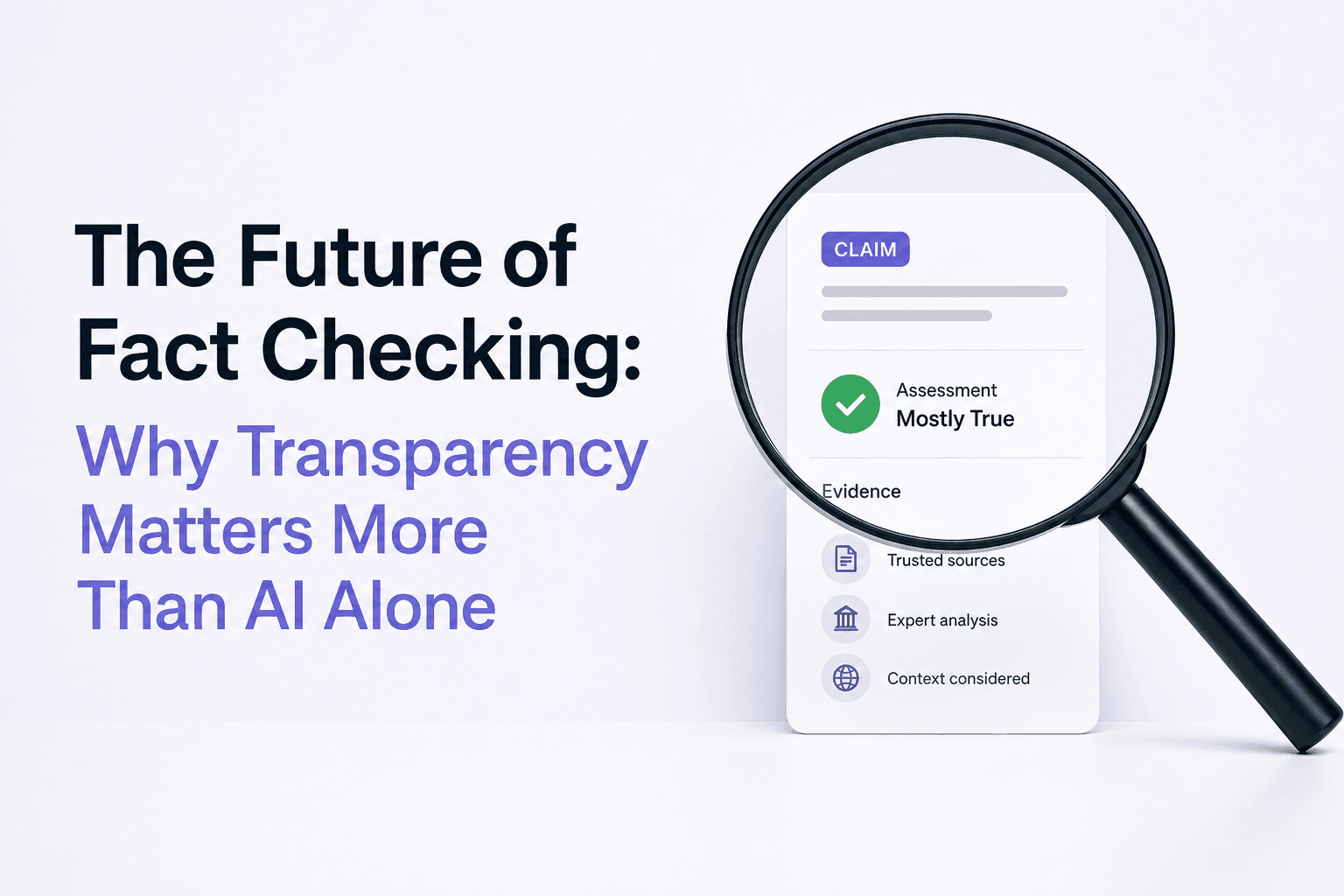
Rather than relying on a single AI model or presenting a one-word verdict, Soval evaluates claims using multiple AI systems alongside trusted sources and supporting references. Every assessment includes an evidence trail that explains how the conclusion was reached and highlights where uncertainty still exists.
This allows users to review the information for themselves instead of placing blind trust in another algorithm.
We also believe verification should be collaborative. As new information becomes available, additional context can be incorporated so assessments evolve alongside the evidence.
In an internet where information changes constantly, transparency is more valuable than certainty.
What This Means for the Future of Online Trust
The internet does not need more opinions.
It needs better ways to evaluate information.
The platforms that earn trust over the next decade will not be the ones that simply provide the fastest answers. They will be the ones that make evidence easier to understand, explain uncertainty honestly and give people the confidence to reach informed conclusions.
That is where fact checking is heading.
Not toward replacing human judgement with artificial intelligence, but toward combining the speed of AI with transparent evidence and informed human decision-making.
Continue Exploring
If you want to strengthen your ability to evaluate information online, these resources are a great place to start.
If you are looking for a practical framework, read our guide on How to Fact Check a News Article, where we walk through the steps professionals use to verify breaking stories before sharing them.
If you are comparing platforms, explore our roundup of Free Fact Checking Tools to see how different approaches to verification compare and what features matter most.
To see transparent assessments of current stories, visit our , where developing claims are reviewed alongside supporting evidence.
You can also follow our Viral Trends section to stay ahead of emerging stories and understand which online conversations are gaining traction before misinformation spreads further.
Looking Ahead
Fact checking is not disappearing. It is evolving.
As AI continues to reshape how information is created and shared, trust will depend less on who makes a claim and more on whether the evidence behind that claim is transparent, current and open to scrutiny.