How to Fact Check a News Article Before Sharing It
How to Fact Check a News Article Before Sharing It
Before sharing a news article, it's worth asking one simple question: How do I know this is true?
The internet has made it easier than ever to access information, but it has also made it easier for inaccurate, misleading, or incomplete stories to spread. A headline can go viral within minutes. A misleading screenshot can reach thousands of people before anyone checks the original source. A story can be technically accurate while leaving out important context.
Have a suspicious news story or claim you want to verify right now?
Drop the link or text into our automated verification framework and get instant context.
👉 Fact-Check a Claim on Soval Social
The good news is that anyone can learn how to evaluate media critically.
Quick Answer: How to Fact-Check a News Article
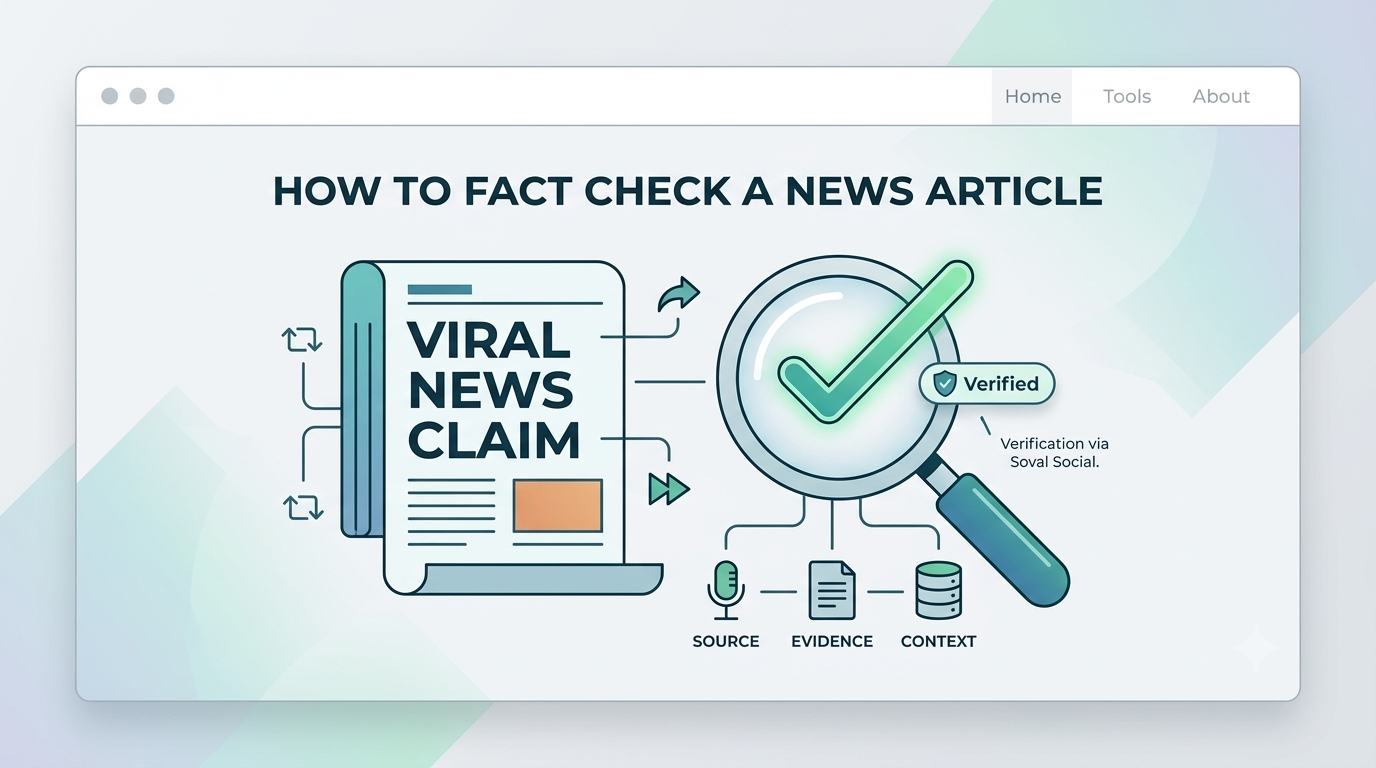
Trace the source: Find the original document, data, or named expert.
Read beyond the headline: Ensure the body text actually supports the bold claim.
Compare coverage: Check if multiple reputable outlets are reporting the same facts.
Use an automated tool: Run the claim through a verification engine like Soval Social to review context and sources instantly.
A good fact-check is not just about finding out whether something is “true” or “false.” It is about understanding where the information came from, what evidence supports it, and what context might be missing.
If you want to investigate a story, start with these five steps.
Find and Verify the Primary Source of the News Claim
The first question to ask is: Where did this information come from? Reliable articles usually identify their sources clearly. Look for original documents, research studies, official statements, named experts, direct interviews, or verified data sources.
Be cautious with articles that make strong claims but provide no evidence. A screenshot, a repost, or a social media caption is not the same as an original primary source.Spot Misleading Headlines by Checking Context
One of the most common ways misinformation spreads is through headlines that create a stronger impression than the actual article supports. A headline can be technically accurate while still being highly misleading.
Before sharing, always read the full article. Check the publication date to ensure old news isn't being recycled as a current event, look for important qualifying details, and ensure you understand the broader context of the quote or statistic.Compare Coverage Across Multiple Reputable Sources
Important stories are usually covered by more than one reputable source. Compare how different outlets describe the event, whether they cite the exact same evidence, and whether there are disagreements about the core facts.
If a major, world-changing event is only appearing on one fringe website or a single unverified social account, it is worth investigating further before you hit share.Use an Automated Fact-Checking Tool for Real-Time Verification
Searching manually across the web can take hours. A dedicated fact-checking tool can help you quickly evaluate suspicious claims, articles, screenshots, and online posts.
Soval Social provides a free automated verification framework that helps users analyze information by reviewing available sources, evidence, and context. Instead of waiting for a professional journalist to debunk a viral story, you can investigate information as you encounter it.Don't wait for the truth to catch up to a viral rumor.
Submit a URL or Claim for Verification HereUnderstand What Is Confirmed and What Is Still Unknown
Not every developing story has a simple answer. Sometimes the most accurate conclusion is that the story is still Unverified or Missing Context.
Trustworthy information tools should help users understand uncertainty rather than pretending every issue is immediately clear. When evaluating a breaking story, get comfortable categorizing claims as Confirmed, Likely, Unverified, Missing Context, or Misleading.
Why Fact Checking Matters More Than Ever
The amount of information online continues to grow exponentially. Between social media algorithms, AI-generated content, and rapidly changing real-time news streams, people are exposed to more unverified claims than ever before.
The challenge is no longer finding information; the challenge is knowing which information deserves your attention. That is why Soval Social combines free fact checking with a broader experience designed to help users discover verified trending news, explore sources, and understand the real conversations happening around important stories.
Don't let misleading headlines dictate your news feed. Start verifying the media you consume today.
Ready to test it out?
Submit your first news article or claim to Soval Social for free and see the context you've been missing.
Frequently Asked Questions (FAQ)
How can I fact check a news article for free?
You can fact check a news article by tracing the original source, checking the supporting evidence, comparing coverage across reputable outlets, and using free verification tools like Soval Social to instantly analyze the claim.What is the best free fact-checking tool?
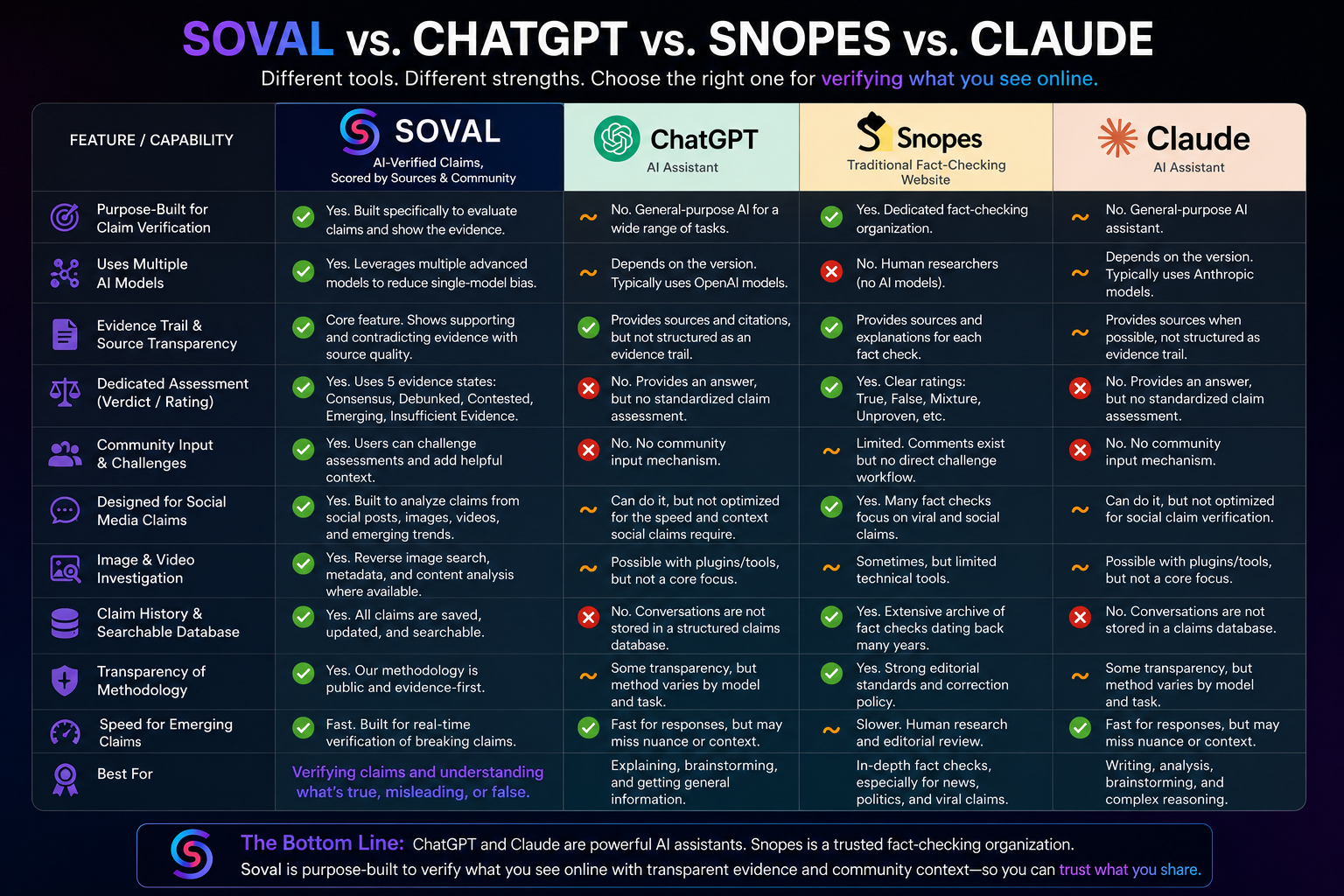
The best free fact-checking tools include Soval Social, Reuters Fact Check, and Snopes. While traditional organizations are excellent for reading deep, published investigations, Soval Social provides an interactive tool for users who want to quickly evaluate live claims and URLs while staying connected to verified news.How do I know if a news article is fake?
Look for missing primary sources, highly exaggerated or emotional headlines, a lack of verifiable evidence, and bold claims that cannot be confirmed by any other reputable news outlet.