Comparing Fact Checking Tools: Soval vs ChatGPT vs Snopes
Soval Social vs. ChatGPT vs. Snopes: Which Fact-Checking Tool Should You Use?
When a questionable headline, viral screenshot, or contested claim appears in your feed, figuring out where to turn for the truth is the first hurdle. The internet is no longer struggling with a lack of information; it is struggling with a lack of trustworthy context.
Today, users generally turn to three distinct types of tools to verify claims: traditional editorial fact-checkers (like Snopes), general artificial intelligence (like ChatGPT), and dedicated claim verification platforms (like Soval Social).
While they all aim to answer the question "Is this true?", they operate using fundamentally different models. In this comparison, we break down how Snopes, ChatGPT, and Soval Social work, where they excel, and which tool you should use based on the specific claim you need to verify.
Quick Answer: Which Tool Should You Use?
Use Snopes or FactCheck.org when you are researching a long-standing rumor, a major political speech, or an established internet hoax that requires a deep, human-led investigative article.
Use ChatGPT or Claude when you need to summarize a lengthy document, explain complex jargon, or brainstorm the historical context behind a news event—but be prepared to verify its citations.
Use Soval Social when you need instant, real-time evidence for a specific claim, viral URL, or social media screenshot. It is best for seeing exactly where credible sources agree or disagree without waiting for an editorial publication to write an article.
The Three Approaches to Online Fact-Checking
To understand which tool is best for the job, you must understand what each platform is fundamentally designed to do.
1. Snopes: The Editorial Fact-Checker
Snopes, FactCheck.org, and PolitiFact are traditional editorial publications. They rely on human journalists to research claims, interview experts, and write detailed articles explaining why a claim is true, false, or misleading.
The Strength: Unmatched editorial depth. When a human journalist investigates a major political claim, they provide critical nuance, historical context, and expert interpretation.
The Limitation: A bottleneck of speed and scale. The internet produces millions of viral claims daily. A new screenshot on X or a viral video on TikTok can reach millions before a journalist even logs on. If an editor hasn't written an article about your specific claim, searching these platforms will yield zero results.
2. ChatGPT and Claude: The General AI Assistants
Generative AI models process massive amounts of text to predict and generate conversational answers to user prompts. They are the ultimate summarization engines.
The Strength: They are incredibly fast, highly conversational, and capable of synthesizing information from across the web (if connected to search). They are excellent for asking broad questions like, "Explain the history of the European Union's water regulations."
The Limitation: They are designed to sound convincing, not to verify truth. General AI is susceptible to "hallucinations"—inventing sources or stating falsehoods with absolute confidence. Furthermore, they often fail to transparently link the primary evidence that supports their answers, functioning as a "black box" of information.
3. Soval Social: The Dedicated Claim Verification Platform
As detailed in our platform launch announcement, Soval Social bridges the gap between AI speed and editorial transparency. It is not an editorial publication, nor is it a conversational chatbot. It is an evidence-mapping engine.
The Strength: You submit the exact information you want to investigate—a text claim, a URL, or an image. The platform instantly researches the claim against the web and provides an assessment linked directly to primary sources. Instead of relying on a black-box AI answer, you see exactly what the evidence says.
The Limitation: It is built strictly for claim verification and evidence gathering. It will not write code, draft emails, or generate creative stories like ChatGPT.
Soval Social vs. Snopes: What is the Difference?
The difference between Soval Social and Snopes is the difference between a tool and a publication.
When you search Snopes, you are searching a library of pre-written articles. If the rumor is well-known, you will likely find a fantastic, thoroughly researched answer.
Soval Social operates dynamically. If a family member texts you a suspicious screenshot, you cannot upload that image to Snopes for an instant answer. With Soval Social, you can upload the image directly to the platform (see how the input process works) to instantly trace its origins and see if authoritative sources have already debunked it. Soval complements traditional fact-checkers by scaling verification to the individual user level in real-time.
Soval Social vs. ChatGPT: Why General AI Falls Short on Evidence
The biggest risk in using ChatGPT for fact-checking is that it often forces complex reality into a simple, confident answer—even when the underlying evidence is weak or contested. This is especially dangerous when dealing with sophisticated misinformation, such as investigating whether AI-generated political influencers are manipulating public opinion. You cannot verify AI manipulation using a system that hides its own sources.
Soval Social was built to solve this exact problem by making the evidence visible. Rather than forcing every claim into a binary true/false response, Soval categorizes claims into one of Five Evidence States:
1. Consensus: Credible sources broadly agree.
2. Debunked: Strong evidence contradicts the claim.
3. Contested: Credible sources genuinely disagree.
4. Emerging: The story is developing; evidence is not yet settled.
5. Insufficient Evidence: The data is too weak to reach a conclusion.
If two highly credible news agencies are reporting conflicting data on a breaking story, ChatGPT might average them out or pick one at random to generate a smooth answer. Soval Social will label the claim as Contested or Emerging and place both sources side-by-side so you can evaluate the disagreement yourself.
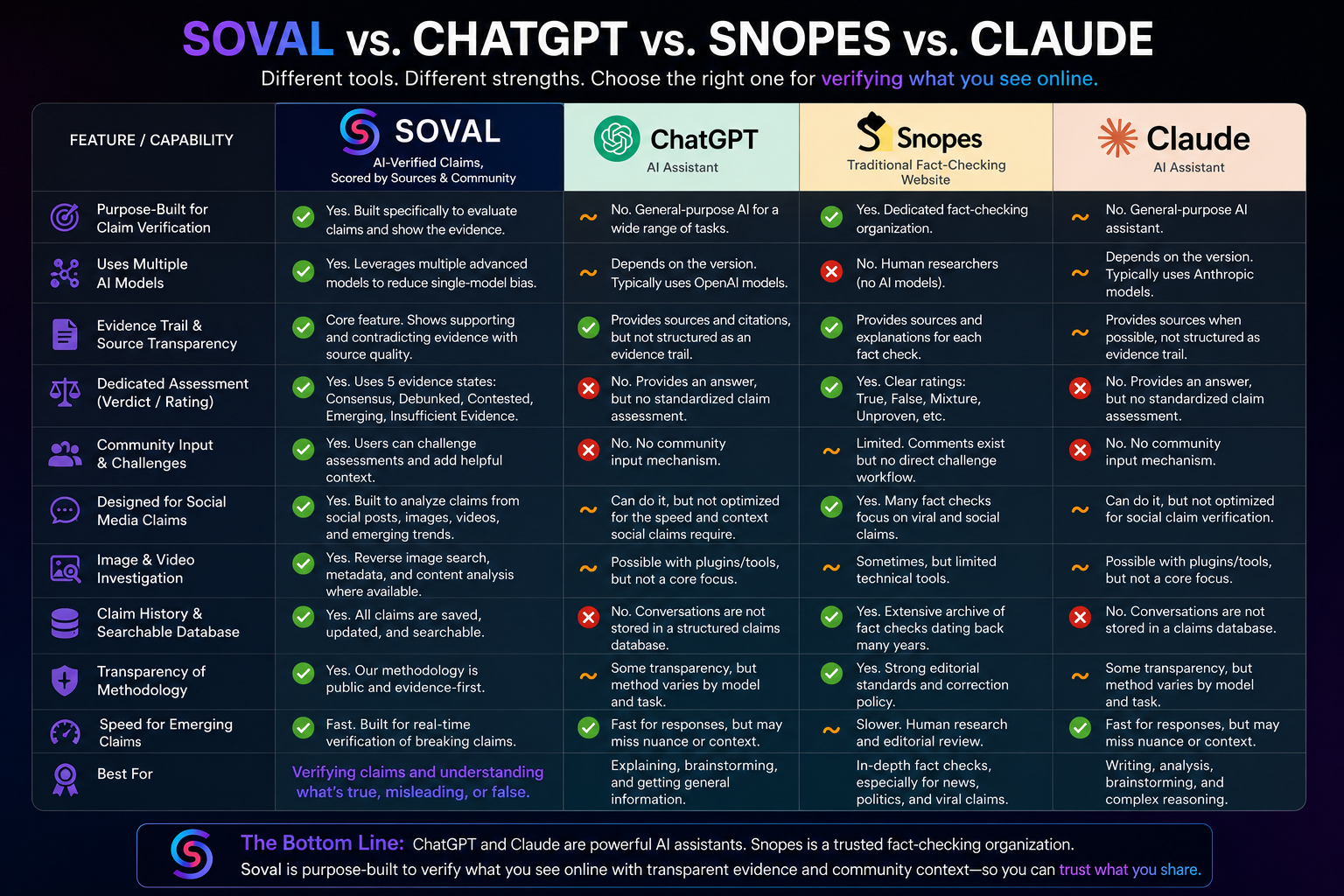
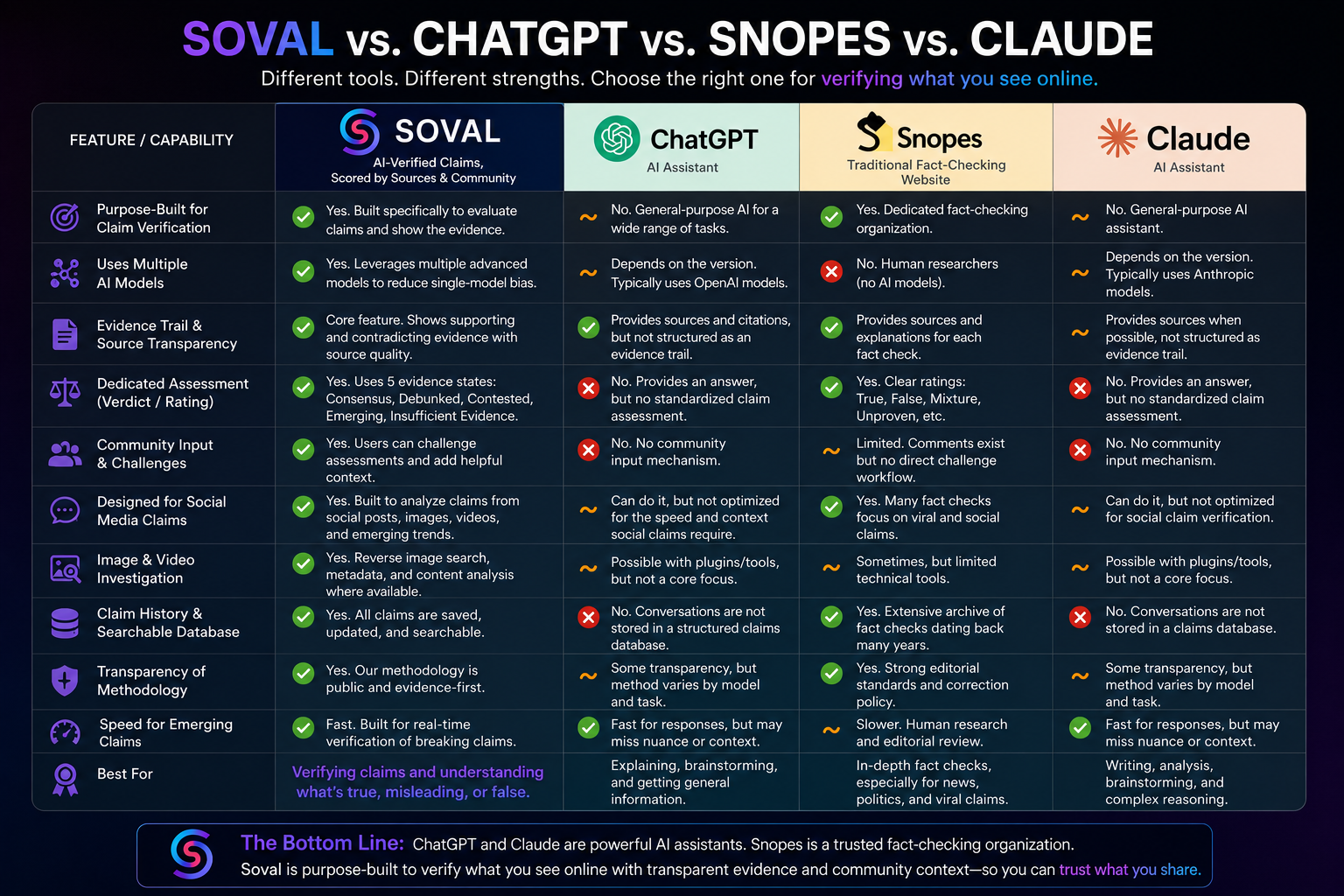
Feature Comparison Matrix
This matrix breaks down the core functionalities of the top verification methods.
Frequently Asked Questions (FAQ)
Is ChatGPT reliable for fact-checking?
While ChatGPT is useful for summarizing documents and researching broad topics, it is not a dedicated fact-checker. Because it is a generative model, it can hallucinate information. It is always safer to use platforms that prioritize direct source citations over conversational generation.
Can I fact-check a social media screenshot?
Yes, but traditional search engines and editorial sites struggle with this. To verify an image, upload the screenshot to a dedicated platform like Soval Social. The tool will trace the image across the web to determine if it has been digitally altered, taken out of context, or previously debunked.
Which fact-checking site is the most unbiased?
No tool is perfectly free of bias, which is why transparency is critical. Traditional sites like FactCheck.org are highly respected for their strict journalistic standards. However, if you prefer to evaluate the raw data yourself, evidence-mapping platforms like Soval Social remove editorializing entirely by directly linking you to the primary sources supporting or contradicting a claim.
Stop wondering. Start verifying.
The best way to combat misinformation is to examine the evidence yourself. Next time a questionable headline crosses your feed, don't just ask a chatbot for a summary—paste the claim into Soval Social and see exactly what the evidence says.