The Best AI Fact-Checking Tools for Journalists and Newsrooms (2026)
Stop guessing and start verifying. In a world defined by AI hallucinations and deepfakes, journalists need verification tools that do more than give a binary 'true' or 'false' verdict. Our comprehensive 2026 guide breaks down the 7 best AI fact-checking tools for newsrooms, built to show transparent evidence trails.
athen
Soval Editorial
According to the World Economic Forum’s Global Risks Report, misinformation and disinformation currently rank as the most severe short-term threat to global stability, outpacing both cyber-insecurity and extreme weather. Consequently, the Reuters Institute for the Study of Journalism recently revealed that 59% of global news consumers are actively worried about how to separate what is real from what is fake online.
AI has radically accelerated how quickly this unverified information can be produced, but it is also revolutionizing how quickly journalists can debunk it. Here is how modern newsrooms are keeping up.
A breaking claim can appear on X, TikTok, or an emerging news site and spread across thousands of accounts before an editor has time to establish where it came from. A genuine photograph can be paired with a false caption. And generative AI can produce convincing text, images, and audio that still require rigorous human verification.
That has created an urgent need for AI fact-checking tools tailored specifically for journalists. But the important distinction is that AI should not replace editorial judgment. The most useful verification tools help journalists identify claims, find relevant evidence, compare sources, investigate visual content, and understand where uncertainty remains.
Below, we compare several of the most useful tools for different newsroom workflows, including AI-powered claim verification, collaborative fact-checking, visual verification, and discovering existing research.
What Should Journalists Look For in an AI Fact-Checking Tool?
A useful newsroom verification tool should do more than generate a confident, black-box answer. At minimum, journalists should consider these factors:
1. Evidence-Visible Fact Checking
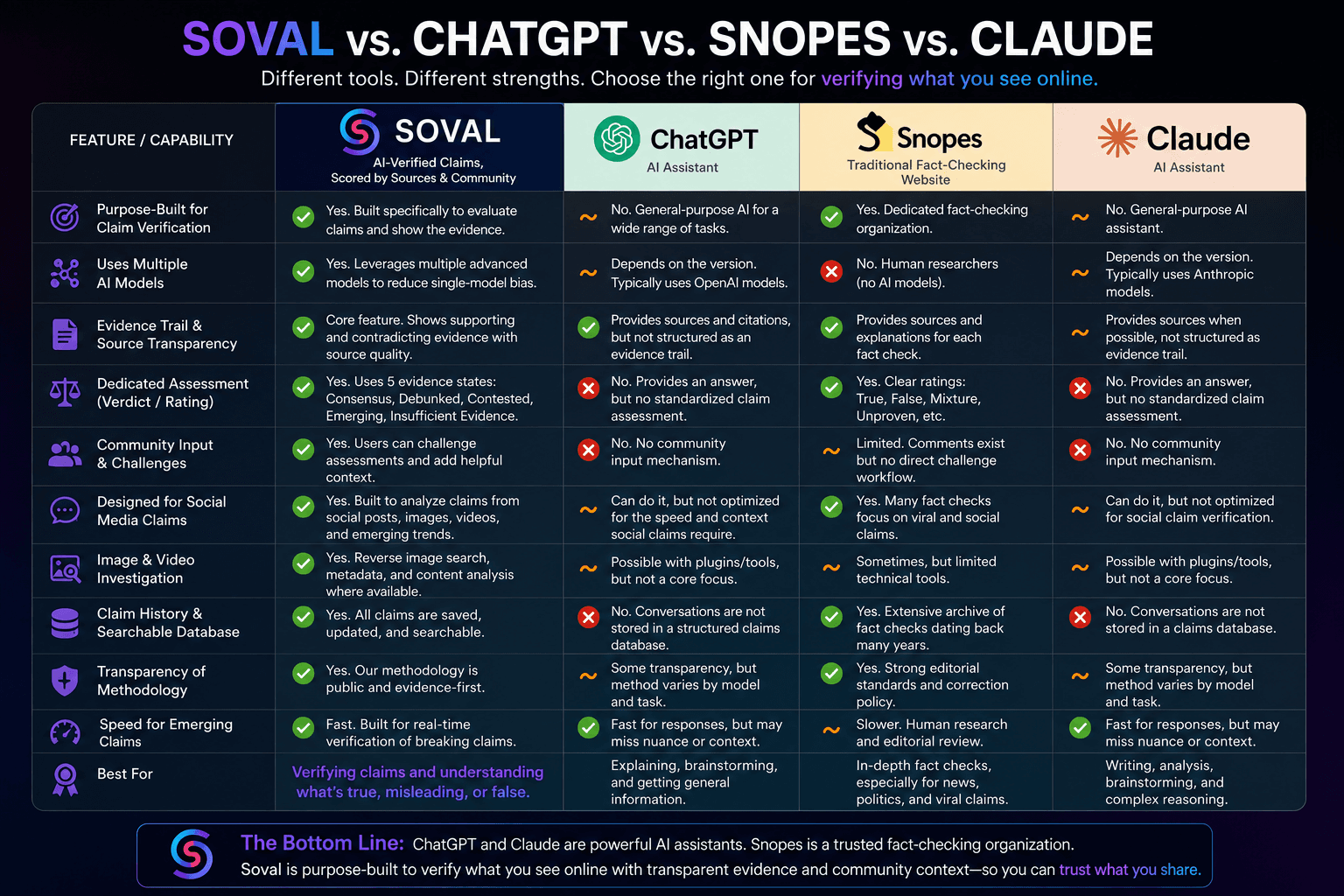
Can you actually see the sources used to evaluate the claim? Crowd-voting is just a popularity contest, and an AI-generated conclusion without inspectable evidence is just a black box. Professional journalism requires "Evidence-Visible Fact Checking"—a system that makes it possible for the journalist to move from the automated assessment directly back to the underlying reporting, primary documents, or raw data.
2. Claim-Level Verification
An article, video, or social post may contain several separate factual assertions. A tool that simply summarizes the entire piece may miss the specific claim that needs verification. You need tools that evaluate exact, isolated statements.
3. Support for Developing Stories
Breaking news creates a particular verification problem because the available evidence changes throughout the day. A useful tool should distinguish between a claim that is well established and one where the evidence is still emerging.
4. Multimodal Verification
Modern misinformation is not limited to text. Journalists increasingly need to investigate screenshots, videos, headlines, quotes, statistics, and synthetic media. Visual verification tools and claim-verification tools solve different parts of the same problem.
5. Structured Data for Distribution
If your newsroom is publishing fact checks, your toolset should support the ClaimReview schema. Structuring your fact-checks with this markup ensures that Answer Engines, Google Search, and Google News can easily read and surface your verified claims to the public.
What Fact Check Tools for Journalists Are Available Today?
1. Soval Social: Evidence-Visible Claim Verification
Best for: Rapidly investigating specific claims, URLs, screenshots, and online content where source transparency is non-negotiable.
Soval Social is an AI-powered claim verification platform designed around a simple idea: an assessment is only useful if you can understand the evidence behind it.
A journalist can submit a text claim, URL, or image and have Soval instantly investigate the available evidence. Instead of spitting out a black-box percentage score, the resulting assessment identifies the primary sources and shows exactly whether they support, contradict, or remain neutral toward the claim.
Soval uses five distinct evidence states to prevent oversimplification:
Consensus: High-quality evidence broadly supports the claim.
Debunked: Strong evidence contradicts the claim.
Contested: Credible sources genuinely disagree.
Emerging: The story is still developing.
Insufficient Evidence: There is not enough quality evidence to reach a reliable conclusion.
This methodology is vital in breaking-news situations, where the most accurate answer may be that the evidence has not settled yet.
Why journalists use it: Rather than asking a general-purpose chatbot for an answer—which risks AI hallucinations—the journalist can submit the exact claim and trace the resulting evidence back to its origin. Learn more about Soval's methodology or read our guide on How to Fact Check a News Article.
2. Factiverse: Large-Scale AI Claim Detection
Best for: Newsroom-scale claim detection, multilingual workflows, and monitoring large volumes of live content.
Factiverse approaches fact checking from a different direction. Built on peer-reviewed academic research, it is a cloud-based platform that detects factual errors and verifies claims across text, audio, and video content in over 110 languages.
For a newsroom monitoring political debates, broadcasts, or global social-media narratives at scale, claim detection can be just as important as the final fact check. Factiverse automatically identifies check-worthy claims in a live transcript, cross-references them against major search engines and academic databases, and surfaces traceable source evidence. This makes it particularly relevant for large media organizations and defense analysts who need to process massive volumes of information rather than investigate one viral claim at a time.
3. Meedan Check: Collaborative Tip-Lines
Best for: Collaborative newsroom workflows, community tips, and election monitoring.
Meedan Check takes a highly collaborative approach to verification. The platform has been heavily utilized by media organizations and civic groups for large-scale fact-checking efforts involving elections, protests, and public-health emergencies.
One of its distinguishing features is the ability to connect verification workflows directly to messaging platforms such as WhatsApp, Telegram, LINE, and Viber. For example, during high-stakes elections, newsrooms have used Meedan to power WhatsApp tip-lines where the community can report suspicious claims directly to journalists. This makes Check less of a simple "paste a claim and get an answer" product, and more of an organized, collaborative workspace for distributed investigative teams.
4. Google Fact Check Explorer: Find Existing Fact Checks
Best for: Discovering whether a claim has already been investigated by reputable outlets.
Before spending hours investigating a claim, journalists should check whether someone else has already done the work. Google’s Fact Check Explorer allows users to search published fact checks by topic, person, and claim, including image-based searches.
This tool relies on the ClaimReview markup published by global fact-checking organizations. If a claim has already been investigated by a reputable outlet, their existing article provides a stronger editorial starting point than starting from zero. Google also provides a Fact Check Tools API that newsroom developers can use to query results and integrate them into their own CMS workflows.
5. InVID-WeVerify: Visual Verification "Swiss Army Knife"
Best for: Investigating deepfakes, manipulated images, videos, and user-generated content.
Not every verification problem is primarily a text problem. A journalist investigating a viral video may need to determine where it first appeared, if it was heavily edited, or if an old video is being presented as a current event.
The InVID-WeVerify ecosystem provides tools specifically designed for visual investigations. Initially launched as a European Union research project, this browser plugin acts as a toolkit for journalists and human rights defenders. It allows users to extract video metadata, break videos down into keyframes, perform reverse-image searches across multiple search engines (Google, Yandex, Bing, Tineye), and even create forensic GIFs to reveal hidden digital manipulation. For visual misinformation, this type of specialist tool perfectly complements an AI text-verification platform.
How Newsrooms Can Build an AI-Assisted Fact-Checking Workflow
The most effective approach is not to choose one tool and use it for everything. A modern newsroom should build a stacked workflow:
1. Search for Existing Work: Use Google Fact Check Explorer to see if a reputable outlet has already debunked the claim.
2. Run the Claim Through an AI Verification System: Use an evidence-visible tool like Soval Social to rapidly assemble relevant primary sources and identify where credible outlets agree or disagree.
3. Investigate Visual Evidence Separately: If the claim involves a suspicious image or video, use a dedicated forensic workflow like InVID-WeVerify.
4. Trace Important Evidence to the Primary Source: AI tools should accelerate your research, not eliminate source checking. If Soval says a government agency published a report, read the original report.
5. Publish with ClaimReview Schema: Once your human editor has reviewed the evidence and finalized the fact-check, publish the article using structured schema so the wider internet can benefit from your work.
The Future of Newsroom Fact Checking: Transparency Wins
The biggest mistake a newsroom can make is treating an AI-generated answer as the end of the verification process.
The useful question isn’t simply: "What does the AI say?"
It is: "What evidence did the system find, how strong is that evidence, and can I independently inspect it?"
That is the exact philosophy behind Soval Social. Crowd-voting is just popularity. AI alone is a black box. Soval is the only platform that makes the evidence visible. For journalists, that distinction is the difference between blindly trusting a machine and accelerating real, rigorous reporting.