Did Scientists Detect Radio Signals From Outside Our Solar System?
Deep space signals detected? Yes, but it’s not aliens. Scientists confirmed these are massive natural auroras on the exoplanet Beta Pictoris b, not extraterrestrial technology. Get the true story behind the headlines.
athen
Soval Editorial
Contradicted by strong evidence
5 sources · 1 contradict · 4 neutral
See all evidence →Are Aliens Sending Radio Signals? Fact Check on Recent Deep Space Detections
Whenever a headline includes the words "radio signals" and "deep space," the internet immediately jumps to one conclusion: aliens. We all secretly want our own Jodie Foster moment from the movie Contact—sitting on the hood of a car in the desert with giant headphones, waiting for an extraterrestrial civilization to beam us the blueprints for a cosmic transit machine.
That speculative instinct went into overdrive recently when a bold claim started circling social media. News snippets and viral posts began spreading with a single, dramatic assertion: “radio signals from outside of our solar system were detected.” It’s the kind of breaking news that changes everything.
Except, when a complex scientific breakthrough gets filtered through the internet, crucial context often gets stripped away. Before you dismiss the speculation entirely, or start looking for first contact protocols, you need to understand the exact breakdown of what’s real and what isn’t.
Here is the science behind what astronomers actually found, and why the alien speculation has been firmly shut down.
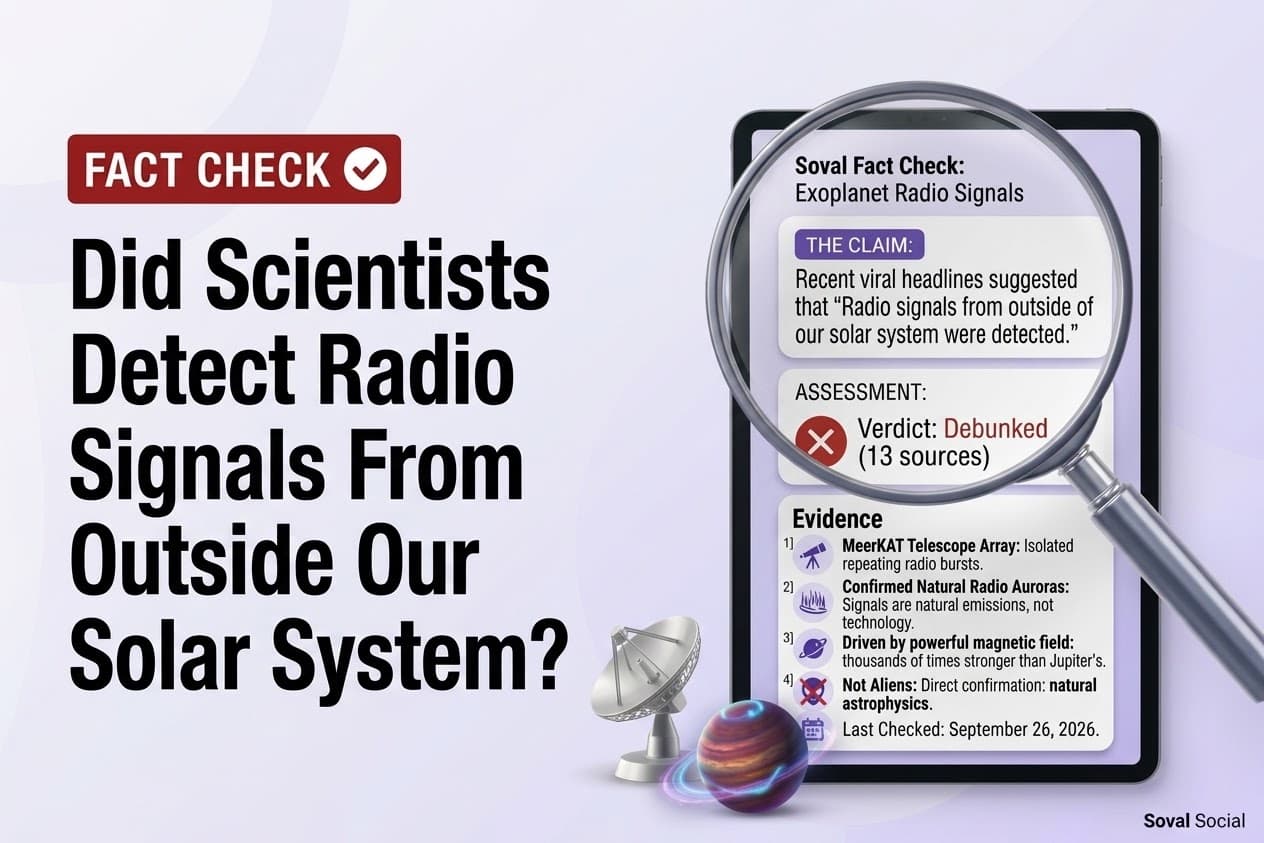
The Claim Circulating Online:
“Radio signals from outside of our solar system were detected.”
The Soval Assessment & Verdict: Debunked
High-quality, peer-reviewed evidence proves that the widespread viral implication of this claim, that we have detected artificial signals from an alien civilization, is false. While scientists literally detected radio emissions localized to an exoplanet, they have confirmed these are natural astrophysical phenomena, not messages from E.T.
The Evidence: How We Know What We Found
1. The MeerKAT Telescope Breakthrough (What is Real)
Historically, astronomers have picked up massive amounts of radio waves from distant star systems. The problem was that stars are incredibly "loud." Until now, scientists could not definitively separate the faint radio signal of an orbiting planet from the overwhelming noise of its host star.
That changed when an international team of astrophysicists from the Harvard & Smithsonian Center for Astrophysics and the University of Oregon used South Africa’s highly precise MeerKAT radio telescope array. By mapping the positions of the signals against distant background quasars, the researchers isolated short, repeating radio bursts and proved they aligned exactly with the exoplanet Beta Pictoris b, rather than the star it orbits.
2. Auroral Activity, Not Alien Technology (What isn't Real)
While "radio signals from space" sounds like first contact, astrophysicists emphasize that these are naturally occurring phenomena. The detected emissions, measuring between 0.85 and 3.5 GHz, show the precise signature characteristics of planetary auroral activity.
On Earth, auroras (the Northern and Southern Lights) occur when energetic charged particles from the sun interact with our planet's magnetic field and upper atmosphere. Beta Pictoris b is experiencing a similar, but vastly more violent, interaction with its host star, generating intense radio waves through a natural process called electron cyclotron maser emission.
3. Measuring the First Exoplanet Magnetic Field (Why this is still huge)
Because these specific radio signals directly correlate with the planet's magnetic environment, researchers were able to calculate its strength. Beta Pictoris b's magnetic field is estimated to be at least 1,250 gauss (1.25 kilogauss), making it thousands of times stronger than Earth's and significantly stronger than Jupiter's. This marks the very first direct measurement of a magnetic field's strength on a planet outside of our solar system.
Why This Actually Matters for Science (Even Without Aliens)
For astronomers and astrobiologists, this detection is a massive breakthrough that goes far beyond a viral headline.
A planet's magnetic field is a crucial factor in its potential habitability. It acts as a vital shield against deadly stellar radiation and prevents the planet's atmosphere from being stripped away into the vacuum of space. Without our magnetic field, Earth would be a barren rock.
While Beta Pictoris b is a young, volatile gas giant located roughly 63 light-years away and definitely not a candidate for life, proving that we can now detect and measure exoplanet magnetic fields via radio signals provides scientists with a powerful new tool. It allows researchers to scan the cosmos for Earth-like planets that possess the necessary magnetic shielding to harbor life, bringing us one step closer to answering if we really are alone in the universe.
5 sources analyzed · 1 contradict · 4 neutral
- 1.public.nrao.eduofficial bodyneutral
- 2.ebsco.comaggregatorcontradicts
- 3.sciencenews.orgmedianeutral
- 4.independent.co.ukmedianeutral
- 5.skyatnightmagazine.commedianeutral